
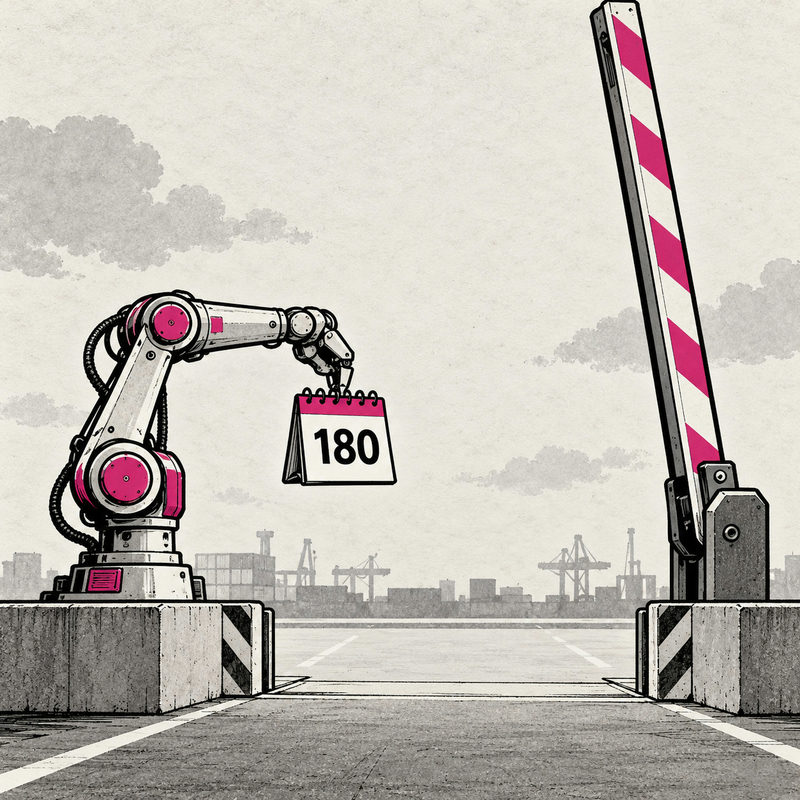
The Trump administration has identified a national-security threat that American manufacturers rely on to make things. It has also decided not to tax that threat immediately. The machinery may be dangerous, but apparently it should finish its shift first.
Reuters reports that Trump concluded Wednesday that imported robotics and industrial machinery pose security risks. He ordered Commerce and the US trade representative to negotiate with trading partners and report back within 180 days. No immediate tariffs were imposed, although the possibility remains if negotiations fail.
That restraint is worth recognising. US manufacturers depend on imported equipment across much of this category, according to Commerce. An immediate new duty could have raised costs for the very factories the administration says it wants to strengthen. Discovering that a machine has a foreign passport does not create a domestic replacement beside it.
The investigation covered considerably more than the humanoid robots that dominate the promotional videos. Machine tools for cutting, welding and handling workpieces were included, along with industrial stamping equipment, ovens, autoclaves and laser and water-cutting machinery. A debate that sounds like science fiction can turn out to involve a fairly ordinary factory purchasing department.
There are real security questions around connected equipment and foreign supply chains. The FCC has warned that robots could collect information or be remotely commandeered. Its July action barred imports of new models of Chinese robots and power inverters while allowing existing robot models to continue entering. Those earlier restrictions are separate from Wednesday’s broader trade decision.
The Daily Heckler
The best of Democrawonk.
No algorithm required.
That distinction matters for manufacturers trying to plan. A security finding, an import restriction and a tariff are different government actions, with different effects on what a business can buy and what it will pay. Rolling them into one dramatic announcement may help a speech. It does not help somebody price a production line.
Wednesday’s decision leaves the industry in an extended negotiation period. There is no new tariff bill today. There is still a possible tariff bill in the future, attached to the outcome of talks whose progress the agencies must report in six months.
Businesses will have to account for that uncertainty alongside delivery schedules, financing and maintenance. An industrial machine is not generally an impulse purchase that can be abandoned at the register because the administration changed its mind during lunch.
If the goal is to reduce dependence, the useful questions are concrete. Which equipment creates which risk? What alternatives exist? How long would replacing a supplier take? Would a duty change the supply chain or simply make the same imported machine more expensive?
Those questions are less cinematic than calling the equipment a threat. They are also the questions that determine whether industrial policy produces more industrial capacity.
The agencies have 180 days to report on the talks. Manufacturers have no equivalent guarantee that tariffs will stay away until then. The government has supplied a deadline for its paperwork; the people buying the machinery still need a plan.
Comments
Have something to say? Give this story a heckle.
Comment Rules
Argue the point. Add a joke. No threats, harassment, hate speech, spam, private personal information or unsupported accusations. First-time comments and comments with links are moderated. Full Comment Rules
Loading comments…
Questions or deletion requests? Contact Us. We retain comments and moderation records until removed. Only hashed email identifiers are stored for comment accounts.