
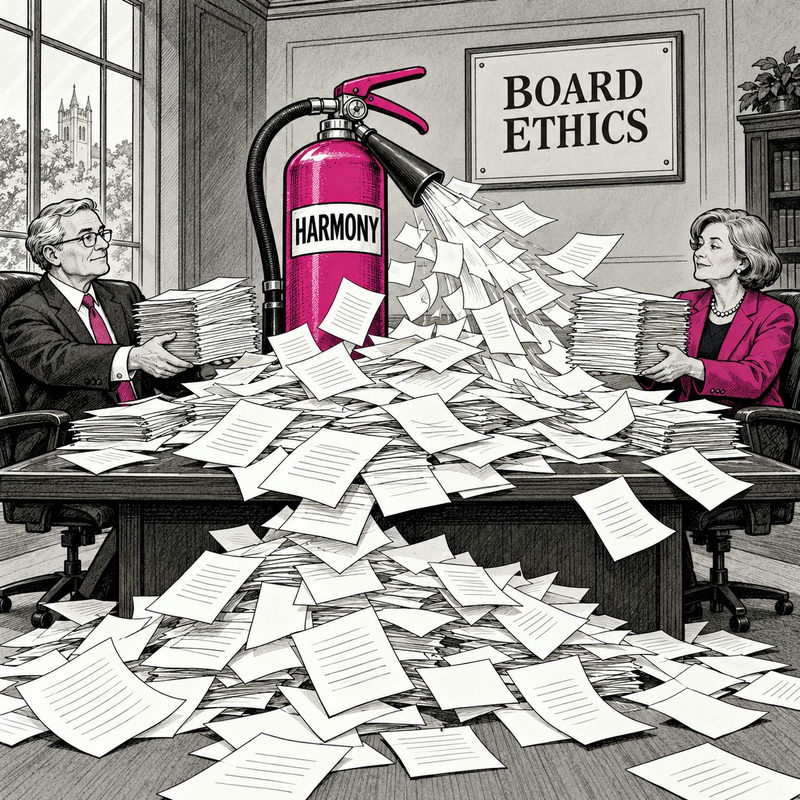
Michigan State University’s Board of Trustees revised its ethics code to reduce infighting. Two trustees have now filed federal lawsuits challenging aspects of the arrangement.
An excellent start. The disagreement has left the meeting room and obtained counsel.
The board approved the changes 5–3 in May. They include restrictions on disclosing confidential information, providing inaccurate or misleading information about the university, presenting personal views as the university’s position, and undermining decisions made by the board majority. Trustees were required to sign an acknowledgment agreeing to follow the code.
Mike Balow and Rema Vassar refused. Both were censured. Balow’s new lawsuit argues that the rules unlawfully restrict his speech; Vassar has also asked a court to stop the acknowledgment requirement as part of her broader discrimination and retaliation suit. Neither lawsuit is a finding that the rules are unlawful.
Board chair Brianna Scott says the code does not restrict speech, oversight or questioning decisions. She calls it commonsense governance and describes Balow’s lawsuit as “petty and frivolous.”
So the rule designed to promote constructive relations is now accompanied by a public statement that a colleague’s effort to challenge it is petty and frivolous. I can practically hear the trust falling into place. It makes a noise like a filing cabinet being pushed down a staircase.
To be clear about the actual dispute, protecting confidential information is a normal duty. Not lying about the university is a normal duty. Not pretending your personal opinion is the institution’s opinion is a normal duty.
Then comes “will not undermine decisions made by the majority.”
There it is. The little phrase wearing a sensible blazer while carrying a net.
What counts as undermining? Scott says members can still question decisions. Balow says the code restricts them. Wonderful. The board has improved governance by creating a new argument over whether participating in the old argument is permitted.
I’m imagining a trustee raising a hand. Is this oversight? Depends what you’re about to say. Is it questioning? Perhaps. Is it undermining? We’ll know once the majority has heard how it feels about itself.
The Daily Heckler: five or six selected stories.
Political satire for your morning inbox.
And then there are the potential sanctions. Public censure. Removal from board leadership positions. Loss of privileges, including complimentary access to university sporting events.
Wait. The football tickets are in the ethics code?
I understand that public office should not be a season-ticket delivery service. But there is something exquisitely American about a university governance dispute reaching the question of whether the First Amendment comes with parking near the stadium.
Balow’s complaint says the restrictions cut him off not just from games but from ceremonies, conferences and other occasions where trustees interact with students, faculty, donors and the public. That is his substantive access argument. It is not simply a federal demand for a better seat.
Still, somebody had to devise this sanctions menu. Somebody looked at the problem of elected trustees disagreeing and arrived at a document that can affect both board leadership and the ability to attend football for free.
Were the penalties arranged by seriousness? Is public censure above or below having to queue at the ticket office? Does an ethics violation become less severe during an away game? I have questions. I would like to know whether asking them undermines the seating plan.
The university will address Vassar’s lawsuit through legal channels, and Scott says she looks forward to seeking sanctions in Balow’s case. So we now have sanctions arising from refusal to sign a code, a lawsuit over those restrictions, and the prospect of a request for more sanctions over the lawsuit.
This is not de-escalation. This is a committee discovering that every fire extinguisher also makes an excellent object to throw.
If the goal was to stop the trustees fighting, the policy has failed its first practical examination. If the goal was to move the fight somewhere with stricter rules, congratulations.
They’ve found a room where somebody can actually order everyone to shut the fuck up.
Unfortunately, that person is a federal judge.
Comments
Have something to say? Give this story a heckle.
Comment Rules
Argue the point. Add a joke. No threats, harassment, hate speech, spam, private personal information or unsupported accusations. First-time comments and comments with links are moderated. Full Comment Rules
Loading comments…
Questions or deletion requests? Contact Us. We retain comments and moderation records until removed. Only hashed email identifiers are stored for comment accounts.