
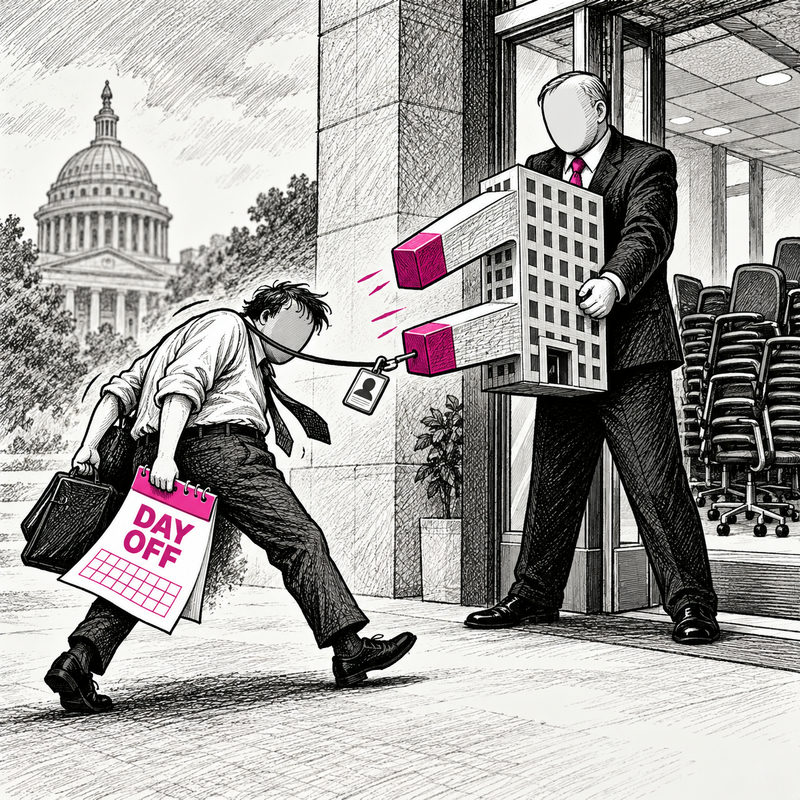
California’s state workers have accepted wage reductions in exchange for days off. Gavin Newsom also wants many of them in the office four days a week. The state is unusually enthusiastic about their presence for an employer that has partly substituted their absence for pay.
CalMatters reports on October 21 that SEIU Local 1000 is beginning its first statewide strike since signing its first collective bargaining agreement in 1982. The union alleges bad-faith bargaining. Its roughly 100,000 members have a dispute with a Democratic governor they once helped elect and then helped keep in office. The union contributed $500,000 to Newsom’s 2018 campaign and another $1 million against his 2021 recall. Those contributions did not purchase a contract. They do make “where else will you go?” a less attractive retention strategy.
Follow what the state has asked employees to exchange. During the pandemic, unions accepted roughly 9% pay cuts for bankable days off. In 2025, most unions accepted two years of wage reductions, again for time off, and deferred raises until next year. The state gets a smaller current payroll obligation. Workers get time they can use later. It is a workable budget measure whose central convenience is that the employee, rather than the state, has to manage the smaller paycheck now.
Make powerful people uncomfortable.
Subscribe to Democrawonk.
One group tried to keep a particular part of its deal. The California Association of Professional Scientists accepted a wage reduction but refused to give up negotiated raises. Then the budget omitted the money for a raise due last summer. Lawmakers eventually restored it in a follow-on spending bill. The scientists had to obtain funding for the agreement after obtaining the agreement. Apparently a contract can be fully negotiated while its money is still considering the offer.
There are fiscal constraints, and Newsom provided bonuses to many workers when revenues were stronger. Total state compensation also rose. But CalMatters puts the increase at about 32% between 2019 and 2025, compared with a 59% increase in overall state spending between the 2018–19 and 2025–26 budgets. Those periods are not identical, and neither number is an individual worker’s raise. They show why expanding government does not automatically settle the bargain with the people doing its work.
Then there is the saving Newsom declines to embrace. A 2025 state audit found that more remote work could save $225 million annually. Newsom argues that in-person collaboration matters; after two office days a week, he required four. The audit’s estimate is not money already in hand. Still, it identifies a potential saving that would not come out of an employee’s pay.
The governor has insisted on bringing the workers back. The office-cost savings may continue working remotely.
Comments
Have something to say? Give this story a heckle.
Comment Rules
Argue the point. Add a joke. No threats, harassment, hate speech, spam, private personal information or unsupported accusations. First-time comments and comments with links are moderated. Full Comment Rules
Loading comments…
Questions or deletion requests? Contact Us. We retain comments and moderation records until removed. Only hashed email identifiers are stored for comment accounts.