
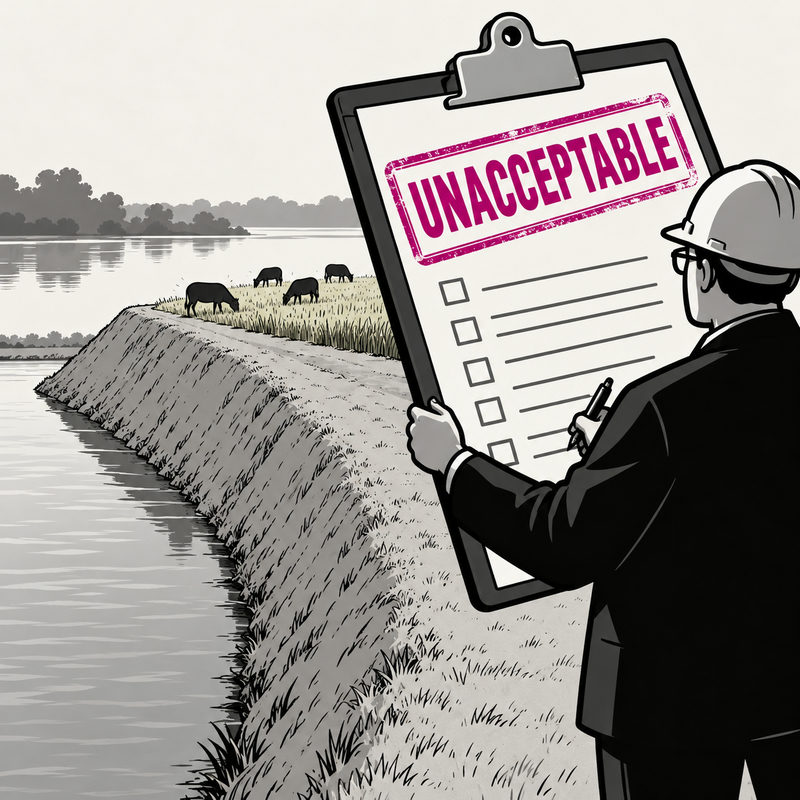
California’s levee oversight has a fail-safe: when local maintenance fails, the state is supposed to take over. There is a small engineering problem with that arrangement. Some levees on the unacceptable-maintenance list are already maintained by the state.
CalMatters’s October 21 report follows an audit finding that nearly a third of the local agencies maintaining Central Valley levees performed unacceptable routine maintenance, sometimes for years. The auditor says the Department of Water Resources has not made takeovers required by state law. DWR disputes the audit’s understanding of flood risk and says taking over can cost tens of millions up front, potentially diverting resources from more effective protection. The backup system has requested a cost-benefit analysis of being the backup system.
The department has specific objections, not merely an allergy to criticism. One listed levee is surrounded by water during high flows and is not a critical flood-control structure. Another may have been made redundant by a dam-related project in 1968; the state began seeking its deauthorization in 1984. A third involves original construction problems and regulations protecting the giant garter snake. An inspection score does not tell you which of these you are looking at. Forty-two years of trying to remove a potentially redundant levee from federal authorization does, however, suggest that paperwork has excellent erosion resistance.
Make powerful people uncomfortable.
Subscribe to Democrawonk.
Local engineer Tom Engler identifies another failure mode. Some agencies, he says, were inspected before grazing animals had finished clearing vegetation, then failed to report the completed work. Their ratings stayed unacceptable. That does not establish that the whole list is wrong. It establishes that a maintenance-monitoring system can lose track of maintenance after the livestock have successfully performed it. The livestock completed their assignment; the reporting chain did not.
These distinctions matter because the response is supposed to follow the actual risk. DWR says maintenance is only one factor, alongside the threat, structural performance and what a levee protects. The auditor links inadequate maintenance to greater danger and identifies substantial exposure, whose scale the department also disputes. We do not need to pretend every overdue mowing operation predicts a disaster to ask what happens after an undisputed repair need is identified.
Here the numbers become less disputatious and less reassuring. The audit says repairs were still unfinished at fourteen of forty-eight critical sites, most on the list since 2023. It also says the repair program is running out of money and has no additional funding for new critical sites it expects to identify. Water managers estimate that fully addressing Central Valley maintenance needs would require at least $165 million more annually than current spending.
No additional funding is available for newly identified critical sites, the audit says. California can put the next dangerous spot on the list. The list is the part of the levee system permitted to expand.
Comments
Have something to say? Give this story a heckle.
Comment Rules
Argue the point. Add a joke. No threats, harassment, hate speech, spam, private personal information or unsupported accusations. First-time comments and comments with links are moderated. Full Comment Rules
Loading comments…
Questions or deletion requests? Contact Us. We retain comments and moderation records until removed. Only hashed email identifiers are stored for comment accounts.