
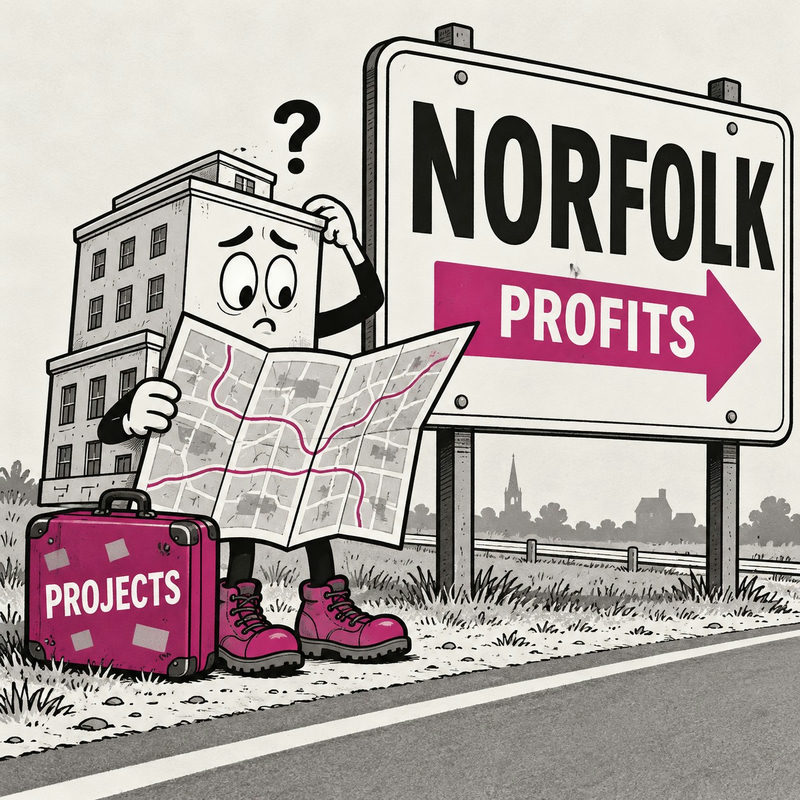
A development firm created by Norfolk’s housing authority has backed projects in 17 states and the District of Columbia, but none in Norfolk since 2008, the Virginia Mercury reported October 19. More than four years after the city council told Hampton Roads Ventures to seek local projects, its latest annual report still offered no local project and no account of efforts to find one.
Seventeen states. The District of Columbia. A remarkable geographical range for an organization still working up to its home address.
The recent investments include a grocery store in Marion, Virginia, a distribution centre in Martinsville and a supermarket in Louisiana. These are useful projects. People elsewhere deserve food, jobs and investment. The mystery is not why those communities received help. It is how Norfolk became the place a Norfolk-created development company keeps admiring from a safe investment distance.
This is not a private firm being criticized for failing to read the mayor’s mind. The city council actually passed a resolution. Seek projects here. Norfolk. The city containing the city council that passed the resolution.
Four years later, that instruction apparently still requires a location pin.
Now, there is a real local return, and it matters. HRV transferred $850,000 in profits to the housing authority this year for youth workforce development, broadband improvements and intergenerational programmes. It has transferred more than $5.2 million in nearly five years. Those are actual benefits, not decorative accounting, and they distinguish this from a story about money disappearing.
The money comes home. It’s the projects that can’t seem to get the time off.
HRV works through federal New Markets Tax Credits, matching investments with projects. Its accumulated allocations have reached $470 million. That is tax-credit authority, not a $470 million suitcase of Norfolk cash, and the latest federal report showed no credits left available to invest. The next awards are due in late 2027. There isn’t a forgotten pile that a councillor can simply shove toward an empty lot tomorrow.
The Daily Heckler: five or six selected stories.
Political satire for your morning inbox.
There is, however, an annual profit stream. Council members want to explore using it to help tackle Norfolk’s housing crisis. Other community-development entities have used this financing mechanism for affordable homeownership. Norfolk’s firm has not, according to the report.
So the hometown has reached the stage of asking whether the returns from development elsewhere could help fund development at home. It’s not a stupid idea. It’s just a rather elaborate itinerary for a mission that began in Norfolk.
You can almost feel the civic pride dividing itself. Excellent work on the supermarket. Wonderful news about the jobs. Could the next economic-development success possibly be visible without changing municipalities?
Oversight is similarly indirect. The city appoints housing-authority commissioners, some of whom serve on HRV’s board, but the council has no direct control over the subsidiary. Its lawyer has said an advisory board spread around the country guides investment decisions. The Mercury reported uncertainty about when or whether that board meets. The chief executive did not respond to the reporter’s request for comment.
The reporting also raises questions about whether the annual account fully describes donations. Council member Carlos Clanton wants a more comprehensive understanding; the city attorney declined to give an opinion on compliance because he was not in office when the resolution passed. This is an oversight dispute, not a verdict that every dollar has been misused.
But fuck me, the city should not need an advanced course in municipal genealogy to work out how the organization descended from its housing authority might help build some housing.
There are people between the city and the decisions, boards between the people and the investments, and considerable geography between the investments and Norfolk. The profits have demonstrated that a return journey is possible. This is encouraging. The route exists.
Perhaps the trouble is familiarity. After all those successful out-of-town projects, Norfolk may need to make itself look like somewhere else.
I would suggest changing the address on the application, but then the company might accidentally invest next door.
Comments
Have something to say? Give this story a heckle.
Comment Rules
Argue the point. Add a joke. No threats, harassment, hate speech, spam, private personal information or unsupported accusations. First-time comments and comments with links are moderated. Full Comment Rules
Loading comments…
Questions or deletion requests? Contact Us. We retain comments and moderation records until removed. Only hashed email identifiers are stored for comment accounts.