
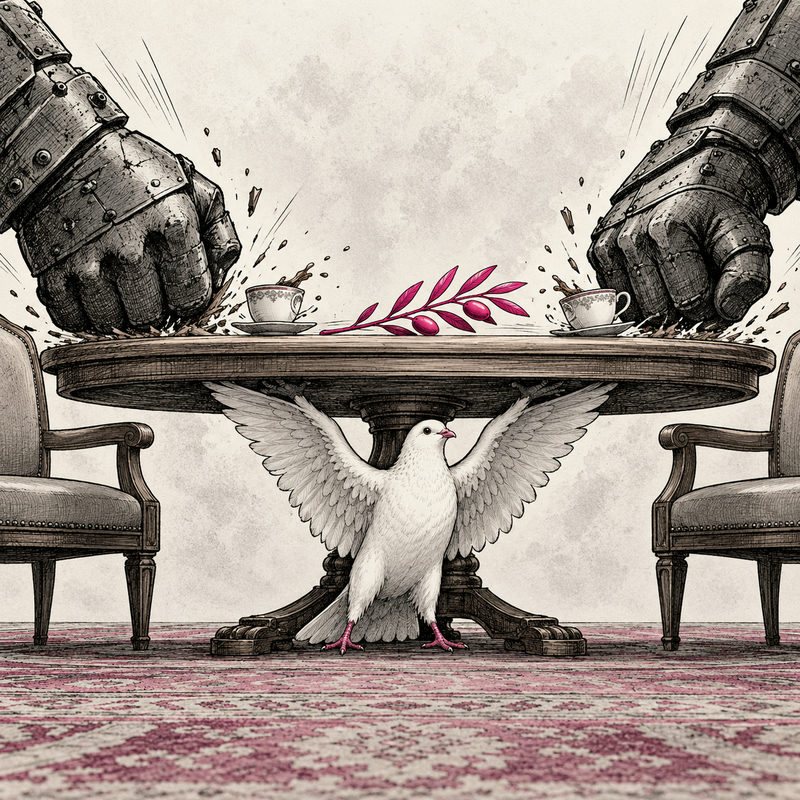
The ideal peace mediator is patient, trusted and, if at all possible, not on either participant's list of prospective targets. The last qualification is proving unfashionably demanding.
AP reports that Oman's sultan began a British state visit Tuesday as his country works to mediate the US-Iran war. Iran has attacked Oman with drones and missiles; Trump threatened in August to bomb it after Iran announced a shipping-route deal. Britain is reaffirming Oman's security. The country sits beside the Strait of Hormuz, so geography has declined to offer a less stressful assignment.
Consider the performance review implicit in this arrangement. Please help us reach an agreement. Please maintain sufficient contact with the other side to be useful. Please explain why you have been maintaining contact with the other side. Your commitment to peace is appreciated; your continued existence remains a separate agenda item.
That is not a quotation from any government. It is the contradiction produced when the people expected to broker talks must also navigate threats from the people expected to attend them. Neutrality becomes a job requiring the employee to absorb everyone's displeasure while remaining available for the next urgent call.
Make powerful people uncomfortable.
Subscribe to Democrawonk.
The state visit provides a revealing contrast. Britain is treating Oman as a strategically important partner. That does not make a royal welcome a peace settlement, and a carriage cannot reopen a shipping route merely by looking magnificent. But recognizing the value of a mediator is at least compatible with wanting mediation. Threatening that mediator requires considerably more intellectual upholstery.
Nor does neutrality mean a government is beyond criticism. An agreement can be questioned; a negotiating position can be challenged. There is a substantial stretch of diplomatic vocabulary between disagreement and bombing. It is unfortunate to see that vocabulary neglected by a president so committed to speaking at length.
The difference between an offer of help and usable help matters in diplomacy as much as anywhere else. Here the useful contribution would include allowing the intermediary to remain an intermediary, instead of requiring it to alternate between peacemaker and potential casualty of the peace-making process.
The absurdity is not that Oman continues trying. Somebody has to keep a channel open. It is that the channel is treated as essential when a message needs delivering and suspicious when it reaches the other end. A telephone that connected only to friendly people would be a delightful diplomatic instrument. It would also leave most of the difficult calls unanswered.
Britain can offer the sultan a welcome. The warring powers could offer something more practically impressive: a negotiation in which the person carrying the message does not have to negotiate whether he may safely carry it.
Comments
Have something to say? Give this story a heckle.
Comment Rules
Argue the point. Add a joke. No threats, harassment, hate speech, spam, private personal information or unsupported accusations. First-time comments and comments with links are moderated. Full Comment Rules
Loading comments…
Questions or deletion requests? Contact Us. We retain comments and moderation records until removed. Only hashed email identifiers are stored for comment accounts.