
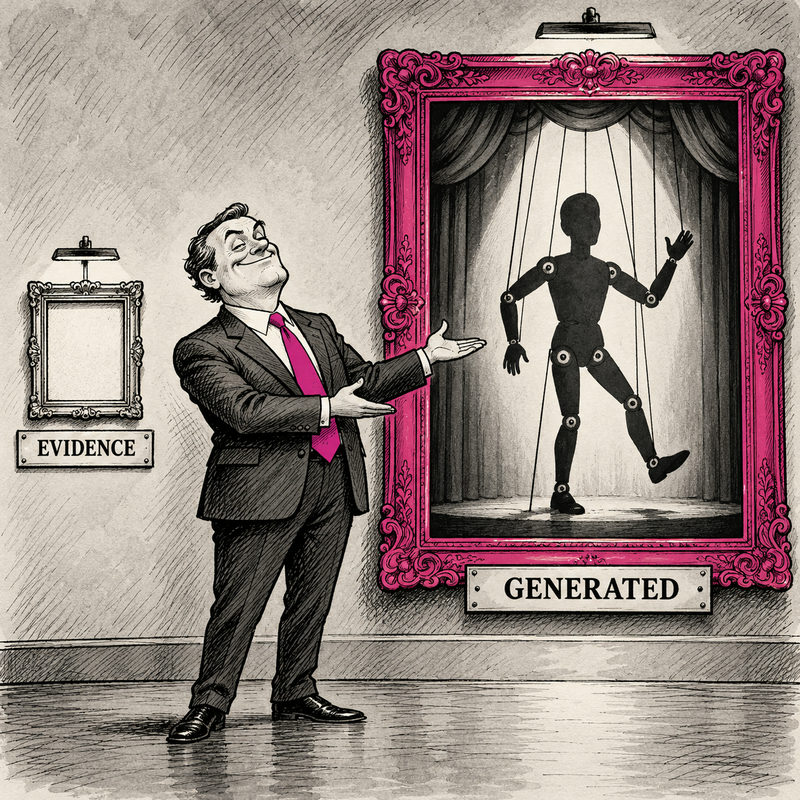
If your opponent is a menace to civilization, you should be able to find something they actually did.
Apparently this is now an unreasonable production constraint.
Axios reports that campaigns and political groups are using AI to manufacture attack-ad footage: candidates receiving beauty treatments, defacing a Bible, or appearing in scenes that never happened. The Wesleyan Media Project counted $137 million spent on 220 AI-generated ads through October 11, mostly from Republicans.
That is a substantial investment in being unable to make your point with reality.
I’m particularly unimpressed by the defense that a fabricated scene is based on somebody’s actual statements or associations. Front Line Action offered that explanation for its attack on Michigan Democrat Abdul El-Sayed, which includes an invented family photograph and board-game scene. The ad discloses its AI use.
Good. Now explain why the real material was apparently too feeble to appear without a fake family.
There is a difference between arguing that someone’s views are dangerous and commissioning a visual hallucination to make the argument for you. One requires a case. The other requires a prompt and a willingness to discover that your opponent’s cousin has seven fingers.
If the facts are devastating, stop improving them.
Disclosure matters, but I refuse to treat it as a moral car wash. Announcing that you manufactured an image does not turn the manufacture into evidence. A warning that some or all of an ad used AI can leave viewers with the enjoyable homework assignment of figuring out which part of the accusation belongs to this universe.
And sometimes even that warning is missing. Axios reports that Senate Leadership Fund’s synthetic ads depicting Jon Ossoff getting beauty treatments do not disclose the AI use; Georgia does not require it.
Imagine having enough money to advertise across an entire state and still being unable to afford the words “we made this up.”
Political caricature isn’t new. Neither is lying. The new convenience is giving an invented moment the visual manners of a recorded one, then acting insulted when anyone asks whether the camera was present at the event that didn’t occur.
I don’t want a federal department deciding which punchlines are permissible. I want meaningful rules against passing fabricated depictions of candidates off as authentic, prominent disclosures people can actually notice, and consequences that cannot be absorbed as a modest surcharge on the media buy.
Campaigns should keep the originals, identify synthetic alterations, and defend their accusations in words that can survive being separated from the special effects. That standard should apply to Democrats, too. Being on my side does not entitle you to manufacture the other side.
Voters have jobs, families, and things to do besides conducting frame-by-frame forensic analysis of a Senate commercial. We are choosing people to govern a country, not auditioning to moderate the world’s most expensive group chat.
If a campaign cannot persuade us with its candidate’s achievements or its opponent’s actual record, perhaps it deserves to lose.
The defeat can be entirely authentic.
Comments
Have something to say? Give this story a heckle.
Comment Rules
Argue the point. Add a joke. No threats, harassment, hate speech, spam, private personal information or unsupported accusations. First-time comments and comments with links are moderated. Full Comment Rules
Loading comments…
Questions or deletion requests? Contact Us. We retain comments and moderation records until removed. Only hashed email identifiers are stored for comment accounts.