
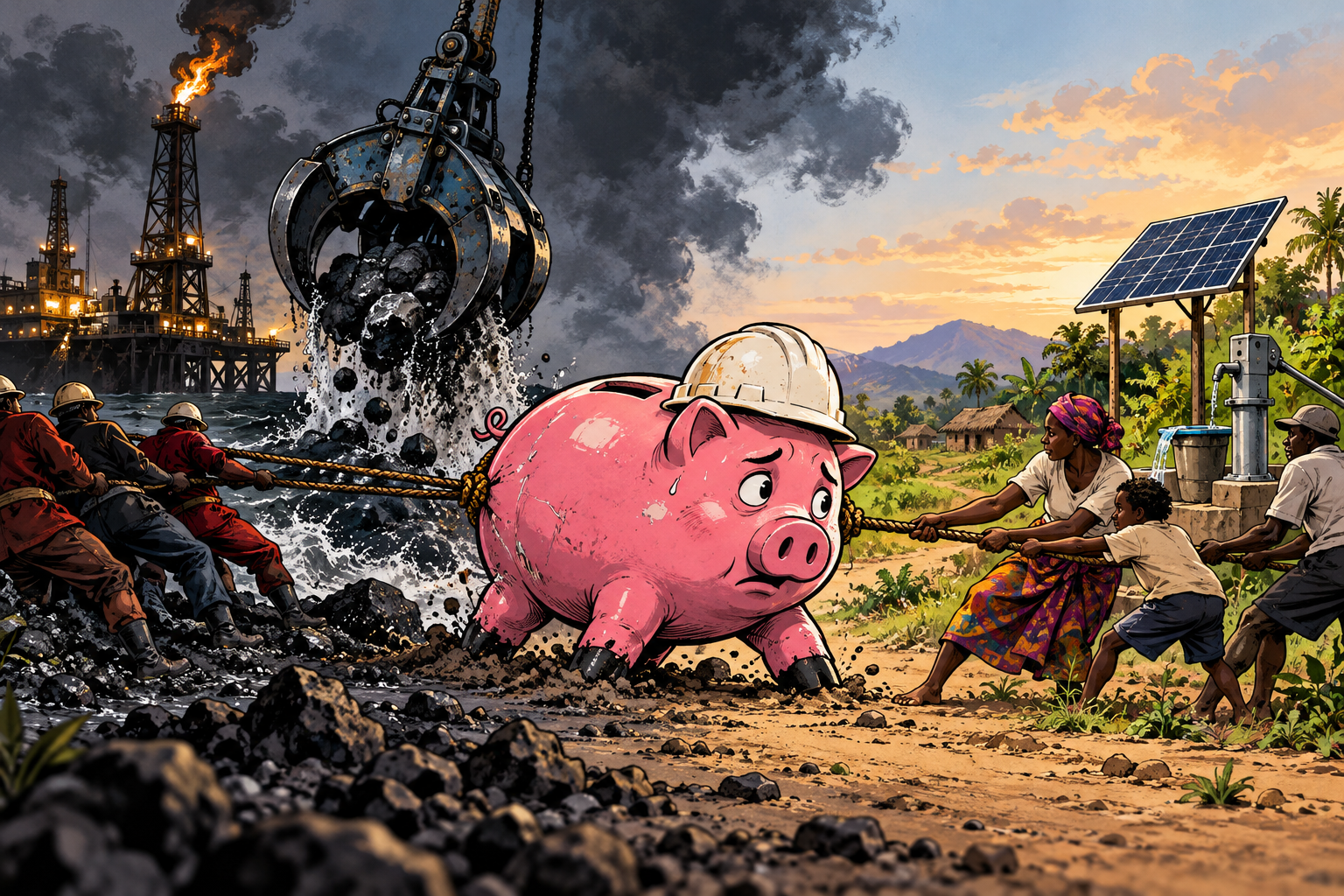
Treasury Secretary Scott Bessent has a plan to get the World Bank "back to basics," and one of those basics is apparently drilling more holes in the planet with public-development money. Nothing says streamlined poverty reduction like adding an oil derrick, a deep-sea mining claw and several decades of climate risk to the loan application.
In a statement released October 14 for the World Bank and IMF annual meetings, Bessent called on the World Bank Group to formally retire its prohibition on financing upstream oil and gas. He argued that poor countries need reliable, affordable energy and should be free to request gas projects. Reuters reported Thursday that the statement also urged a role for the Bank in deep-sea critical-minerals mining and procurement changes aligned with the administration’s priorities.
The energy-access problem is real. Hundreds of millions of people, especially in Africa, still lack reliable electricity. Hospitals need refrigeration. Schools need lights. Businesses need power that does not vanish whenever the grid sneezes. Rich countries that built their wealth with fossil fuels do not get to lecture poorer countries from the climate-controlled mezzanine.
But acknowledging that hypocrisy does not require handing the oil industry a development-bank gift card.
Development Means Owning The Full Bill
The World Bank announced in 2017 that it would stop financing upstream oil and gas after 2019, with limited consideration for upstream gas in exceptional circumstances involving energy access in poor countries and consistency with national climate commitments. Bessent’s proposal would replace that restrictive presumption with a broader invitation to assess projects on their merits.
Fine. Then assess all the merits — including the ones fossil-fuel lobbyists keep leaving in the other briefcase. Upstream projects can lock countries into volatile commodity markets, create stranded assets as technology changes, expose public budgets to price cycles and produce methane and carbon pollution whose costs do not politely remain at the drilling site. Big projects also raise familiar governance questions: who owns the contract, who receives the revenue, who carries the debt and who gets electricity at the end.
A pipeline can be infrastructure. It can also be a very expensive monument to somebody else’s extraction agreement.
The same caution applies to deep-sea mining. Critical minerals are important for batteries, grids and modern industry. That does not magically settle questions about ecological damage, monitoring, liability or whether developing countries will gain local processing and durable jobs instead of another raw-material export lane. Calling the sector "nascent" should invite more scrutiny, not a ceremonial shovel.
Give Countries Choices That Last
A serious liberal development policy would fund the widest practical menu: transmission lines, distributed solar, storage, geothermal power, efficiency, clean cooking, resilient grids and, where genuinely necessary, transitional fuels under strict climate and transparency standards. It would prioritize local ownership, public access and competitive procurement. It would measure success by reliable power delivered to people, not barrels promised to investors.
Bessent is right about one thing: development institutions should not confuse activity with results. But the result poor communities need is affordable energy and economic power, not merely permission for another extraction project.
If the World Bank returns to upstream oil and gas, the public deserves proof that each project beats cleaner alternatives, survives realistic price and climate scenarios, protects communities and leaves borrowers better off. "Energy abundance" is a slogan. Development is what remains after the rig packs up.