
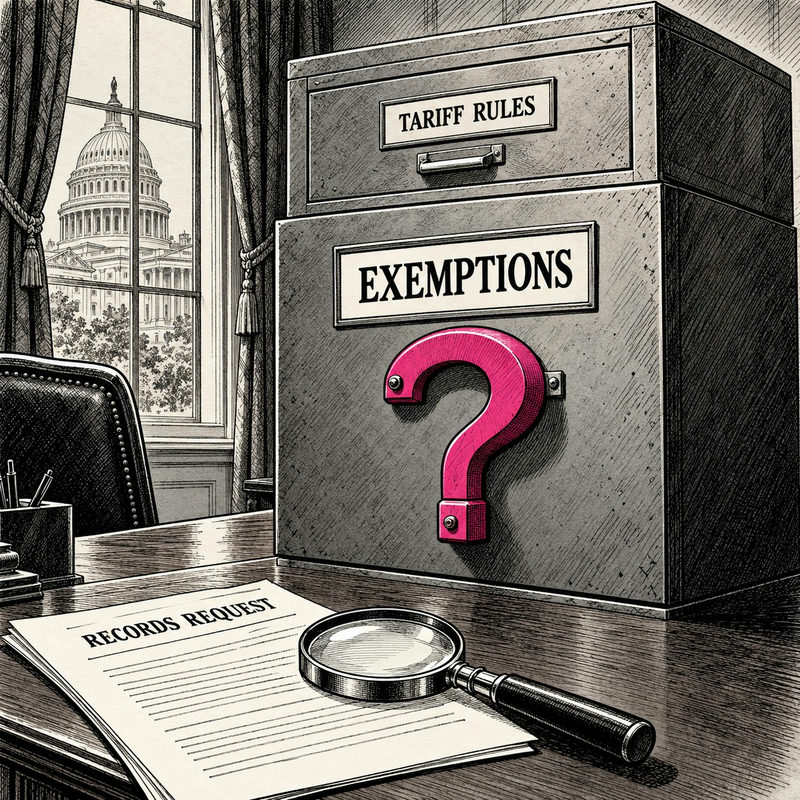
Representative Jamie Raskin has asked the White House for records about tariff exemptions and communications with industry representatives. The Maryland Democrat, the ranking member of the House Judiciary Committee, wants the material by November 11. His October 28 letter alleges that President Trump has used tariff relief to reward people and companies offering gifts or donations.
Those are allegations. A letter demanding records is not a verdict, a subpoena or proof that anybody bought an exemption. The White House told CNBC that the administration's decisions serve the American people's interests, not special interests.
Good. Then let's examine how those decisions were made.
That's the boring part of government everyone claims to support until somebody requests the emails. Then transparency becomes a beautiful principle best admired from behind a locked cabinet.
The particular tariffs Raskin is questioning were imposed in July under Section 301 of the Trade Act of 1974. The administration says they target foreign forced labor. Raskin points to exemptions involving beef, diamonds and smartphones, arguing that they don't square with that justification.
The trade office does allow exceptions, including when extra duties wouldn't help reduce forced labor. So the existence of an exemption alone doesn't prove hypocrisy, much less corruption. There can be an argument for it.
Excellent. Produce the argument. Ideally the one that existed before someone asked why.
If the policy is about labor conditions, explain how the exceptions fit the labor conditions. This should not require a congressional scavenger hunt with a constitutional law degree and a flashlight.
Raskin cites objections from American cattle producers concerning forced labor in Brazil's cattle sector. He notes that the Labor Department identifies diamonds as a product associated with forced or child labor. He also questions the smartphone exemption, citing abusive manufacturing conditions.
These are questions the administration should answer with something more specific than a statement of its own excellent intentions.
The Daily Heckler
The best of Democrawonk.
No algorithm required.
WHO THINKS THAT'S ENOUGH? WHO? If I ask why the basement is flooded, telling me your only interest is a dry house does not identify what happened to the fucking pipe.
And the gifts and donations make scrutiny reasonable. They don't make the conclusion automatic. Apple pledged $25 million to Trump's ballroom project. Raskin points to that and other gestures while questioning the smartphone exemption. The records may clarify the decision. The pledge itself does not establish that it purchased anything.
Which is why this story needs documents, not a national contest to see who can feel certain first.
YOU DO NOT GET TO REPLACE AN EXPLANATION WITH A PRESS STATEMENT ANNOUNCING THAT YOU ARE THE GOOD GUYS.
Nor does Raskin get to replace proof with a strongly worded adjective. Investigate it. Establish the timeline. Examine the criteria. Show the communications. If the allegation holds up, the evidence should carry it. If it doesn't, the allegation doesn't become true because the letter had terrific rhythm.
I need some water. Plain water. No commemorative plaque. No naming opportunity. Something that can enter a room without requiring a conflicts-of-interest assessment.
Because beneath all this, tariffs have costs. Raskin cites a Tax Foundation estimate that the latest round will cost the average American household $820 this year. That's an estimate, not a uniform invoice, but it gives the argument a dimension beyond who complimented whom in the Oval Office.
People affected by the policy deserve to understand how relief gets allocated.
And then, and THEN, consider the administration's stated purpose. Forced labor is an actual abuse affecting actual people. It deserves a serious policy explanation, not a moral heading pasted onto a spreadsheet whose most interesting cells are exceptions.
IF THAT'S THE REASON, SHOW HOW THE DECISIONS SERVE THE REASON.
November 11 is Raskin's requested deadline. Whether the records arrive, and what they establish, remain open questions. Neither side's certainty closes them.
The White House says it works for the American people. Fine. The American people would like to see the work.
Comments
Have something to say? Give this story a heckle.
Comment Rules
Argue the point. Add a joke. No threats, harassment, hate speech, spam, private personal information or unsupported accusations. First-time comments and comments with links are moderated. Full Comment Rules
Loading comments…
Questions or deletion requests? Contact Us. We retain comments and moderation records until removed. Only hashed email identifiers are stored for comment accounts.