
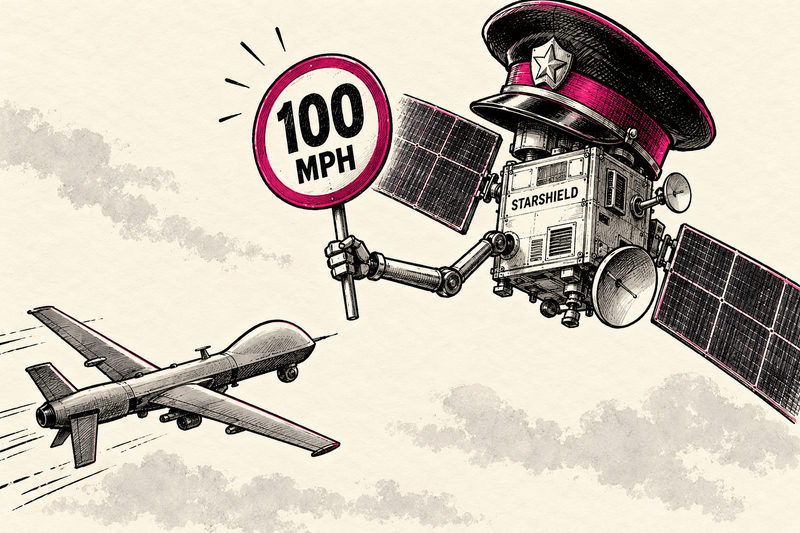
A speed limit is a sensible traffic measure. As an air-defense concept, it leaves one important participant out of the consultation: the thing you are trying to catch. Perhaps the incoming drone will respect the sign. Perhaps it has somewhere to be.
AP reports that Ukrainian presidential adviser Serhii Beskrestnov says Kyiv is negotiating with SpaceX and the Pentagon over a Starshield restriction that cuts connections when terminals exceed 100 mph. Separate outages were fixed, he says, but the cap remained. Ukraine is exploring a more expensive, uncapped aviation package or lifting the restriction.
Our imaginary traffic planner finds the arrangement elegant. The defender must observe the speed limit. The attacker has not yet attended orientation.
Defensive Driving, Literally
In this fictional traffic school, an interceptor drone raises an obvious objection: interception involves arriving before something else does. The instructor recommends leaving earlier. The drone explains that its schedule is unfortunately dependent on a hostile aircraft. The instructor suggests discussing flexible hours.
Beskrestnov says the service supports interceptors pursuing Russian jet-powered drones moving much faster than the cap. He also says this Starshield service is not used for refinery attacks inside Russia. That distinction prevents a convenient explanation from flying into the wrong story.
At our imaginary school, an engineer can perfect the wings, propulsion and controls, only to find that the most demanding aerodynamic surface is a dropdown menu. The aircraft can do its job. The permission to do it has developed a separate career.
Our fictional instructor draws a beautiful diagram of successful interception. Two arrows meet. Then he erases the faster arrow, because it exceeds the plan’s limits. The diagram is now compliant and considerably less useful. He gives it a gold star for restraint.
Please Keep The War Within The Package
Musk says the U.S. government controls Starshield’s use; Trump denies ordering restrictions. AP says the Pentagon did not answer its questions. Beskrestnov suspects politics but says decision-making is unclear. None of that identifies an order’s author or proves a revenue motive.
What it does leave is a remarkable practical question: whether a military communications arrangement needs the aircraft package to accommodate aircraft doing aircraft things. A toaster with an optional bread tier would at least have the decency to sit on a counter.
In our invented product demonstration, the basic diagram shows a handsome interceptor. The upgraded diagram shows the same interceptor farther along. Someone in the audience asks whether movement was not implicit in the wings. An excellent question for the commercial team, the military team and whichever team is currently not answering.
The actual negotiations remain unresolved in the AP interview. A more expensive package is an option being explored, not a purchase already made. One hopes the answer involves restoring useful capability rather than congratulating the equipment on its excellent potential.
Back in the imaginary traffic school, the instructor unveils his final contribution: a very large speed-limit sign facing outward, toward the other side. It cannot chase anything. It cannot intercept anything. It does, however, stay perfectly still.
At last, an air-defense asset the connection can keep up with.