
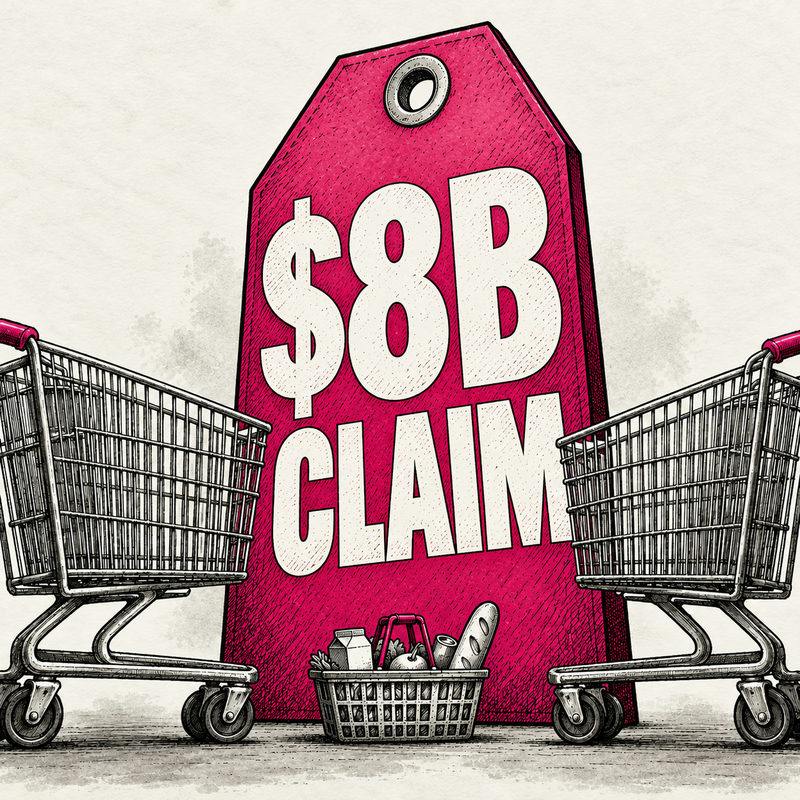
Notice how precise the numbers become when the injured party is a shareholder.
Albertsons is beginning a trial seeking more than $8 billion from Kroger over their failed merger, Reuters reports. Its demands include up to $6.88 billion in the premium shareholders would have received, a $600 million termination fee and more than $1 billion in tax adjustments.
That is a remarkably detailed description of disappointment. When grocery customers discuss disappointment, we usually just put something back.
The proposed $24.6 billion combination was blocked by federal and state courts in December 2024. States and the Biden administration argued that eliminating direct competition would raise checkout prices. The companies argued that combining would help them compete with businesses such as Walmart, Costco, Amazon and Aldi.
Now Albertsons says Kroger failed to do enough to win regulatory approval, including selling enough stores. Kroger denies breaching its obligations and blames regulatory opposition. This trial concerns their agreement; it is not a finding that Kroger owes the money, and a decision may take months.
I do not propose that the judge settle the case by reading the grocery bill taped to my refrigerator. Contracts matter. Companies can have enforceable obligations to one another even when their grand romance was not particularly attractive to the rest of us.
But the dispute is an illuminating antidote to merger publicity. The buyer and seller are now arguing, in expensive detail, about how much competition they were required to preserve to obtain permission to reduce competition. Somewhere inside that sentence is the shopper they kept promising to help.
Albertsons alleges Kroger designed divestiture packages to protect the combined company’s profitability rather than secure clearance. Kroger says it spent more than $1 billion trying to close and honored its commitments. Those are competing claims for the court to examine, not facts a columnist gets to settle by choosing the funnier defendant.
The public argument is simpler: consumers are not obliged to surrender a competitor because two companies have already spent a great deal preparing to become one. An expensive wedding does not establish that the neighborhood must consent to the marriage.
We keep hearing that scale will make things better. Better for whom is where the interesting arithmetic starts. The lost shareholder premium has a figure down to hundredths of a billion. The benefit to someone struggling with a grocery receipt tends to be presented with a more lyrical confidence.
Competition enforcement should require evidence of consumer benefits, not gratitude for corporate ambition. If a deal cannot survive the conditions needed to protect the public, stopping it is a legitimate result. Regulators are not a concierge service for disappointed acquisition teams.
Let the court decide what Kroger promised Albertsons and whether it kept that promise. I hope the evidence is thoroughly examined.
Meanwhile, shoppers can appreciate one reassuring development: the supermarkets have discovered that being denied a benefit you expected can be deeply upsetting.
Perhaps someone should offer them a loyalty card.
Comments
Have something to say? Give this story a heckle.
Comment Rules
Argue the point. Add a joke. No threats, harassment, hate speech, spam, private personal information or unsupported accusations. First-time comments and comments with links are moderated. Full Comment Rules
Loading comments…
Questions or deletion requests? Contact Us. We retain comments and moderation records until removed. Only hashed email identifiers are stored for comment accounts.