
Opinion & Satire
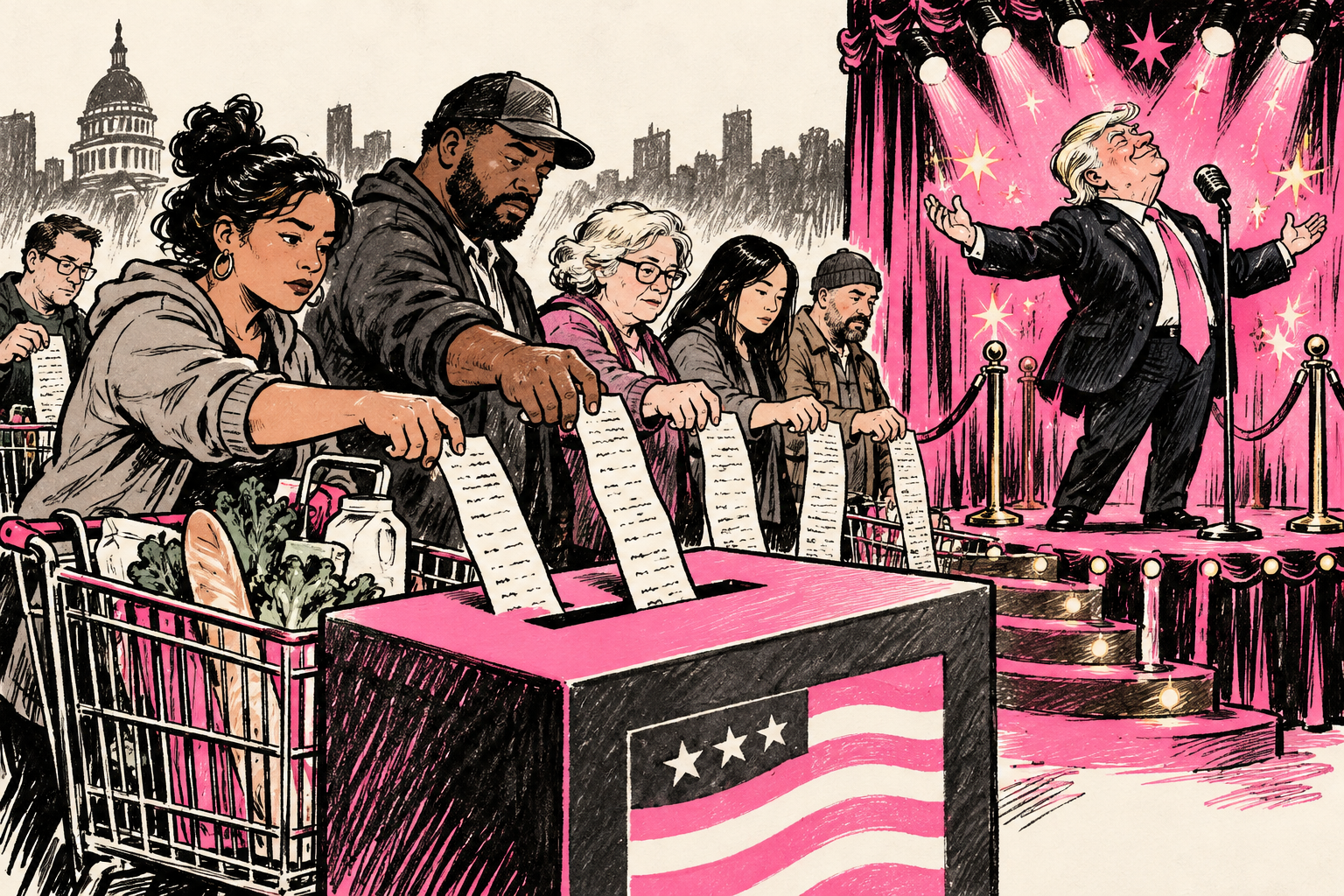
Somewhere, a campaign consultant is probably preparing a presentation about controlling the narrative. Meanwhile, a voter is staring at a grocery receipt that has already delivered a devastating rebuttal, in twelve-point thermal print.
The AP-NORC survey released October 15 finds the economy and cost of living among the leading issues for registered voters. Its project summary reports 85% naming the economy and 84% naming living costs as among their most important election issues. Those are overlapping priorities, not rival teams in a tournament.
The underlying topline also finds 80% of adults want substantial change or complete upheaval in how the country is run. That result measures dissatisfaction, not agreement on what should replace the status quo.
Fieldwork took place October 8–12, before this morning's coverage, using NORC's probability-based AmeriSpeak panel. The survey included 1,119 adults; the overall sampling-error margin is plus or minus 3.9 percentage points. Registered-voter estimates have a different margin. A poll is a snapshot, not an advance copy of election results.
AP's reporting also finds Democratic voters more motivated to cast ballots than Republicans. That is useful evidence for a campaign. It is not permission to cancel the knocking on doors.
Your Message Has A Checkout Lane Problem
The political argument here is fairly straightforward: people should be allowed to judge economic leadership by whether their lives are becoming more manageable.
This apparently radical proposition does not require voters to have a spreadsheet of global commodity markets in their kitchen. They can understand that presidents do not personally set every price and still expect an administration to explain its decisions, acknowledge pressure and offer credible relief.
What they should not have to do is audition for the role of grateful consumer.
A lecture about how wonderful everything supposedly feels has an obvious weakness: the audience gets to check. A family budget is a stubborn little fact-checking department. It works weekends, accepts no spin and has a particularly vicious correction policy when the account balance reaches zero.
That does not make every proposed cure sensible. A politician promising instant relief from every bill deserves follow-up questions about costs, authority and trade-offs. Annoyance is real. Magic remains unavailable, even to candidates with excellent signage.
Anger Is Not A Governing Coalition
There is an important warning for liberal readers inside that appetite for change.
Wanting the current arrangement to change does not tell us whether someone wants stronger public services, weaker regulation, different leadership or simply fewer reasons to dread opening the mail. Those are not interchangeable demands.
Treating every dissatisfied person as an honorary Democrat would be a spectacularly efficient way to misunderstand them.
The progressive response should connect economic security to practical choices: accessible healthcare, bargaining power at work, serious competition enforcement and public services that save households time and money. Each proposal should explain who benefits and how it works. The case should survive outside a room full of people who already clap at the right moments.
Democrats should welcome scrutiny of their own plans. If a promise cannot withstand a basic question from someone who has worked a full shift and still cannot make the numbers add up, perhaps the problem is not that person's failure to appreciate messaging.
Republicans, meanwhile, owe voters more than the suggestion that economic disappointment is a public-relations error. Government is accountable for its choices even when the campaign soundtrack is extremely confident.
This poll does not award anyone a majority. It identifies an audience with priorities that ought to be impossible to miss.
The grocery receipt has no communications director. Somehow, it is still getting its message across.