
 By
By The American courtroom has spent centuries refining a difficult procedure called proving things. Witnesses testify. Lawyers challenge them. Experts inspect records. Judges decide what a jury may hear. It is slow, expensive and imperfect, but at least the security question was never: Which of these pixels has a soul?
Representatives from OpenAI and Meta warned the federal judiciary’s Advisory Committee on Evidence Rules on Thursday that synthetic audio, images and video are becoming harder for both people and software to distinguish from authentic media. Reuters reported that the committee created a subcommittee to keep studying the issue. The federal courts’ own site confirms that AI-generated evidence is on the committee’s October agenda.
The immediate crisis is not yet everywhere. A Federal Judicial Center survey cited at the meeting found that only 15 of 931 responding judges had encountered a case where a party challenged evidence as a deepfake. That is useful perspective. Courts are not currently drowning in holographic alibis. They are trying to install the sump pump before the basement floods.
Patch Notes For Reality, Version 2.0 — Parody
New feature: anybody with affordable software may manufacture convincing evidence.
Known issue: humans cannot reliably spot it.
Proposed workaround: look for watermarks created by competing companies using systems that do not necessarily recognize one another.
Support status: a federal subcommittee has been opened. Please allow six to eighteen months for a procedural response while the models continue updating on Tuesdays.
The companies are not wrong to warn the courts. Provenance tools, cryptographic credentials and consistent authentication practices could help. But there is something magnificent about the industry’s position. Silicon Valley spent years promising software that could generate anything, then arrived at the courthouse to explain that the software can now generate anything. This is less a product recall than an earnings-call victory lap conducted beside the evidence locker.
The Catch is that authentication costs will not fall evenly. A wealthy company can hire forensic experts, examine metadata and fight over chain of custody for months. A criminal defendant, small business or ordinary person may have to prove that a convincing recording is fake while the other side merely presses play. When verification becomes a premium service, truth develops a subscription tier.
There is also a danger in overreacting. Judge Valerie Caproni noted that courts already have rules against forged evidence, and the small number of reported disputes does not justify pretending every photograph is a robot in a trench coat. A rushed AI-only rule could create fresh confusion or teach litigants to yell ‘deepfake’ whenever reality is inconvenient.
That is why the real job is less glamorous than either panic or denial. Courts need practical standards for provenance, disclosure and expert testing. Technology companies need interoperable systems instead of five competing authenticity badges that behave like charging cables. Lawyers need consequences for submitting fabrications and a fair process for challenging them.
The legal system can adapt. It adapted to photography, recorded calls, digital files and social media. But this upgrade comes with a special joke: the machines were designed to imitate us so well that human institutions must now prove they are not the imitation.
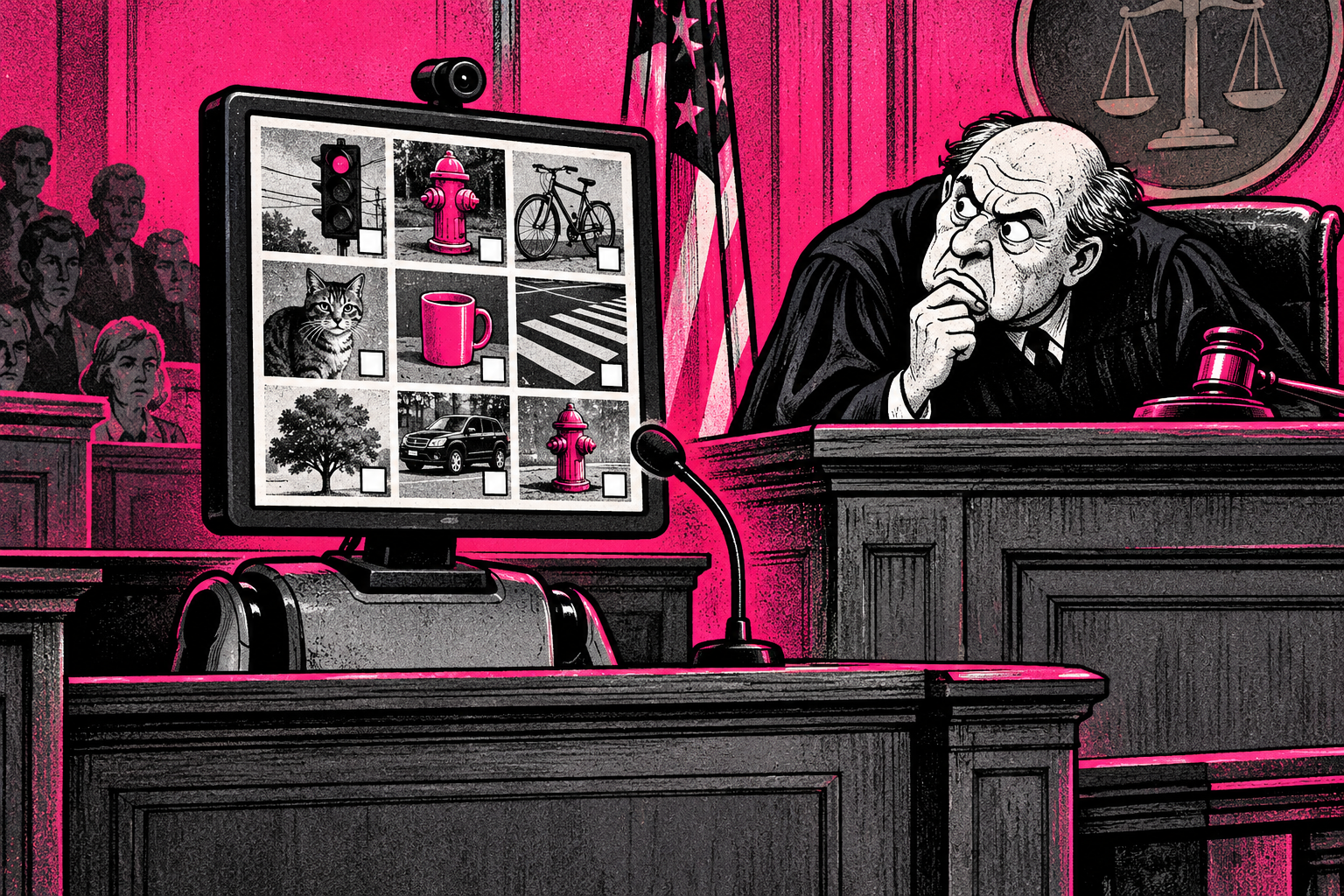
Soon Exhibit A may enter the courtroom, raise its right hand and be asked to select every square containing a traffic light.