
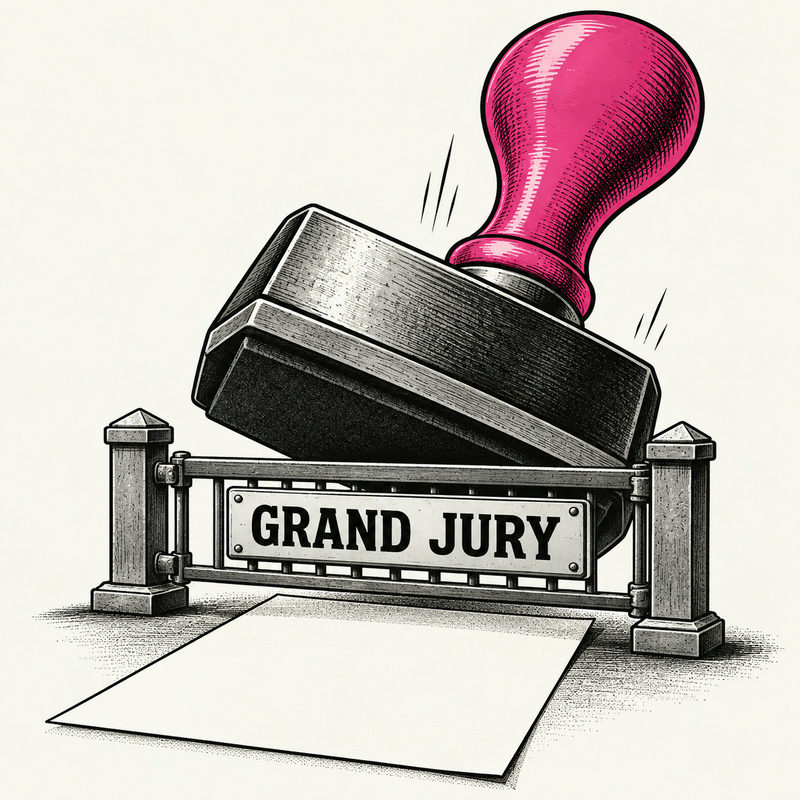
The Justice Department has encountered an inconvenient feature of seeking an indictment: someone else has to agree.
A federal grand jury declined to indict Cassidy Hutchinson over her testimony about January 6, CBS News reported Tuesday, citing four sources briefed on the proceedings. A Civil Rights Division lawyer also told a judge during a hearing on another matter that the grand jury had not concurred on a proposed indictment. He did not identify the person; CBS's sources identified Hutchinson.
The rubber stamp, it turns out, was a group of people.
Hutchinson was an aide to White House chief of staff Mark Meadows. Her 2022 testimony to the House committee investigating the Capitol attack angered Trump's allies, and House Republicans referred the matter to the Justice Department, according to reports cited by CBS.
That explains the political setting. It does not establish what precise allegation prosecutors took to the grand jury. CBS says it could not determine which parts of her testimony were under scrutiny. The department had not responded to its request for comment.
That missing detail matters. One widely discussed part of Hutchinson's testimony concerned a story she said another official, Tony Ornato, had told her: that Trump lunged at a vehicle's steering wheel after being told he would not be driven to the Capitol. Trump's driver later contradicted that account in sworn testimony.
Make powerful people uncomfortable.
Subscribe to Democrawonk.
We should not turn the grand jury's refusal into a ruling that every word of Hutchinson's testimony was proved correct. Nor should we pretend we know that the steering-wheel story was the proposed charge. Neither conclusion is in the reporting.
What we do know is narrower and still important: prosecutors sought an indictment and did not get one.
A congressional referral, a controversial witness and an audience already convinced of wrongdoing can produce an enormous amount of political momentum. They do not, by accumulation, become an indictment. The grand jury is not a checkout screen where the government clicks “confirm” after loading its preferred defendant into the cart.
The Civil Rights Division's involvement also puts the institutional question in unusually sharp focus. The department is exercising the government's power to pursue criminal charges against a prominent witness whose testimony damaged the president. That power warrants scrutiny, not an exemption from scrutiny because the witness's enemies are enthusiastic.
A refusal to indict is not an acquittal after a trial. It is also not nothing. A required part of this attempted prosecution declined to approve it.
Washington can explain that result, dispute its significance or issue another statement. It cannot count the statement as the missing indictment.
Comments
Have something to say? Give this story a heckle.
Comment Rules
Argue the point. Add a joke. No threats, harassment, hate speech, spam, private personal information or unsupported accusations. First-time comments and comments with links are moderated. Full Comment Rules
Loading comments…
Questions or deletion requests? Contact Us. We retain comments and moderation records until removed. Only hashed email identifiers are stored for comment accounts.