
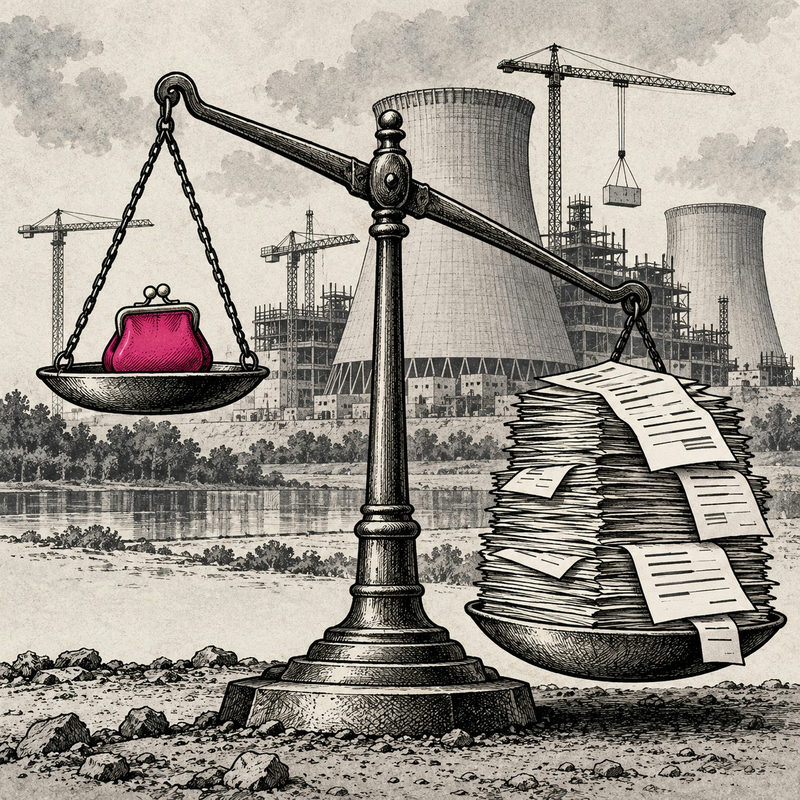
Britain’s Sizewell C nuclear project has achieved an impressive financial breakthrough: the risk can travel directly to your electricity bill without stopping at an investor’s wallet for very long.
The public accounts committee says the funding arrangement exposes taxpayers and consumers to an extraordinary level of risk. According to the Guardian’s account of its report, a higher-cost outcome could require billpayers to contribute an extra £9.8 billion during construction and another £12 billion over the plant’s operating life. Private investors would have to put in an extra £30 million.
Those are potential costs, not bills that have already landed. But as an illustration of shared sacrifice, the proportions suggest one participant has brought a teaspoon to help bail out a swimming pool.
The government owns 44.9% of the project. EDF holds 12.5%, with Centrica, La Caisse and Amber Infrastructure holding the remaining stakes. The public is therefore involved twice: through the government’s investment and through the energy bills helping finance the plant. If this arrangement needs a reassuring slogan, “You’re already in it” has the advantage of being difficult to dispute.
There is a serious argument for building nuclear power. Supporters point to reliable low-carbon generation, less dependence on gas backup and the costs of balancing the grid. The government says Sizewell C could save £2 billion a year across the energy system once operational. It also rejects the committee’s assessment, saying the deal gives investors incentives to finish construction cheaply and quickly.
Make powerful people uncomfortable.
Subscribe to Democrawonk.
That response deserves to be heard. It does not make the allocation of overruns disappear. Incentivizing someone to arrive on time is a different contractual achievement from establishing who pays when they do not. A restaurant can strongly encourage the chef to avoid burning dinner while still having a remarkably unfriendly policy about whose credit card gets charged for the replacement.
The projected construction bill ranges from £40.5 billion to £47.7 billion, with completion between 2039 and 2043. That is a long time for a household to remain the dependable party in an arrangement it cannot negotiate. The person paying the electricity bill does not get to phone the project and demand a more favorable risk allocation before renewing for another month.
The committee’s requests are consequently less glamorous than the launch photographs and considerably more useful. It wants the government’s scenario analysis within three months and progress updates every six months. Show the assumptions. Show what happens if they are wrong. Keep showing the work while the money is being spent.
None of that requires pretending nuclear power has no benefits, or treating the worst-cost scenario as inevitable. It requires distinguishing a case for a power station from a case for this financing deal. “We need electricity” cannot be the answer to every question about who gets paid and who absorbs the overruns. Otherwise the national procurement strategy is just pointing at a lightbulb until the accountant leaves.
If ministers are confident the incentives will deliver, they should be equally comfortable publishing the scenarios. The public has already been given a substantial role in the project. It would be nice to receive something resembling the information normally supplied to an investor.
Comments
Have something to say? Give this story a heckle.
Comment Rules
Argue the point. Add a joke. No threats, harassment, hate speech, spam, private personal information or unsupported accusations. First-time comments and comments with links are moderated. Full Comment Rules
Loading comments…
Questions or deletion requests? Contact Us. We retain comments and moderation records until removed. Only hashed email identifiers are stored for comment accounts.