
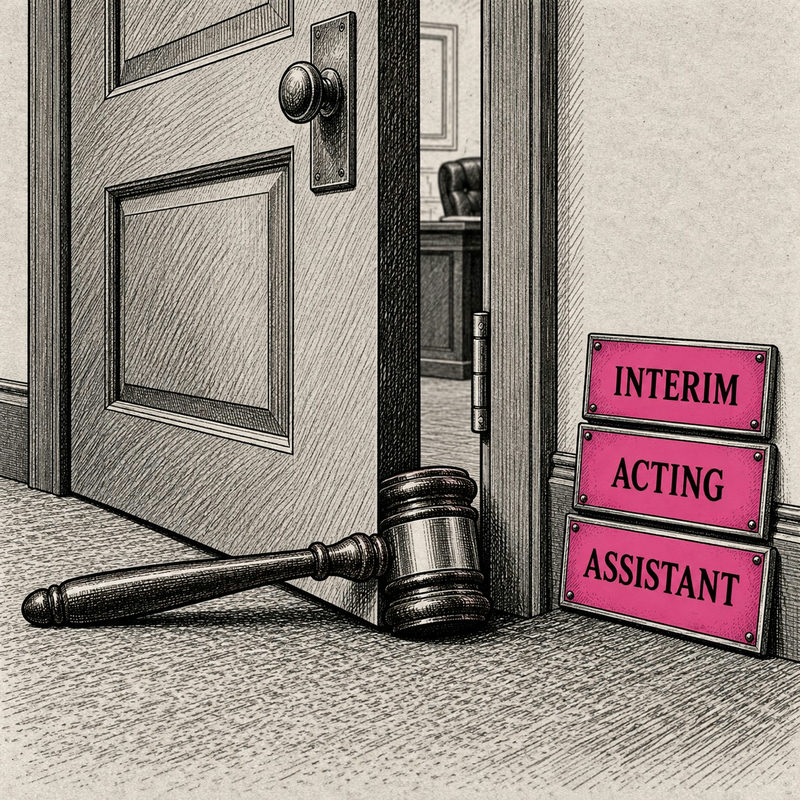
The Trump administration has tried several job titles for Bill Essayli. A federal judge has now supplied another: unlawfully serving.
According to the Guardian, Tuesday’s ruling disqualifies the southern California prosecutor from participating in or supervising two criminal prosecutions in which his authority was challenged. It does not take effect immediately, and the Justice Department intends to appeal. This is not a finding that every case handled by the office disappears. The procedural qualifications matter, even when the office-label collection is doing its best to distract us.
Essayli became interim U.S. attorney in April 2025 without Senate confirmation. When that appointment ended, the administration moved through an acting designation and then a first-assistant role after a judge found he was serving unlawfully. The latest ruling says the first-assistant and special-attorney designations do not solve the problem.
At this point, the door plaque has received more institutional attention than the appointment process. Perhaps the next title will be Regional Executive Vice President of Being the Same Guy.
Judge Michael Seabright cited an appellate ruling involving a similar arrangement in Nevada. That is an inconvenient feature of a legal system: sometimes a decision in another case means you cannot simply keep testing synonyms until the courthouse gets tired.
The Daily Heckler
The best of Democrawonk.
No algorithm required.
Essayli disagrees. He says the president and attorney general can select Justice Department supervisors, expects the Supreme Court ultimately to decide the question, and intends to continue in his current role until then. His position is not that the office has accidentally accumulated too many nameplates. He contests the court’s understanding of the administration’s authority.
The question deserves more than a joke about stationery because federal prosecutors exercise power over people’s liberty. Their legal authority is not a decorative credential, like a motivational certificate hung beside the printer.
The administration’s approach effectively asks everyone else to litigate the difference between a changed title and a changed job. Defendants must challenge it. Judges must rule. Appeals must proceed. Meanwhile, the official remains behind the desk, announcing his intention to stay there.
There is a peculiar audacity in running a law-enforcement office this way. The institution expects the public to obey legal requirements precisely while its own leadership offers a rotating selection of business cards.
For now, the ruling concerns two prosecutions, the appeal is coming, and the wider dispute remains unresolved. No one should confuse that with a completed removal.
But if the same appointment problem survives every new title, the stationery department may not be the department that needs attention.
Comments
Have something to say? Give this story a heckle.
Comment Rules
Argue the point. Add a joke. No threats, harassment, hate speech, spam, private personal information or unsupported accusations. First-time comments and comments with links are moderated. Full Comment Rules
Loading comments…
Questions or deletion requests? Contact Us. We retain comments and moderation records until removed. Only hashed email identifiers are stored for comment accounts.