
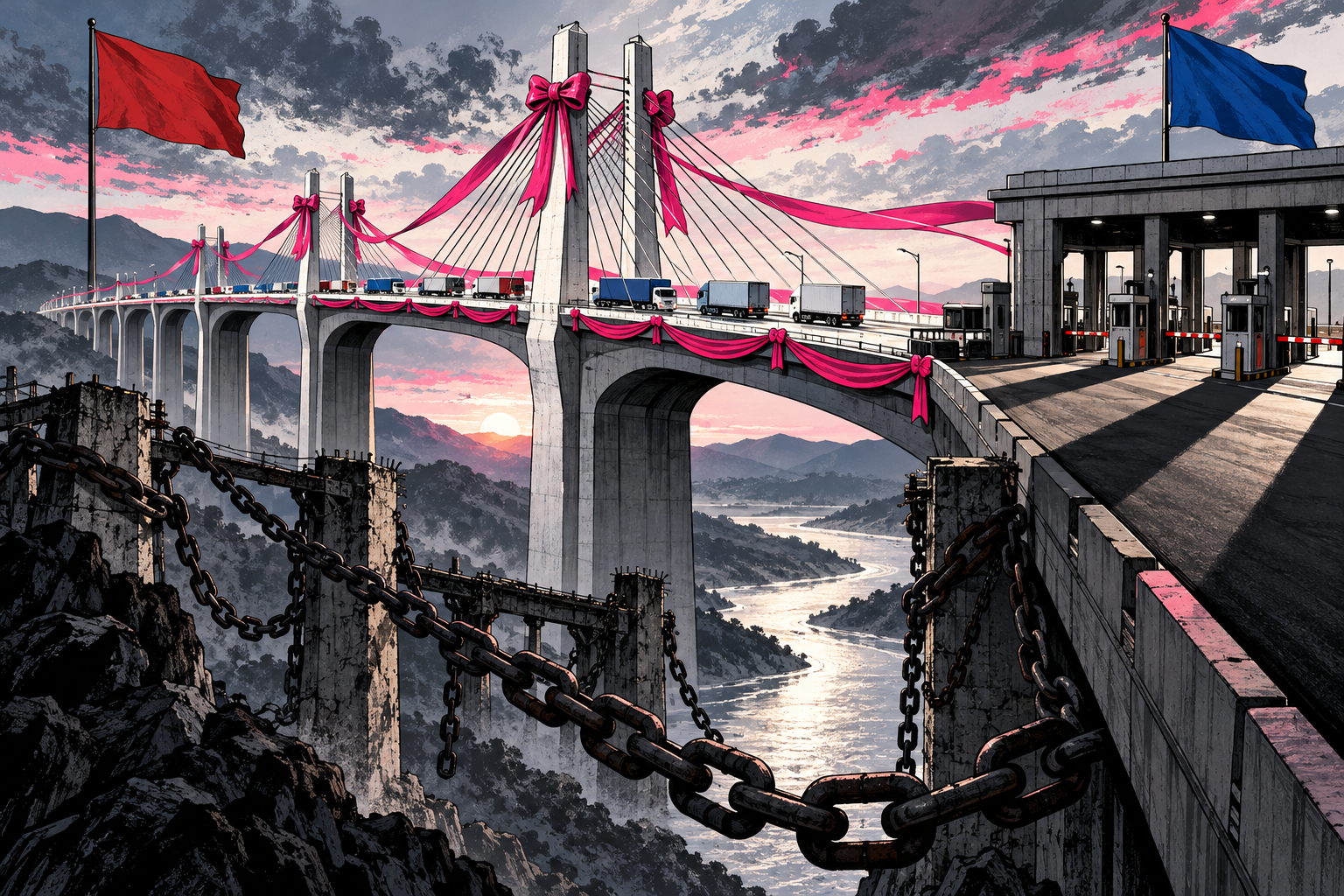
China and North Korea have opened a three-kilometer bridge that was completed in 2014, proving that even authoritarian friendship projects can spend twelve years trapped in the equivalent of municipal permitting limbo. Trucks crossed the New Yalu River Bridge on Thursday under ceremonial ribbons and national flags. The concrete was new to traffic. The geopolitical complications came preinstalled.
Reuters reported from Dandong that the crossing links the Chinese city with Sinuiju in North Korea and is now the most significant land border connection between the two countries. The bridge sat unused for years while North Korea’s approach roads and customs compound remained unfinished. Chinese Premier Li Qiang said the crossing would promote trade, improve border clearance and deepen practical cooperation. China’s government published those remarks as part of its official account of the ceremony.
The opening follows warmer ties and recent meetings between Xi Jinping and Kim Jong Un. Reuters reported that China’s exports to North Korea reached $2.3 billion last year, up 25% but still below levels before U.N. sanctions tightened in 2017. A South Korean Unification Ministry official called the bridge the first visible implementation of agreements reached at the leaders’ June summit.
Infrastructure Is Policy With Guardrails
A bridge is not morally suspicious. Cross-border commerce can feed families, reduce isolation and create ordinary human contact. Dandong residents have waited years for the economic activity they were promised. North Koreans need food, energy and basic goods, not another lecture delivered from a well-stocked capital.
But this crossing does not open between two ordinary trading partners. North Korea remains under U.N. sanctions connected to its nuclear and missile programs. China voted for those measures before later questioning their effectiveness. Russia’s expanding relationship with Pyongyang has added another layer of military and strategic concern. A wider trade route therefore raises unavoidable questions about what crosses, who monitors it and whether commerce helps civilians or strengthens the state apparatus that keeps them isolated.
Chinese state media framed the bridge as a landmark of friendship and said it would improve the well-being of both peoples. That is the government’s position, not an audited outcome. The difference matters. Ceremonies are excellent at photographing trucks. They are less talented at showing the cargo manifest, the bank transfer or which household eventually receives the benefit.
Engagement Needs Receipts
The liberal answer is not permanent isolation for its own sake. Sanctions can impose costs on civilians while elites route around them. Broad pressure without humanitarian safeguards often becomes another hardship ordinary people did not vote for. At the same time, opening commerce without transparent enforcement risks rewarding a government that has invested heavily in weapons while restricting information, movement and political freedom.
The practical standard should be boring and firm: inspect cargo, enforce U.N. rules, publish trade data, protect humanitarian channels and watch for dual-use goods. Encourage exchanges that materially improve civilian life. Do not let the language of development become a scenic bypass around nonproliferation commitments.
The bridge may help a border economy and still strengthen a dangerous alliance. Both can be true, which is why ribbon-cutting optimism is not a monitoring system. After twelve years of waiting, the crossing deserves a chance to work. It also deserves a customs desk with better eyesight than the ceremony’s camera crew.