
Opinion & Satire
An international finance meeting can make a household sound like an abstract unit of adjustment. The household has a less technical description: the bills are here, and the money is not.
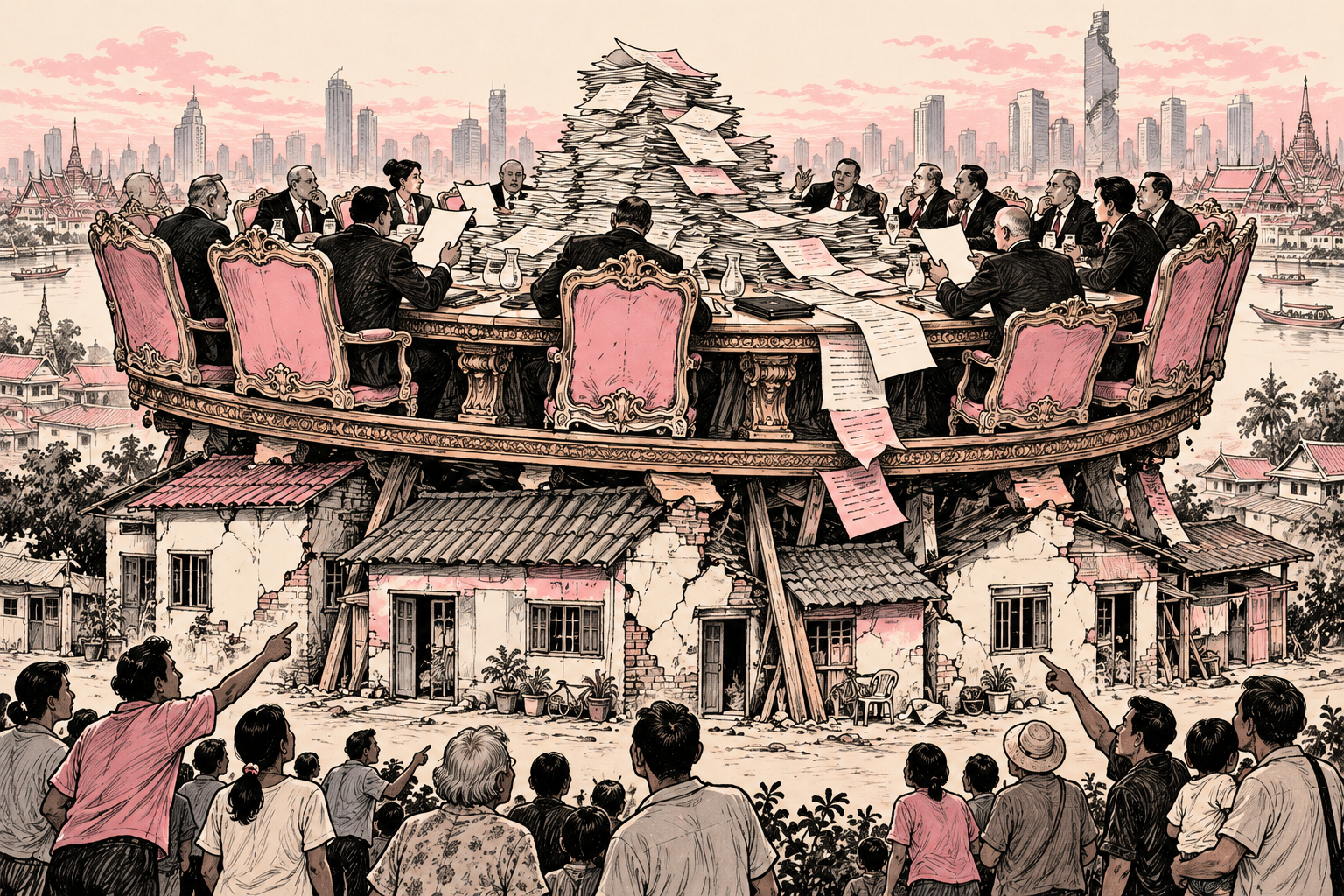
Dozens of protesters marched in Bangkok October 15 during the IMF and World Bank meetings, AP reports. Their grievances included poverty, household debt, pollution and the conduct of financial institutions. A small demonstration is not a scientific measure of public opinion. It is still an opportunity to hear people who are not delivering a presentation from the conference stage.
There is a substantive debt warning inside the venue too. AP reported October 14 that IMF Managing Director Kristalina Georgieva urged wealthy countries, including the United States, to confront mounting debt rather than expect growth alone to solve it.
The IMF's own October 14 Fiscal Monitor briefing warns that fiscal risks are rising and that decisions in major economies have consequences beyond their borders. It advocates targeted, temporary and transparent support rather than broad, open-ended subsidies, and discusses improving taxation without sacrificing revenue.
Those positions deserve to be assessed accurately. The institution is not simply calling for every government to stop helping people. The real argument is how to manage constraints without making the least protected people the default shock absorbers.
A Budget Has People On Both Sides
Debt service is not imaginary. Neither are hospitals, classrooms, flood protection or the time somebody spends trying to hold a family together while prices rise.
A serious budget discussion has to put those realities in the same frame. Otherwise, we get one group describing a fiscal adjustment and another group wondering which necessary part of life is about to disappear.
There are circumstances in which borrowing finances valuable investment. There are circumstances in which rising interest costs narrow a government's choices. Neither observation settles the fairness of a specific tax increase, spending cut or debt agreement.
The questions are practical and political: who has benefited from past choices, who can pay, which services are essential and what happens if investment is postponed?
It is convenient to call those questions complicated and move on. They are complicated. That is why the people with the microphones should answer them.
The liberal standard should be to protect basic security while pursuing a credible public-finance plan. That means scrutinizing waste and privilege as energetically as assistance to a person without an accountant.
If discipline arrives at the clinic before it visits a well-connected tax preference, the public is entitled to ask for a different travel itinerary.
The Spreadsheet Needs A Street Address
The IMF's warning about spillovers is especially relevant to Americans.
We should not assume that choices made in a wealthy country end neatly at its coastline. The ability to issue debt and attract capital does not make the effects on other countries morally irrelevant.
That is an argument for responsible policy and international cooperation, not for announcing that the federal government is identical to a family's checking account. They are different institutions with different powers and obligations.
It is also an argument against using distant hardship as scenery. Bangkok's protesters have their own concerns about their government and financial institutions. Their lives are not a prop for an American partisan speech.
Listening to them does not require accepting every slogan. It requires treating participation from outside the meeting hall as something more than a security complication.
Officials should publish intelligible explanations of proposed changes, assess their distributional effects and provide ways to challenge assumptions. A policy can be technically tidy and politically destructive if the people expected to endure it are the last to hear the details.
We need budgets that can withstand arithmetic and public scrutiny. Avoiding either one invites trouble.
A spreadsheet can tell you that a column balances. It cannot, by itself, tell you whether the people underneath it can still stand up.