
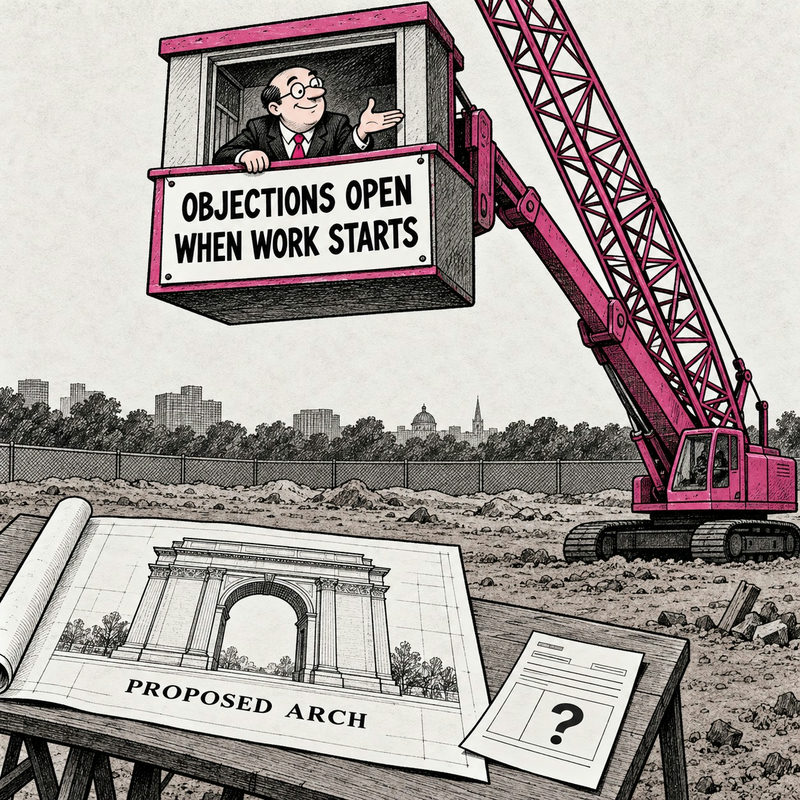
At Friday’s hearing over Donald Trump’s proposed 250-foot arch, a Justice Department lawyer suggested that the challengers bring their request to stop construction again once construction begins. Judge Tanya Chutkan was also trying to establish who would pay for the project, CBS News reports.
A useful sequence for a public undertaking: build first, clarify the objection window later, and perhaps someone will eventually produce a wallet.
Three Vietnam veterans and a historian are seeking to stop the arch planned between Arlington National Cemetery and the Lincoln Memorial. Their lawyers argue that the project lacks required congressional approval. The administration disputes their legal standing to sue, citing a Supreme Court decision involving the White House ballroom.
Standing is a real legal requirement, not a word the government invented on Friday. Chutkan identified it as her most important initial question. An objection to a project does not automatically establish a right to bring a case.
But there is something magnificently irritating about telling people who want construction stopped to come back when the construction has started. The bureaucratic version of refusing to discuss the leak until the sofa can float.
According to the administration’s filings, work could begin as soon as November 5 if the National Capital Planning Commission gives final approval that day. Could begin. Conditional approval. This is not a report that the first truck is already reversing over the lawn.
The Daily Heckler: five or six selected stories.
Political satire for your morning inbox.
Still, that is a remarkably tidy proposed turnaround. Approval in one hand, equipment keys in the other. Meanwhile, the judge said she did not even know who was paying.
We have a potential start date. We have 250 feet of ambition. We have people asking whether they are allowed to object. Could someone please open the drawer marked Basic Project Information?
The veterans described how the proposed structure would change their visits to graves at Arlington. The government characterized their objection as a deep personal disagreement. You need not decide the legal merits to notice the difference between those perspectives. One side is describing a place of remembrance. The other is trying to clear the calendar for a high-priority White House project.
Chutkan questioned what harm a temporary delay would cause beyond the president’s wish to decorate the city. She also pressed the administration’s national-security explanation. The hearing did not amount to a final decision on the lawsuit, and judicial skepticism is not an injunction you can assemble from quotations.
But the questions are refreshingly ordinary. Who is paying? Why now? Why must the activity people want stopped begin before they should ask again?
I’m tired. An enormous monument apparently comes with a microscopic period in which the public is supposed to be procedurally interesting.
Answer the questions before the fucking construction starts. The government should not need a crane to establish that a dispute has become concrete.
Comments
Have something to say? Give this story a heckle.
Comment Rules
Argue the point. Add a joke. No threats, harassment, hate speech, spam, private personal information or unsupported accusations. First-time comments and comments with links are moderated. Full Comment Rules
Loading comments…
Questions or deletion requests? Contact Us. We retain comments and moderation records until removed. Only hashed email identifiers are stored for comment accounts.