
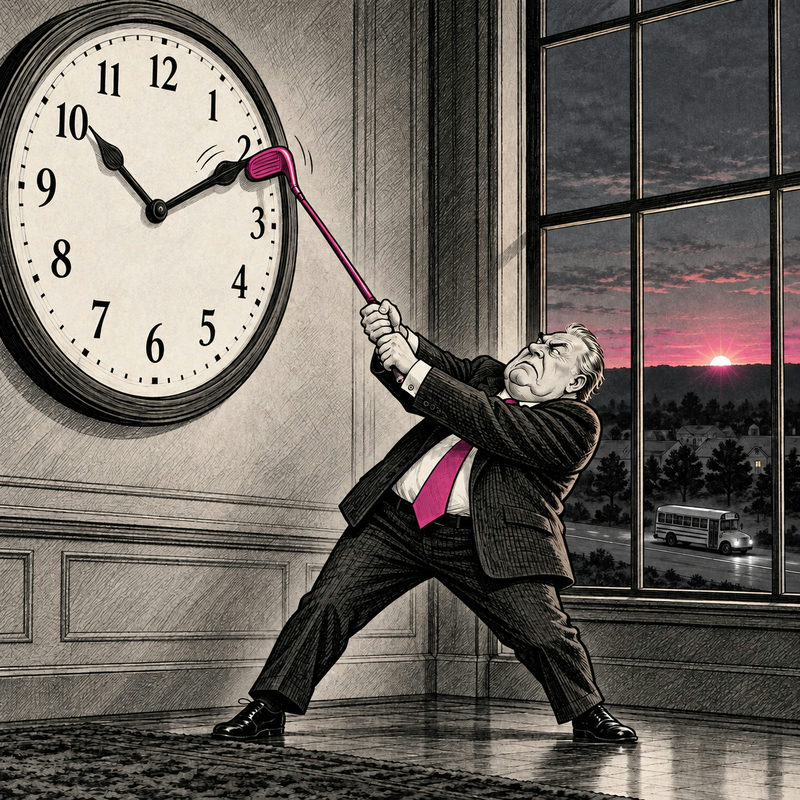
Donald Trump has a plan to improve the afternoon: move an hour out of the morning and let somebody else explain it to the school bus.
The House has passed permanent daylight saving time. The Senate, the Associated Press reports, is unlikely to take it up before the year ends. Republican opponents keep raising a tedious implementation issue: in some places, winter sunrise would arrive after 9 a.m. Apparently the sun has retained outside counsel.
Trump has not confined himself to explaining the benefits. Earlier this month he posted Senator Tom Cotton’s personal cellphone number and demanded action. This is an ambitious legislative strategy for a bill about making people’s mornings less annoying.
Cotton objects to late winter sunrises. South Dakota’s Mike Rounds points to children heading to school in darkness. There is a real trade-off here, which is why disliking clock changes does not automatically settle which time should become permanent. The clock can redistribute daylight on the schedule. It cannot manufacture more of it. Congress would need a considerably larger appropriation.
The Daily Heckler: five or six selected stories.
Political satire for your morning inbox.
The president’s case also includes more afternoon golf and the danger of reaching clocks on high steeples. Somewhere between the school commute and the municipal clock tower, this has become a transportation bill for one man’s backswing.
Supporters have arguments beyond golf: less disruption from switching and more usable afternoon light. Democrats including Ed Markey back the change. But America has already tried year-round daylight saving during the 1970s energy crisis and abandoned it amid falling support and concerns about children traveling to school in the dark. We do have historical evidence. It is simply less convenient than a picture of a sunset.
For now, most Americans still turn the clocks back Sunday. Trump can give out every senator’s number. Sunrise remains stubbornly unavailable by phone.
Comments
Have something to say? Give this story a heckle.
Comment Rules
Argue the point. Add a joke. No threats, harassment, hate speech, spam, private personal information or unsupported accusations. First-time comments and comments with links are moderated. Full Comment Rules
Loading comments…
Questions or deletion requests? Contact Us. We retain comments and moderation records until removed. Only hashed email identifiers are stored for comment accounts.