
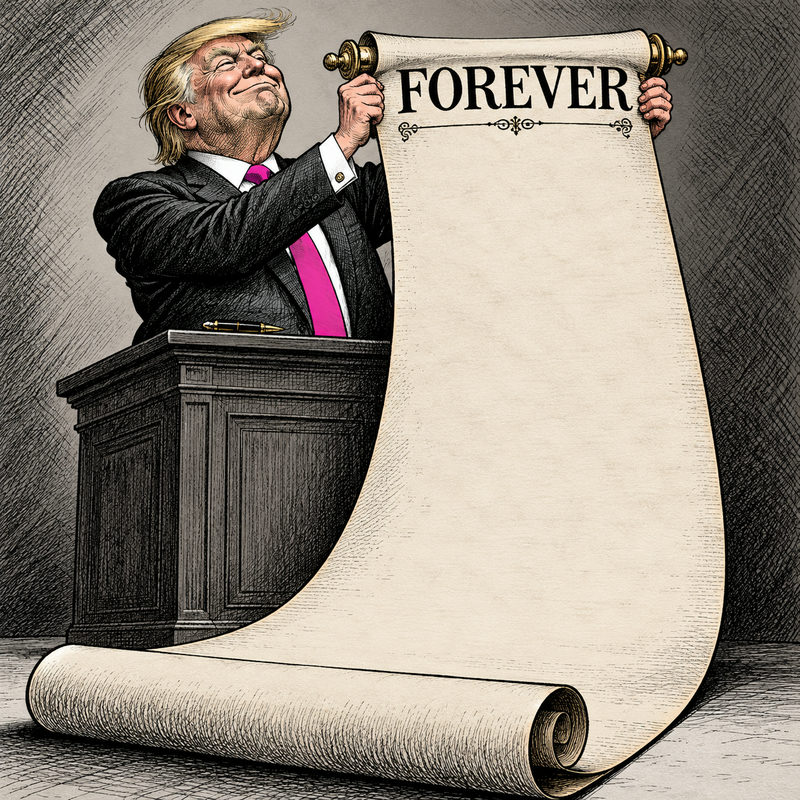
Permanence has arrived ahead of the first draft. Donald Trump is promising an immigration law that will settle the conduct of every future president, although the legislation has not yet settled on its own contents. An impressive promotion for a document still awaiting existence.
In Roll Call’s account of his post-election agenda, the proposed No Invasion of Our Country Act remains uncrafted. Trump nevertheless says it would prevent future presidents from opening the borders to illegal immigrants. The name is ready. The prohibition is ready. The future has been informed. A modest administrative residue remains: the law.
Ordinary legislation suffers from particulars. Somebody writes a provision, somebody asks what it means, and suddenly the magnificent promise has acquired a page number at which it can be questioned. The unwritten bill enjoys a superior standard of service. It can answer every objection without changing a word.
Ask how it works, and the title is available. Ask how broadly it applies, and the promise expands to include presidents who have not been elected. Ask what Congress is actually being asked to enact, and you have rather spoiled the atmosphere by introducing Congress.
Make powerful people uncomfortable.
Subscribe to Democrawonk.
This is a campaigning proposal, dependent on the political outcome and whatever lawmakers eventually produce. That dependence is precisely what makes the presidential certainty so grand. He needs voters to help secure a Republican Congress in order to do the thing he describes as binding presidents forever. The immediate future requires assistance; the indefinite future has apparently signed already.
We have seen a payment promise give voters a much firmer deadline than the government. Here the imbalance is more ambitious. The obligation extends across administrations while the instrument imposing it is still prospective. Nobody has misplaced the fine print. There is not yet any fine print to misplace.
A serious immigration proposal would give supporters something to inspect and opponents something specific to contest. It might even force the president to explain how a favored phrase becomes a workable instruction. That is the inconvenience of writing: the words remain on the page after the crowd has gone home.
For now, the bill can be as absolute as the speech needs. No troublesome clause limits its reach. No definition distracts from the title. Every future president stands magnificently restrained by a document that has yet to impose the smallest burden on its author.
Comments
Have something to say? Give this story a heckle.
Comment Rules
Argue the point. Add a joke. No threats, harassment, hate speech, spam, private personal information or unsupported accusations. First-time comments and comments with links are moderated. Full Comment Rules
Loading comments…
Questions or deletion requests? Contact Us. We retain comments and moderation records until removed. Only hashed email identifiers are stored for comment accounts.