
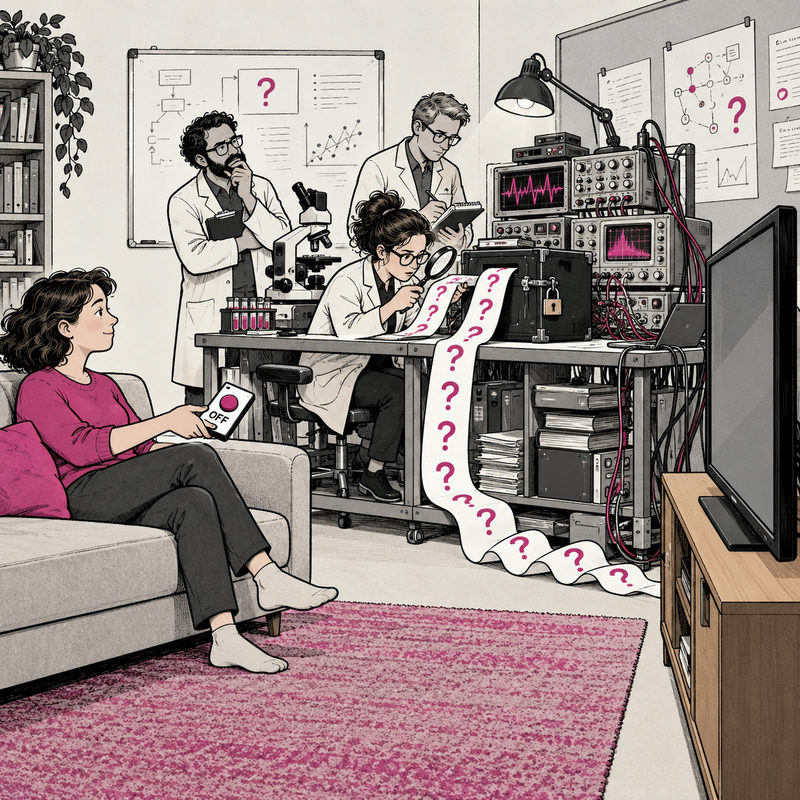
A television privacy control labelled off seems like a complete sentence. If more explanation is required, I would expect it to concern how to turn tracking back on.
Ars Technica reports that Northeastern researchers found traffic consistent with automatic content recognition continuing after opt-out on tested Samsung, Vizio and Roku systems. They ran 5,943 controlled experiments across 12 televisions and eight operating systems. The traffic was encrypted, so they could not establish its contents or prove that every transmission was tracking. That qualification matters. The television gets to know what the television is sending. You get a qualification.
Start with the most reassuring case. On Roku, the behavior appeared only in its own streaming app, The Roku Channel, and the exception is disclosed. So perhaps the button works, provided we understand that opting out of the television’s tracking does not necessarily mean opting out of the television company’s channel. This is the sort of distinction a viewer might have missed while making the elementary mistake of watching television.
Make powerful people uncomfortable.
Subscribe to Democrawonk.
Samsung and Vizio were less tidy. The researchers observed similar traffic in additional scenarios; on Vizio, the identified endpoint continued receiving traffic in every opted-out scenario tested, including when the set was idle. Ars asked the companies about the behavior and had not received answers in the report. The study does not establish the same result for every television or provider. We can keep the uncertainty properly bounded without mistaking it for a working privacy control.
There is another possible reassurance: perhaps the data arrives and is thrown away. The lead researcher considers that unlikely, pointing to the wasted bandwidth and server work. But he cannot independently audit what happens there. I am trying to picture the consumer benefit of a privacy system whose best explanation is that it takes something on a journey solely to demonstrate the restraint of not keeping it.
It might instead be a bug. That would make the intention less sinister, while leaving the customer with the unusual task of distinguishing a malfunctioning refusal from an ignored one. Neither diagnosis is available from the button.
The researchers have supplied addresses users can block to prevent contact with recognition services. They also suggest keeping the TV off the network or using a suitable external device.
I began by agreeing to press off. I now appear to be applying for the network administrator position.
Comments
Have something to say? Give this story a heckle.
Comment Rules
Argue the point. Add a joke. No threats, harassment, hate speech, spam, private personal information or unsupported accusations. First-time comments and comments with links are moderated. Full Comment Rules
Loading comments…
Questions or deletion requests? Contact Us. We retain comments and moderation records until removed. Only hashed email identifiers are stored for comment accounts.