
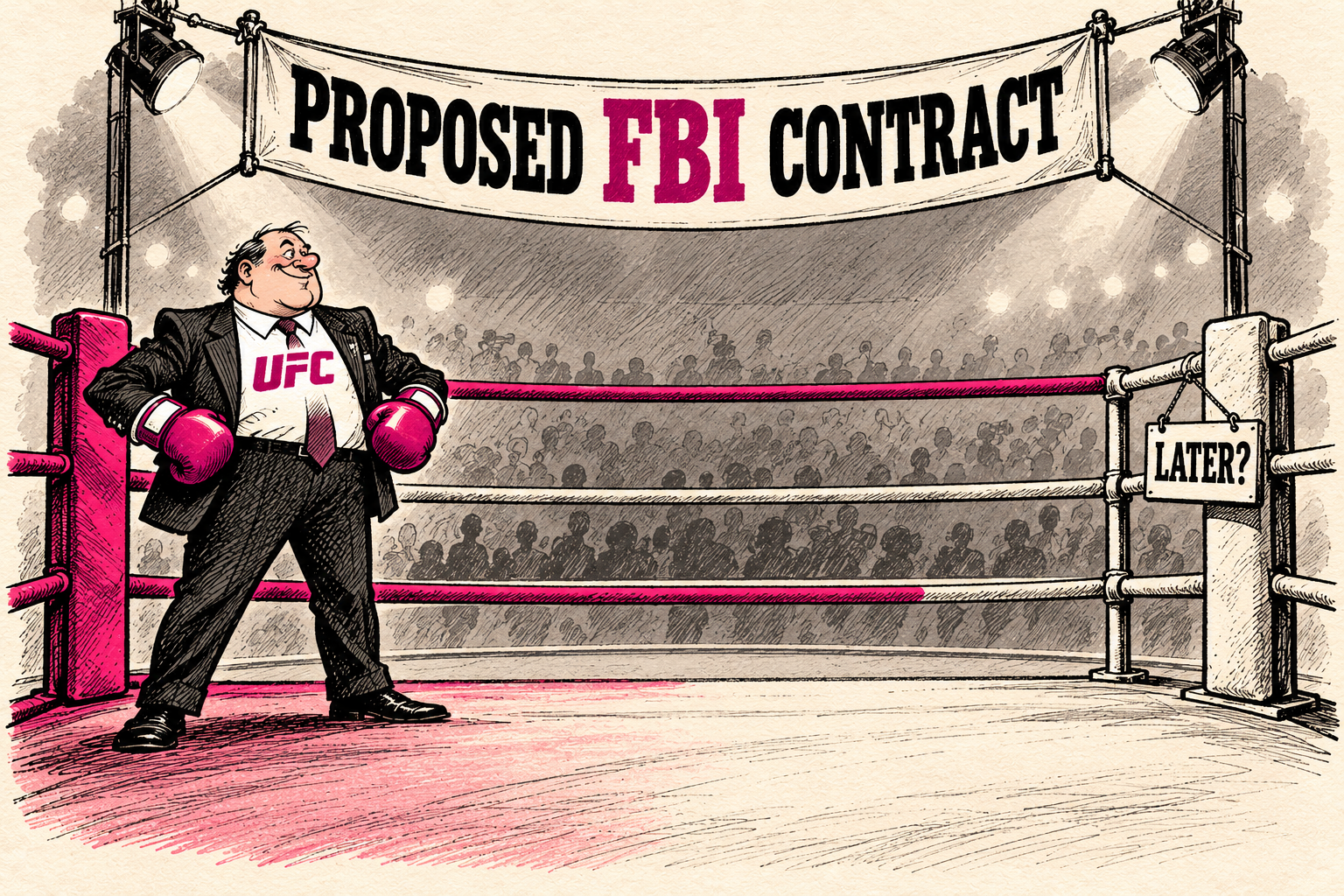
Welcome to an imaginary procurement-night broadcast, where the UFC could achieve a remarkable sporting breakthrough: winning without requiring anyone in the other corner. No opponent means fewer promotional arguments, although it does limit the footage available for the rivalry montage.
The Guardian reports that the FBI filed a September sole-source justification for a proposed one-year UFC training contract. A potential longer contract would face competitive bidding after market research. The report does not establish a completed award, and the price is undisclosed. Tonight’s broadcast is parody; that procurement sequence is the reported foundation.
In our fictional red corner: a fighting organization. In the blue corner: the exciting possibility of competition at a later event. Please remain seated while the announcer tries to build tension between a named supplier and a future procurement method.
A Very Promising Weight Class
From a commercial perspective, this is beautiful matchmaking. The bureau’s reported justification calls the UFC “uniquely qualified.” An ordinary supplier must explain why it is better than someone else. A unique supplier gets the more economical assignment of being itself. Imagine the savings on scouting the opposition when the category description has already introduced the favorite.
That phrase is the FBI’s stated justification, not a court finding that no other trainer exists. Nor does a sole-source proposal establish an illegal deal. We can grant those distinctions without pretending this is the normal kind of UFC spectacle. One business usually sells the drama of a contest. This proposed business opportunity has a more comfortable relationship with suspense.
The bureau identifies striking, grappling and weapon defense: sensible training needs. In our parody demonstration, the agents practice escaping holds while the proposed supplier practices remaining uncontested. Please do not confuse these exercises. Only one requires an opponent to show up.
The commercial staging is already promising. The Guardian describes jointly branded UFC-FBI training gear at an earlier seminar. A logo gets to work out beside a federal institution. Ordinarily a sports brand has to buy advertising space. Here, the attraction is the institution standing next to it, looking extremely official while wearing the partnership.
We do not know the proposed price, so tonight’s imaginary production cannot display a taxpayer scorecard. The lower-third graphic will instead feature the one statistic available without speculation: competing bidders are not part of the proposed sole-source selection. The announcer can still shout. There is simply less to announce.
Then comes the possible longer-term arrangement, with market research and competitive bidding. Excellent: a future card on which the contest itself might finally make an appearance. Other providers can look forward to the possibility of being considered, which is a less lucrative form of exposure but does keep the promotional vocabulary optimistic.
The proposed opening round belongs to the commercial brand the bureau has identified. The potential later round could feature the rather unfashionable idea of a comparison. One can admire the business development without mistaking the sequence for an upset victory.
Competition may join the program later. For now, it is working on its conditioning.