
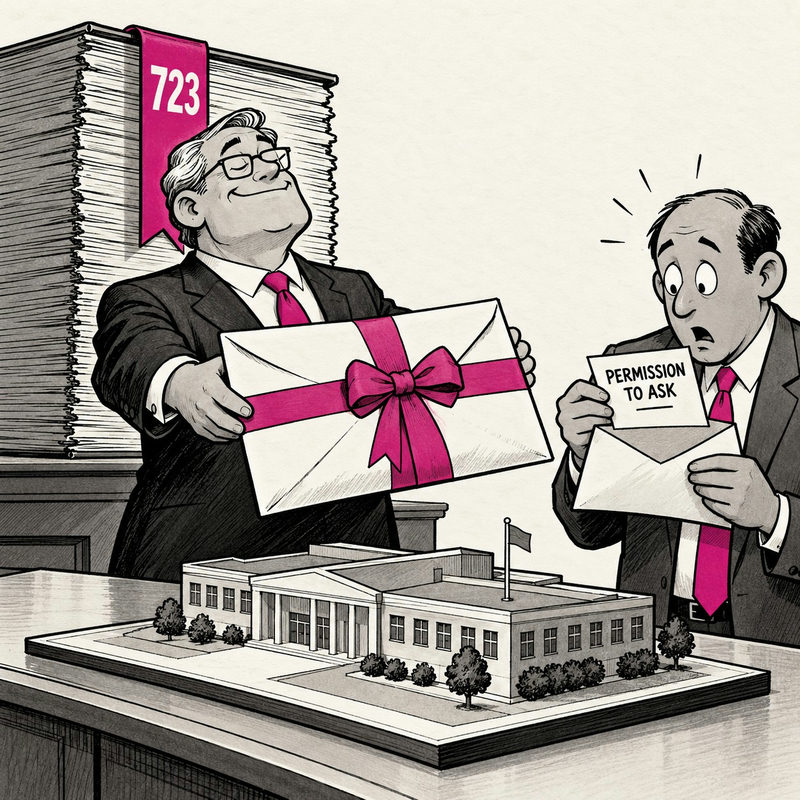
Voters in 47 Virginia localities will decide Tuesday whether to approve sales-tax increases of up to one percentage point for public-school capital improvements. The authority to hold those votes arrived in the state budget, on page 723 of an 887-page document, after a standalone bill passed the House but was carried over by the Senate to 2027.
Page 723. A lovely place to put the public’s involvement in a major funding decision. By then the reader has either developed a specialist qualification or started seeing the appropriations move.
The budget became law on June 29, a day before the deadline to avert a state shutdown. So the permission was not waiting politely on the front porch with a name tag. It was somewhere inside the legislative furniture van while everyone shouted that the building had to be emptied by tomorrow.
And what had the state delivered? Not a cheque covering every local school project. Permission for counties and cities to ask voters whether they would pay more sales tax to fund them.
I’m imagining the ceremonial handover. We believe every child deserves a safe, modern school. Here is an envelope. Wonderful, is the money inside? Better. Your authorization to request the money from the people already standing around you.
The sales-tax proceeds would be restricted to capital improvements. That is real funding for real buildings if voters approve, not a slush fund with a cartoon schoolhouse painted on it. Eight localities with earlier permission have together raised $119 million since 2019, according to the reporting discussed in Bob Lewis’s Virginia Mercury column. Halifax has a new high school and remodeled schools; Danville has financed substantial improvements.
Good. Buildings matter. A renovated school is not diminished by the fact that the route to funding it involved spelunking through a budget.
The Daily Heckler: five or six selected stories.
Political satire for your morning inbox.
But the route deserves attention. Virginia restricts local taxing authority, so the localities first needed Richmond’s permission to ask their own residents. The standalone legislation stalled. The budget supplied the authority. Now voters must weigh the school projects against the extra cost at the checkout.
This is a remarkable delivery service. The state signs for the problem, places it in a bigger box and returns it to the locality with a certificate saying the locality may now open it.
The fairness objection is not that schools should go unfunded. Sales taxes take a heavier share of smaller incomes. A household already stretched by necessities can value its schools and still have trouble finding another dollar. The ballot does not create a third option labeled “I support both the roof and my ability to afford things.”
York County illustrates another concern. Approval would take its combined sales-tax rate from 7 to 8 percent, while neighboring jurisdictions could offer shoppers lower rates. Supervisor G. Stephen Roane Jr. says the county moved too quickly and should have spent more time considering options and effects on local merchants. He also points out that a high county average income does not make every resident affluent.
Thank you. An average is not a bank transfer. If a rich household moves onto my street, I cannot put the resulting statistic toward a washing machine.
The decision remains with voters. They may judge the school improvements worth the added tax, as other communities have. They may want another route. What they should not have to do is mistake state authorization for state delivery of the underlying money.
I keep returning to that envelope. A statewide promise of excellent schools, followed by a locally payable invoice, with the permission to issue it discovered deep inside the budget.
For the next ribbon-cutting, perhaps make the ribbon 887 pages long.
The scissors are on page 723. The community has permission to buy them.
Please remember the fucking sales tax.
Comments
Have something to say? Give this story a heckle.
Comment Rules
Argue the point. Add a joke. No threats, harassment, hate speech, spam, private personal information or unsupported accusations. First-time comments and comments with links are moderated. Full Comment Rules
Loading comments…
Questions or deletion requests? Contact Us. We retain comments and moderation records until removed. Only hashed email identifiers are stored for comment accounts.