
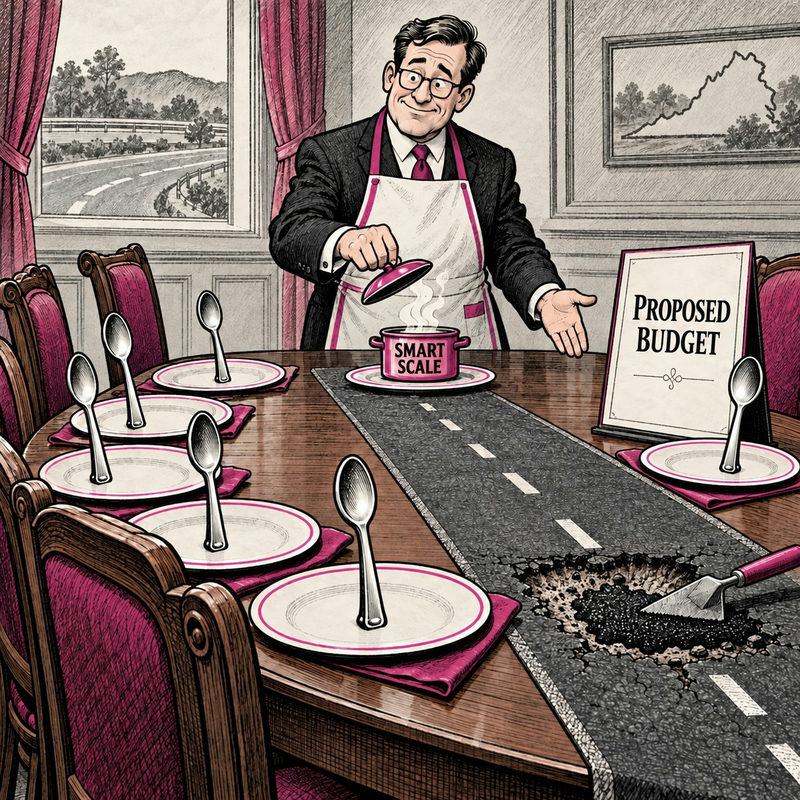
Virginia is considering shifting construction money toward a $1.7 billion highway-maintenance gap. Under the proposal, Smart Scale, a grant program supporting transportation projects, would lose about a quarter of its funding. Six projects that previously had funding could also enter its current competition, the Virginia Mercury reports.
The Commonwealth Transportation Board is scheduled to vote December 9. This is a proposal, not a completed cut or an announcement that any particular sidewalk has been canceled.
Still, it is an admirably compact demonstration of public budgeting: less money in the pot, more projects approaching with spoons.
Maintenance matters. Virginia law puts it first, and costs have risen sharply. Roads and bridges do not preserve themselves through the healing power of a ribbon-cutting photograph. The state has actual assets to repair, and last year’s emphasis on construction helped create the gap alongside rising costs.
The plan would add $239 million a year for pavement repairs beginning in fiscal 2028. Moving money and issuing $300 million in bonds would help soften construction cuts. That is a real attempt to deal with a real problem, not evidence that officials have spent the asphalt budget on ceremonial capes.
But Smart Scale also supports local safety projects, sidewalks and transit. The tradeoff is not simply one grand road losing money to another grand road. People trying to cross a street or get somewhere without a car have needs that do not become decorative because pavement has submitted a more urgent invoice.
The Daily Heckler: five or six selected stories.
Political satire for your morning inbox.
Then come the six potential late entrants.
Transportation Secretary Nick Donohue says they were considered fully funded when applications opened in March, so they could not apply. If their funding moves, he argues, they should get a chance to compete. They would receive no scoring preference, and existing applications would not need rescoring.
That is a comprehensible explanation. It is also a fascinating consolation prize for everyone who already applied: the rules for judging you stay the same, but the available money may shrink and the field may grow.
Congratulations on reaching the next stage. We have reduced the oxygen and added six runners.
Donohue explicitly acknowledged that the projects would get to skip the application process. Not skip the evaluation. Not win automatically. Skip the application. Those are different things, and none makes the original applicants’ concern irrational.
Could we perhaps stop presenting every rearrangement as though nobody will notice the furniture moving? A grant applicant does not need a conspiracy theory to ask what happens when a smaller pool acquires more swimmers.
The board still has a decision to make. Repair the roads. Explain the consequences. Show the communities whose safety projects depend on this money what the new competition actually means.
The potholes are real. So are the tradeoffs. No amount of budget choreography makes either one a fucking optical illusion.
Comments
Have something to say? Give this story a heckle.
Comment Rules
Argue the point. Add a joke. No threats, harassment, hate speech, spam, private personal information or unsupported accusations. First-time comments and comments with links are moderated. Full Comment Rules
Loading comments…
Questions or deletion requests? Contact Us. We retain comments and moderation records until removed. Only hashed email identifiers are stored for comment accounts.