
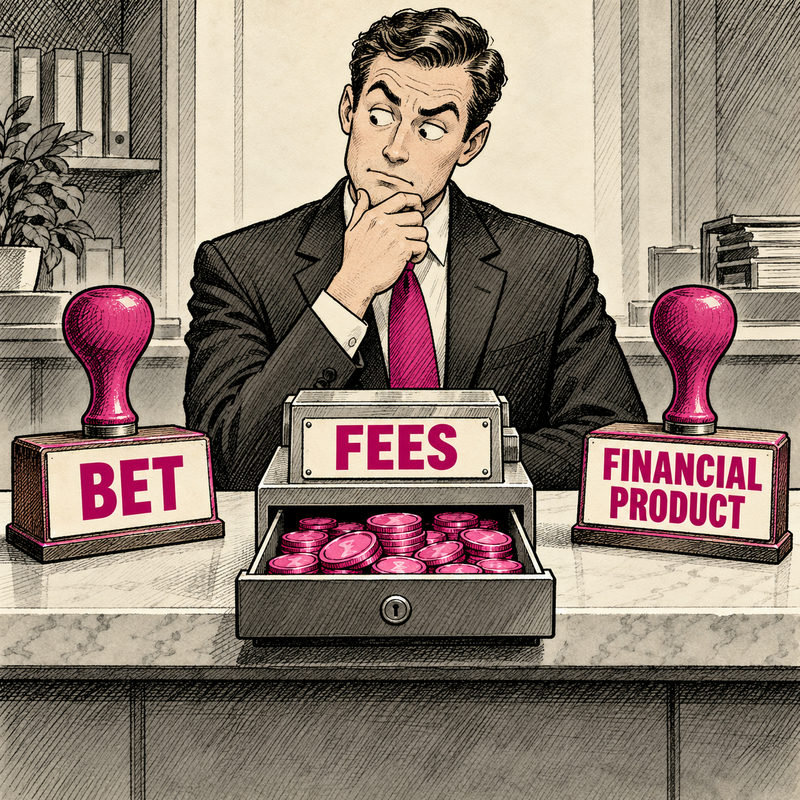
I am willing to consider that an activity which looks like betting may actually be a financial exchange. Many important financial activities look peculiar from outside. Sometimes they also look peculiar from inside, after the fees have cleared.
Kalshi says it operates a federally regulated exchange where customers set prices, and that one state cannot veto a nationwide market overseen by the Commodity Futures Trading Commission. That sounds like a definite answer. Utah has supplied an equally definite lawsuit, which suggests the answer may need a courtroom attached.
As Utah News Dispatch reports, the state is seeking to stop Kalshi's Utah activity and obtain damages and restitution. Its complaint estimates more than $3 billion in lifetime wagers from Utah users, generating between $30.6 million and $61.2 million in fees. Those are the state's estimates and allegations, not a court's findings. Even with that qualification, the proposed scale gives the vocabulary dispute a remarkably healthy revenue department.
I can follow the distinction between an exchange, where people trade with one another, and a bookmaker taking the other side. The trouble begins when that distinction is asked to do every other job too. It can describe the platform's structure. Can it also decide which state laws count? Apparently that part requires more than a good diagram of the matching process.
Make powerful people uncomfortable.
Subscribe to Democrawonk.
Utah has prohibited gambling since statehood in 1896. The state calls this gambling; Kalshi says federal law governs its financial products. An earlier federal order went against Kalshi's effort to block state enforcement, and the company is appealing. The company says the state suit does not change that appeal. Neither side appears ready to settle the matter by agreeing that the other has chosen an excellent noun.
The platform's defense may ultimately prevail. Federal and state jurisdiction is a legal question, not something resolved by how strongly I feel about the word “wager.” But the business advantage of winning that question is easy to understand: a state prohibition becomes a state misunderstanding. The customers remain. The transactions remain. Only the state's ability to object has been reclassified.
This is where my attempt to accept the reassurance runs into its limitation. Calling the service an exchange explains how the service wants to be regulated. It does not, by itself, explain why Utah must accept that arrangement. That is the very dispute the explanation is supposed to have already answered.
While the courts work through it, I notice the fees have avoided all this uncertainty. Nobody seems to be arguing that those are merely predictions of revenue.
Comments
Have something to say? Give this story a heckle.
Comment Rules
Argue the point. Add a joke. No threats, harassment, hate speech, spam, private personal information or unsupported accusations. First-time comments and comments with links are moderated. Full Comment Rules
Loading comments…
Questions or deletion requests? Contact Us. We retain comments and moderation records until removed. Only hashed email identifiers are stored for comment accounts.