
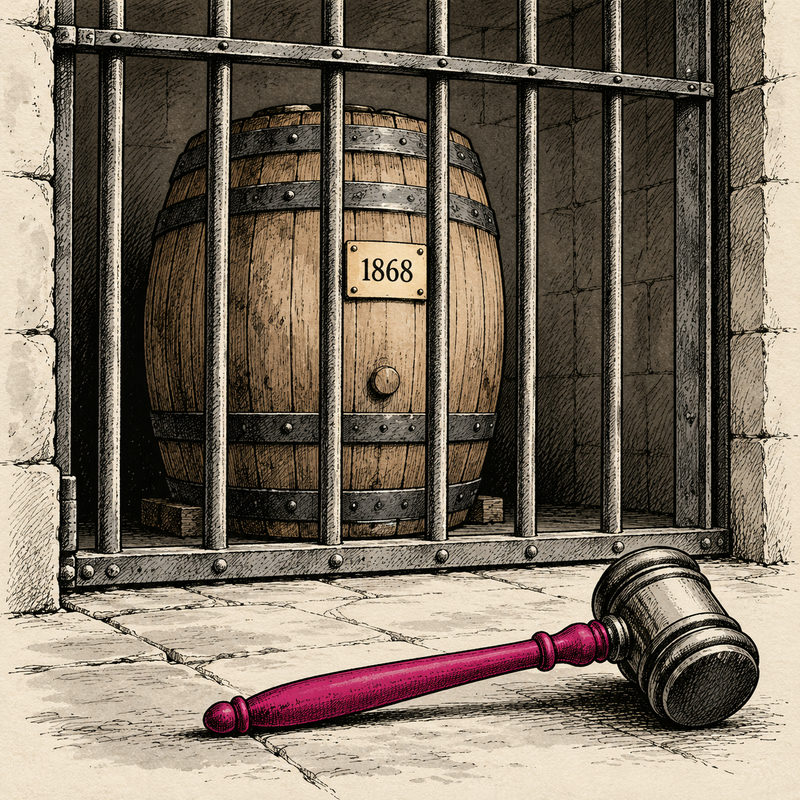
Five years in prison is an ambitious pairing for homemade whiskey.
That is the maximum prison term under a federal ban on distilling spirits in private homes, along with a possible $10,000 fine. The Supreme Court has agreed to review the law, which dates to 1868, according to the Associated Press. The whiskey is allowed a rich historical character. I am less convinced the punishment benefits from one.
The court has not legalized home distilling. Agreeing to hear a case is not a federal invitation to clear a corner of the basement. Please do not cite this column to an inspector; sarcasm is an unreliable license.
What interests me is how an ordinary question of proportion becomes a grand constitutional demolition project. The challengers argue Congress exceeded its taxing power. The government says the prohibition helps prevent tax evasion and makes enforcement feasible. Lower courts disagree, which is why the justices are getting involved.
I think the government can collect alcohol taxes without making every inherited enforcement choice sacred. Rejecting an excessive penalty does not oblige us to weaken the federal government’s taxing power. We can replace the cork without smashing the bottle.
One challenger, Ohio resident John Ream, wants to make whiskey at home for personal consumption. His case is not the same one the Supreme Court agreed to review; the conflicting appellate decisions involve his challenge and one brought by the Hobby Distillers Association. Even the route to asking this question has acquired enough complexity to need a designated driver.
There are legitimate enforcement concerns. “Personal use” cannot simply become two magic words that cause every commercial operation to vanish from the tax rolls. I would not trust that arrangement with corporations, and adding a charming barrel would not improve it.
But the existence of a tax problem does not settle whether this particular ban, backed by this particular maximum sentence, is a sensible answer. A tool can be effective and still wildly disproportionate. You can discourage people from using the office microwave by confiscating the building. Lunch will indeed become quieter.
Congress could examine a modern, limited framework for personal production while preserving taxes and enforceable safety rules. That would require lawmakers to distinguish a household hobby from a commercial business, an intellectual challenge they routinely overcome when deciding which one has a lobbying budget.
Instead, the country gets another constitutional case over a rule older than the household appliances surrounding the proposed activity. We are asking the Supreme Court to untangle a problem Congress could at least try to update.
I am not campaigning for unregulated liquor or declaring anyone entitled to ignore the current law. I am asking whether five years behind bars should be sitting at the far end of this particular hobby.
Let the whiskey spend years in confinement.
It is the part of the arrangement that improves there.
Comments
Have something to say? Give this story a heckle.
Comment Rules
Argue the point. Add a joke. No threats, harassment, hate speech, spam, private personal information or unsupported accusations. First-time comments and comments with links are moderated. Full Comment Rules
Loading comments…
Questions or deletion requests? Contact Us. We retain comments and moderation records until removed. Only hashed email identifiers are stored for comment accounts.