
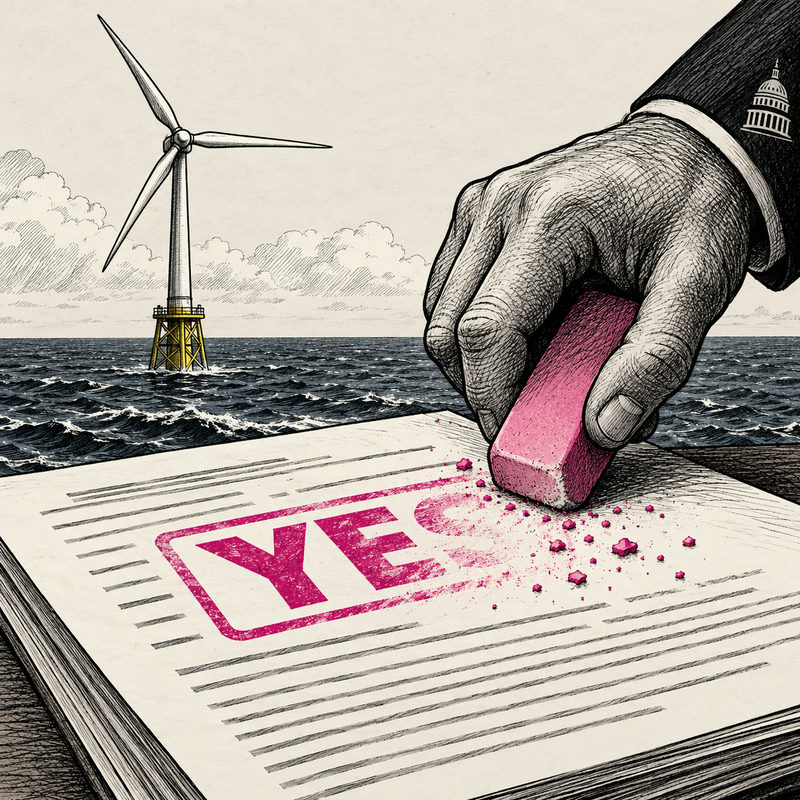
The difficult part of building a wind farm used to be getting the government to say yes. The Trump administration is working on a second difficulty: finding out whether yes has expired while you were building the wind farm.
According to the Associated Press, the Justice Department asked a judge Tuesday to send New England Wind’s 2024 construction-and-operations approval back to Interior for reconsideration. Construction has not started. The government says the approval overlooked major adverse impacts; a residents’ group has challenged its legality. This is a request to revisit a permit, not a court ruling that the turbines are unlawful.
Now put that request beside the bipartisan Senate agreement intended to speed energy and infrastructure permitting. The bill has not had a vote. Senator Sheldon Whitehouse says the administration risks blowing up the deal. An industry trying to shorten the wait for a decision is discovering a more demanding problem: making a decision stay decided.
Faster review saves time only if the approval at the end counts. Otherwise, Congress can reduce the length of the queue while Interior supplies repeat customers. Congratulations on reaching the front. We have improved the service by giving you another turn.
Make powerful people uncomfortable.
Subscribe to Democrawonk.
New England Wind is not the strongest demonstration of this mechanism. Interior also wants to revisit approval for Revolution Wind, where construction is finished. There is something exquisitely administrative about reconsidering permission to build a thing that is standing there. The project has supplied a physical answer. The department would prefer another round of paperwork.
Nor is the warning confined to environmentalists. The National Ocean Industries Association, which represents both oil and wind businesses, objects to the uncertainty of reopening approvals, particularly for projects being built or already operating. An association containing the fossil-fuel industry has reached the radical conclusion that a federal authorization ought to authorize something.
Interior says Tuesday’s filing followed a briefing schedule and announced no change in policy. Its opposition to offshore wind has been consistent. Fair enough: the uncertainty for developers is the consistent part. They can reliably expect an unreliable endpoint.
The administration has already tried to halt construction on five East Coast projects, only to be blocked by judges, and moved to buying back leases. Here, the switch is between telling a project to stop and asking whether it should ever have been allowed to start.
Congress could make the first answer arrive faster. Revolution Wind has already finished construction and is still waiting to learn whether the answer was yes.
Comments
Have something to say? Give this story a heckle.
Comment Rules
Argue the point. Add a joke. No threats, harassment, hate speech, spam, private personal information or unsupported accusations. First-time comments and comments with links are moderated. Full Comment Rules
Loading comments…
Questions or deletion requests? Contact Us. We retain comments and moderation records until removed. Only hashed email identifiers are stored for comment accounts.