
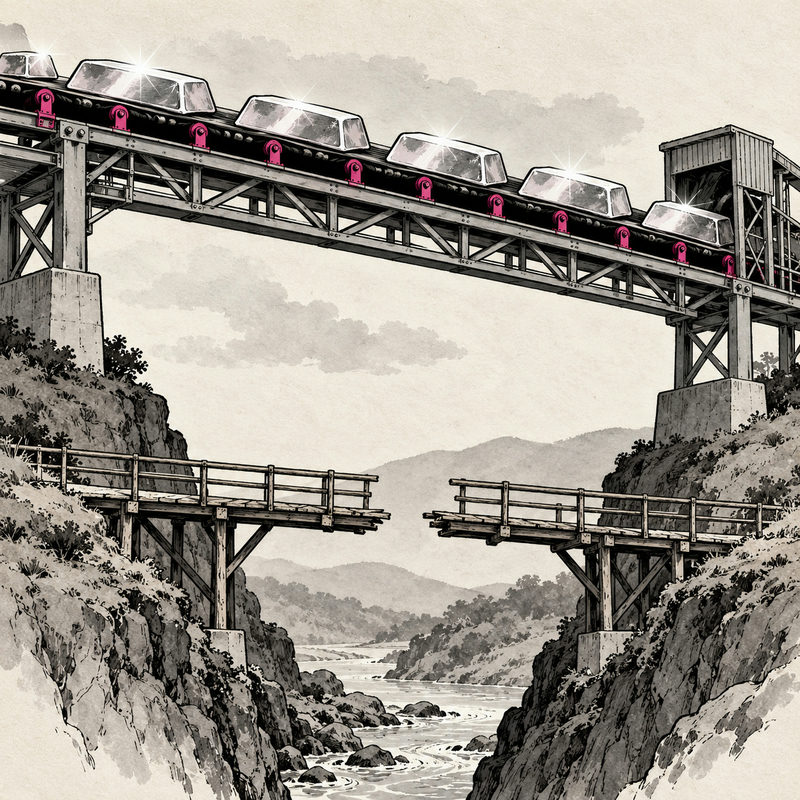
Zimbabwe’s mining economy can move valuable material out of the ground. Getting a classroom or a usable road into the communities above it appears to require a separate geological breakthrough.
New reporting by Enos Denhere for Al Jazeera follows residents across the country’s platinum belt who say public services have not kept pace with the wealth and population growth around major mines. This is not a story in which prosperity has yet to arrive. The trucks have found the address.
The country’s mining sector generated a reported $8.5 billion in export earnings in 2025, according to the then-president of the Chamber of Mines. That is the whole mining sector, not a figure for platinum alone, and export revenue is not the same thing as money available in a local council’s bank account. But it makes the infrastructure question rather more substantial than whether there is any economic activity to support it.
During a September visit, Al Jazeera saw pupils at Turf Primary School learning under trees as enrolment strained the available facilities. A local councillor described children in other communities travelling between 15 and 25 kilometres to secondary school. The countryside is doing an admirable amount of work as both classroom and school transport system. Neither job should have been assigned to it.
Residents also described trouble with the Ngwazani River. They allege sewage from the mining area has affected water they previously used for washing and gardens. Al Jazeera’s reporting records those allegations; it does not supply an independent finding assigning legal responsibility for the pollution. One resident described children missing school when the crossing floods and asked for a footbridge.
A footbridge is a refreshingly specific development strategy. Nobody has to invent a new economic acronym to explain what it would do.
Make powerful people uncomfortable.
Subscribe to Democrawonk.
The reporting does not support a claim that the companies contribute nothing. Ward 11 councillor Nhomboka Kurebwa Javangwe said Zimplats has built classrooms and houses, while demand continues to exceed the facilities. Unki told Al Jazeera it had averaged $1.5 million a year in community development over five years, built 63 boreholes, supported 32 schools and made substantial payments to local authorities.
Those contributions deserve to be counted. They also deserve to be assessed against what people can actually use. A corporate spending total and a child reaching school are different measurements. The second one is inconveniently unwilling to fit inside a presentation slide just because the first looks respectable.
Then there is access. Javangwe said local councillors could not raise residents’ concerns directly with Zimplats and that only the council chairperson was authorised to meet its officials. The people hearing about the missing services do not necessarily get into the room where the company can be asked about them.
Al Jazeera sought responses from Zimplats and council officials. Promised replies from the company’s corporate affairs head and the council chairperson did not arrive by publication; the council’s chief executive asked for written questions. Mimosa also did not respond despite repeated attempts. Silence does not establish wrongdoing. It leaves the residents’ practical questions unanswered.
That is where the accountability belongs: which institution is responsible, what has been paid, what has been built, and what will meet the demand that mining has helped bring to these communities? Calling every contribution worthless would obscure the answer. Calling every contribution sufficient would do the same thing in a nicer brochure.
The residents are not asking for the platinum itself to be laid across the river. An ordinary bridge would do. The extraordinary part is having to argue for one beside an industry so accomplished at getting things moving.
Comments
Have something to say? Give this story a heckle.
Comment Rules
Argue the point. Add a joke. No threats, harassment, hate speech, spam, private personal information or unsupported accusations. First-time comments and comments with links are moderated. Full Comment Rules
Loading comments…
Questions or deletion requests? Contact Us. We retain comments and moderation records until removed. Only hashed email identifiers are stored for comment accounts.