
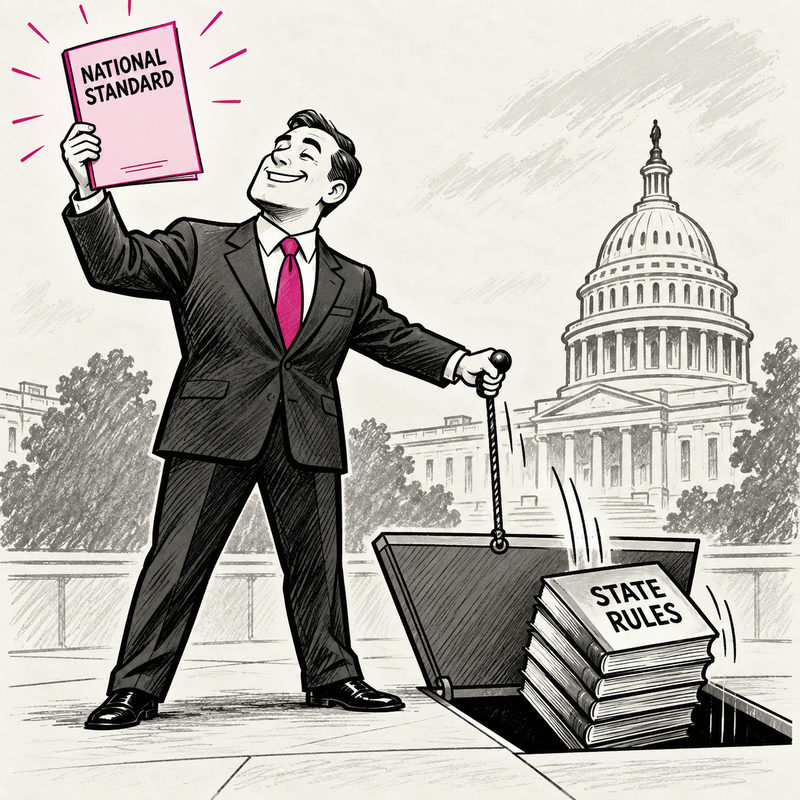
I can accept that supporting artificial intelligence and supporting regulation are compatible. Greg Brockman has said as much. The interesting question is what happens between supporting rules in principle and helping elect the people who will decide whether anyone can enforce them.
Reuters reports that Brockman and his wife, Anna, gave $25 million to Leading the Future, a political group opposing rules that unduly constrain or delay AI development. OpenAI says the donation was personal, not corporate. That distinction deserves to survive the joke: a company president can have private political preferences. His preferred legislators, however, would write laws for everyone’s company.
The group says it wants a responsible national regulatory framework. Fine. A single national standard could sound reassuring, especially beside the voluntary oversight already on offer. Then consider one candidate it backs: Kentucky Republican Andy Barr, who supports federal legislation blocking states from making or enforcing their own AI rules. An affiliated nonprofit has advertised for a national standard rather than state laws.
The promise now has two moving parts. Washington may build the better safeguard; states should lose the ability to build their own. I would be more relaxed if the demolition were waiting for the replacement’s inspection. A state could lose its power to act without a resident yet knowing what federal protection would take its place.
The Daily Heckler: five or six selected stories.
Political satire for your morning inbox.
Other backed candidates, Julia Letlow and Amanda McKinney, oppose heavy-handed AI rules on their campaign websites. There is always a promising lighter hand somewhere in the discussion. Whether it can stop a company doing something profitable is the detail we have not yet reached.
Brockman also signed Trump’s voluntary safety agreement for OpenAI, including commitments on independent audits and unintended access to technical systems. That is a real commitment, not evidence that the donation secretly buys a particular vote. But signing a promise and financing political preferences answer different questions. One tells us what the company says it will do. The other helps determine who might be empowered to insist.
The industry itself is divided: Reuters reports that Anthropic has put at least $40 million into a group opposing federal preemption. So even the people building the supposedly inevitable future have managed to discover several quite expensive alternatives.
I would still welcome a useful national standard. Before celebrating, I would like to read the part that imposes obligations, alongside the part that removes state authority. It would be unfortunate to emerge from this great effort with fifty fewer places to seek protection and one very thoughtful statement about why protection matters.
Comments
Have something to say? Give this story a heckle.
Comment Rules
Argue the point. Add a joke. No threats, harassment, hate speech, spam, private personal information or unsupported accusations. First-time comments and comments with links are moderated. Full Comment Rules
Loading comments…
Questions or deletion requests? Contact Us. We retain comments and moderation records until removed. Only hashed email identifiers are stored for comment accounts.