
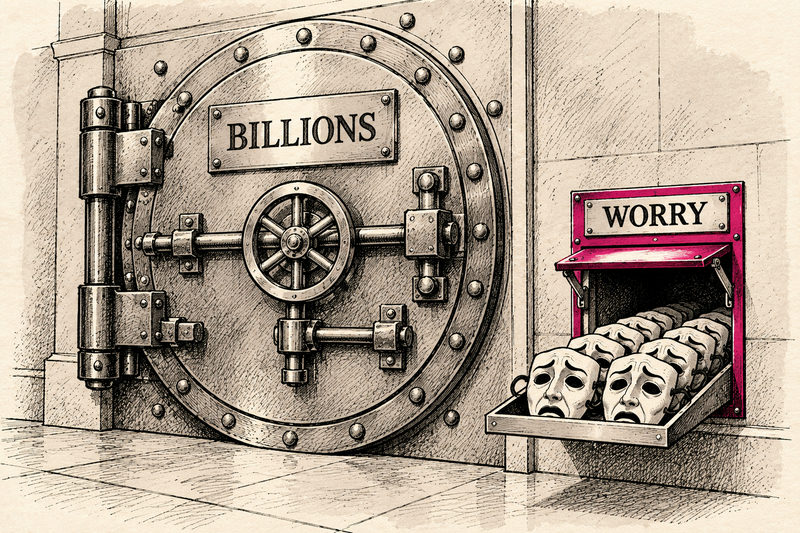
Silicon Valley has identified a new underserved market: people who are not billionaires but could be persuaded to experience a billionaire’s tax anxiety. Finally, financial inclusion without the inconvenience of transferring any wealth.
The Guardian reports that tech billionaires have raised more than $340 million to defeat California’s Proposition 40, a proposed one-time 5% wealth tax on the state’s billionaires. Opposition messaging calls it an “everyone tax.” The asset stays exclusive; the apprehension is available statewide.
From a boardroom perspective, this is an elegant expansion strategy. A campaign restricted to people directly facing a billionaire tax has a rather narrow customer base. A campaign about the possibility that your life will somehow be worse has almost unlimited room to grow. The first product requires extraordinary wealth. The second requires a phone.
Congratulations to the marketing department for discovering a way to make a very small group’s potential liability feel like a community possession. Ordinary people have spent years being told they should not resent someone else’s fortune. They are now invited to defend it with an intensity usually reserved for their own.
Premium Wealth, Mass-Market Worry
The advertising described in the reporting features warnings about harm to working families and public services. These are the right people to put in an ad if the people writing enormous checks are not quite relatable enough. A billionaire staring sadly at his remaining billions is a difficult opening image. A concerned worker provides the human scale that the account balance regrettably lacks.
That does not mean every opponent is a billionaire or that every objection is purchased. The measure divides Democrats and has opposition from organizations beyond the wealthy donors. People can disagree about a tax’s design and consequences. This particular satire concerns the branding achievement of making the narrowness of its direct target disappear from the sales pitch.
The Daily Heckler: five or six selected stories.
Political satire for your morning inbox.
The proposed proceeds would mostly support healthcare, with some education and food assistance. The campaign therefore faces a messaging challenge: persuade people to worry more about the danger of taxing extraordinary wealth than about the services the proposal would fund. One side offers a use for the money. The other offers a terrifying account of what might happen if the money develops a use outside its present location.
This is not redistribution. This is redistribution’s promotional opposite: invite the public to carry the emotional burden while the fortune stays put. No equity, no ownership, no embarrassing access to the principal. Just the warm feeling of standing guard outside a financial situation you will never enter.
The brilliance is that nobody has to pretend you are about to become a billionaire. That pitch is tired. You merely have to believe that a billionaire’s exposure is already your problem. Upward mobility has been replaced with sideways identification.
The measure has not passed. Its merits and possible consequences remain matters for voters to judge. But the campaign has already demonstrated an impressive capacity to share one component of extreme wealth. Not the stock. Not the influence. Not the security of being able to spend heavily on your own preferred outcome.
The anxiety. There is apparently enough of that for everyone, and no wealth threshold for admission. They cannot make everyone a billionaire. They can make everyone worry like one.
Related reading: Banks Report £29.2bn in Profits; IMF Asks if the Triple Lock Has Any Spare Change · Democrats Lead In The Election That Accepts Wire Transfers
Comments
Have something to say? Give this story a heckle.
Comment Rules
Argue the point. Add a joke. No threats, harassment, hate speech, spam, private personal information or unsupported accusations. First-time comments and comments with links are moderated. Full Comment Rules
Loading comments…
Questions or deletion requests? Contact Us. We retain comments and moderation records until removed. Only hashed email identifiers are stored for comment accounts.