
Brazil is voting today, and Flávio Bolsonaro has an interesting offer: a tougher approach to crime, alongside a promise to free his father.
Reuters reports that the presidential runoff pits Bolsonaro against Lula da Silva. Jair Bolsonaro was convicted in 2025 of plotting a coup. His son has pledged to free him if elected while also campaigning on a severe approach to other crimes. The election remains undecided.
This is a remarkably efficient way to explain the difference between a principle and a family plan.
Usually, when a product has exceptions, you have to read the small print. Here the exception appears in the family photograph. The stern commitment to consequences comes with a softer setting for someone who helped pay for your childhood.
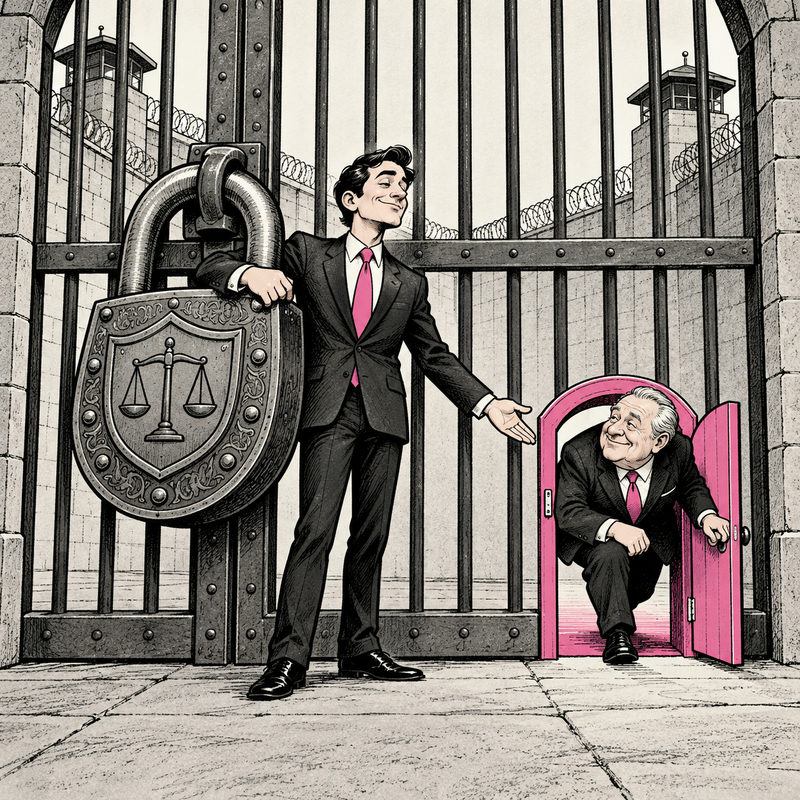
Imagine ordering an enormous iron gate for the nation, then asking the contractor to install a discreet side entrance labeled Dad. You still get the campaign photograph in front of the bars. You just retain a sensible arrangement for Christmas.
The actual side entrance is my invention. The tension in the platform is not.
Make powerful people uncomfortable.
Subscribe to Democrawonk.
Crime and personal safety deserve serious policy. So does the question of what elected power is for. If the answer includes rescuing a relative from the consequences of a conviction, voters are entitled to notice the helpful overlap between public ambition and private convenience.
That criticism does not require pretending Lula has no record to defend or that everyone voting against him shares a single motive. It requires applying the advertised standard to the advertiser.
A person promising to be merciless toward wrongdoing should at least explain why mercy becomes urgent when the defendant has his surname.
There is nothing confusing about loving your father. The confusion starts when the entire country is invited to elect a government so that love can acquire executive powers.
Law and order should be able to survive a family dinner. If it cannot, put that on the poster before asking everyone else to live under it.
Source: Reuters, October 25. The gate and family entrance are satirical metaphors, not an actual building or event.
Comments
Have something to say? Give this story a heckle.
Comment Rules
Argue the point. Add a joke. No threats, harassment, hate speech, spam, private personal information or unsupported accusations. First-time comments and comments with links are moderated. Full Comment Rules
Loading comments…
Questions or deletion requests? Contact Us. We retain comments and moderation records until removed. Only hashed email identifiers are stored for comment accounts.