
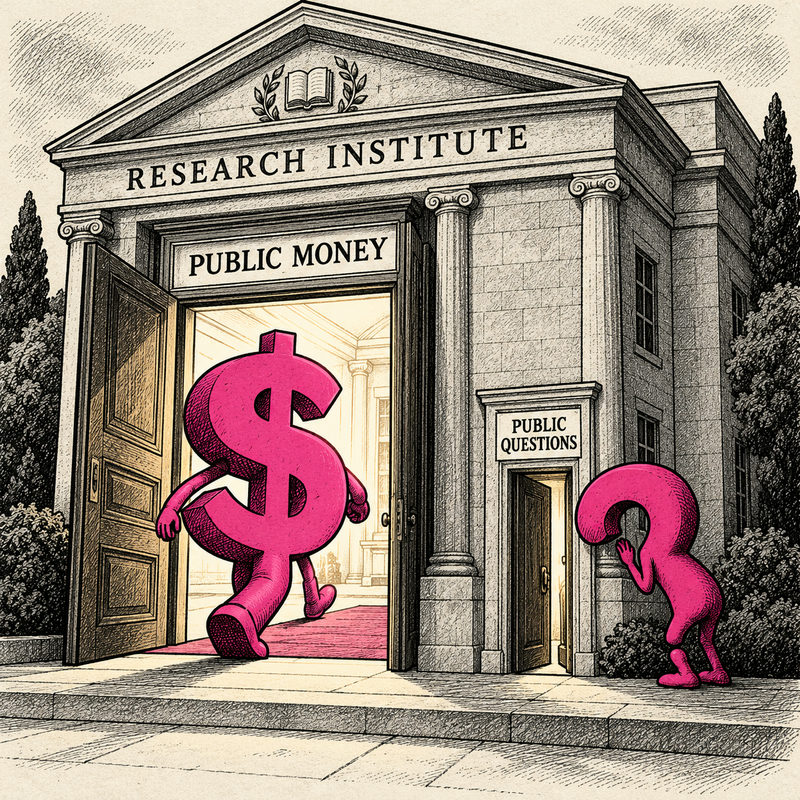
California’s proposed research investment has identified a delicate compatibility problem. Billions in public money can enter a private institute. Public-records rules, on the other hand, may not fit comfortably. The money appears to have much better manners than the people supplying it.
CalMatters reports that Proposition 38 would direct half an $8.4 billion research bond toward a single institute meeting highly specific criteria. Only the California Institute for Immunology and Immunotherapy currently qualifies. Its principal funder, Gary K. Michelson, wrote the measure. The selection is formally unnamed, in the refined sense that a place setting can omit your name while remaining shaped exactly like your elbows.
The institute reported three employees last month, well below an earlier hiring plan. That head count raises a readiness question; it does not describe how the money would be delivered. Research is already underway in interim UCLA space. The campaign says readiness is required, state officials decide and funding would arrive in approved increments. The interesting question is what the public can inspect as the institution grows into the promised scale.
The measure exempts the recipient from state public-records and public-meeting requirements. Its defenders say those rules do not suit the operation of private organizations, while pointing to annual reports, state audits and other required disclosures. There will be oversight. It will arrive through selected entrances.
Make powerful people uncomfortable.
Subscribe to Democrawonk.
One can appreciate the architectural care. California supplies the enormous new wing, but must respect the original building’s preference about where visitors may walk. A report will be brought out. An audit will take place. The broader request to see the underlying business is asked to recognize that this remains a private establishment.
Those forms of accountability are useful, and different. An annual report tells the public what the organization is required to report. A public-records request lets the public ask a question that did not make the organization’s list. The latter can be awkward. That is among its qualifications.
The case for supporting medical research is strong enough to survive questions about a particular financing arrangement. Indeed, treating every governance question as an interruption to the search for cures would give the arrangement a remarkable privilege: its public purpose would become its protection from public examination.
We recently examined public hospital funding with conditions attached to the states receiving it. California’s proposal illustrates how carefully the conditions can instead be tailored around the recipient. The public is sophisticated enough to borrow billions for science. It should be able to handle a little more information about where the money is going.
Comments
Have something to say? Give this story a heckle.
Comment Rules
Argue the point. Add a joke. No threats, harassment, hate speech, spam, private personal information or unsupported accusations. First-time comments and comments with links are moderated. Full Comment Rules
Loading comments…
Questions or deletion requests? Contact Us. We retain comments and moderation records until removed. Only hashed email identifiers are stored for comment accounts.