
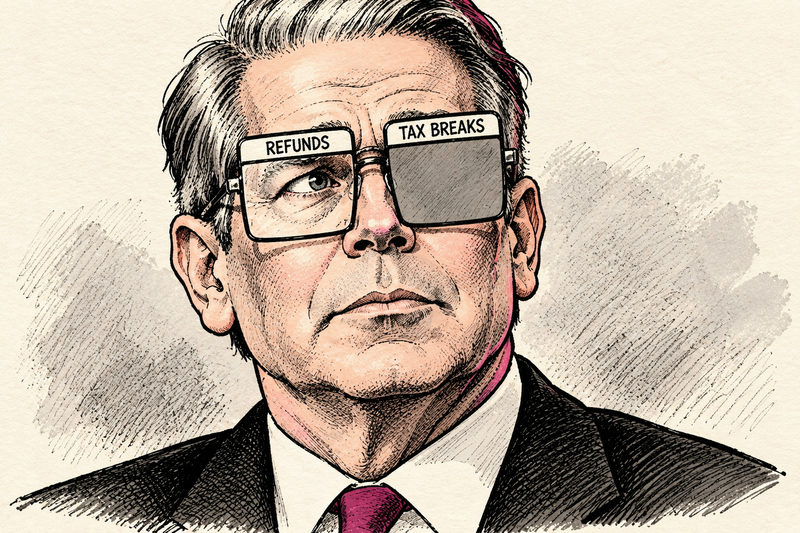
The federal deficit reached $1.992 trillion in fiscal 2026, up 12% from the previous year, Yahoo Finance’s Ben Werschkul reports. Treasury Secretary Scott Bessent has focused on court-ordered tariff refunds. An excellent place to locate fiscal responsibility: at the moment the government has to give money back, rather than the moment it decides how to collect it.
The refunds are a real contributor, not an invented excuse. Yahoo reports $144.6 billion returned against $317.8 billion in gross tariff receipts. Nearly half the much-promoted revenue came with a return journey. The administration’s tariff triumph is considerably smaller when measured after the money leaves again, a cruel accounting technique known as finishing the calculation.
In February, before the refund orders, the Congressional Budget Office projected a $1.85 trillion deficit. The final figure was roughly $140 billion higher. Bessent is not pointing at an irrelevant number. He is pointing at a relevant number with the concentration of a man who would prefer that nobody look to either side of it.
The Revenue That Received A Deduction
There is another substantial development in the reporting: corporate income-tax collections fell 16%. The CBO attributes that decline to larger deductions under Trump’s One Big Beautiful Bill, which offset the revenue increases otherwise expected from rising corporate income.
Corporate income rose. Corporate income-tax receipts fell. Whatever else that is, it is a wonderfully concise demonstration that prosperity and public revenue are not the same thing when Congress has carefully modified the connection between them.
Businesses did not need to become less successful to contribute less. They needed the law to become more accommodating. The economy can grow, the companies can earn more, and Washington can still find itself collecting less from them. For the beneficiaries, this is fiscal discipline with the discipline removed.
That does not make corporate deductions the sole cause of the deficit either. Spending increased, refunds reduced net tariff revenue, and the budget has more than one moving part. But a defense centered on the refunds is conspicuously convenient for a government whose tax legislation helped produce the corporate-revenue decline. One consequence is being explained. Another has beneficiaries.
Under Control, In The Broadest Possible Sense
The final Treasury statement puts annual revenue at about $5.4 trillion and spending at about $7.4 trillion. Members of Trump’s team have downplayed the deficit as a blip and maintained that the fiscal situation is coming under control, Yahoo reports. A nearly $2 trillion annual shortfall is doing strenuous work for the word “blip.”
Deficits are not automatically proof that every public expenditure is wasteful. The question is which choices the administration defends, which costs it emphasizes and which successful corporations it has decided should yield less tax revenue. Calling everything a spending problem would conveniently erase the part where lawmakers voted to collect less.
Tariff refunds deserve scrutiny. So do tax deductions. An administration cannot ask for applause when it promises a revenue windfall and then treat the final budget as an unfortunate event that happened to it.
Bessent has identified the cost of giving money back. Now try the cost of choosing not to collect it.
Comments
Have something to say? Give this story a heckle.
Comment Rules
Argue the point. Add a joke. No threats, harassment, hate speech, spam, private personal information or unsupported accusations. First-time comments and comments with links are moderated. Full Comment Rules
Loading comments…
Questions or deletion requests? Contact Us. We retain comments and moderation records until removed. Only hashed email identifiers are stored for comment accounts.