
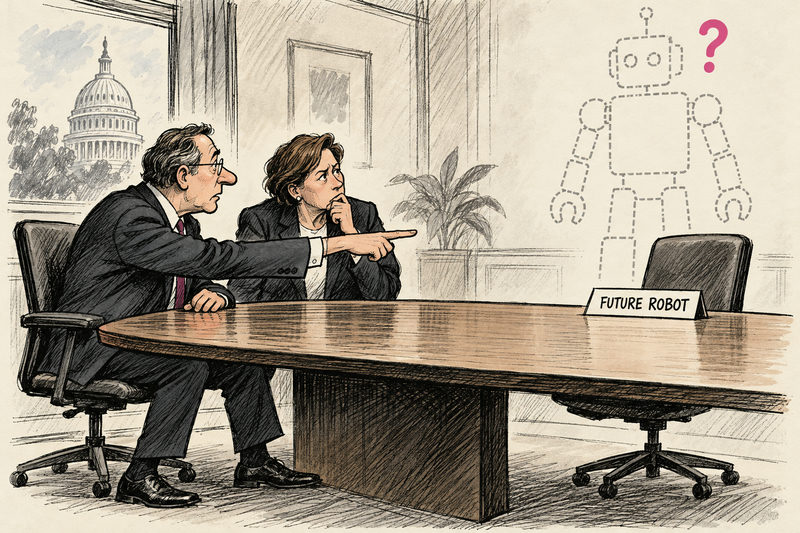
Elon Musk has discovered the perfect successor to a government-efficiency project: someone who cannot attend the handover meeting because its relevant capabilities are still being promised.
Axios reports that Musk told Walter Isaacson that DOGE showed the deficit could not be solved from within government, and that AI and robots were the only way to solve the national debt. The interview is for a podcast series premiering Tuesday. Musk also said he stayed away from his companies too long and should have returned to AI sooner.
This is a splendid division of labor. The human receives credit for recognizing the scale of the challenge. The hypothetical machine receives the challenge. If it objects, that will be an exciting breakthrough in conversational reasoning.
In our imaginary technical meeting, someone asks which robot is responsible. The answer is the capable future robot, not the present one that would require specifications. Specifications are what people demand when they are trying to ruin a vision with a date.
Another attendee asks what the system will actually do. Produce more? Change public spending? Settle the political choices over who receives what? The chair points to a diagram containing a robot, an arrow and the word solved. Nobody has ever accused an arrow of insufficient ambition.
Musk’s account places the obstacle in the willingness of political institutions to cut spending. That is rather different from discovering that a computer lacks enough processing power. It is like arriving at a dinner argument, establishing that the relatives disagree, and announcing that the solution is a more advanced toaster.
Perhaps more capable AI and automation will increase output. Perhaps they will change the economic possibilities dramatically. Neither possibility supplies the missing answer to who makes public choices, or who gets the benefits. A machine can make a bigger pie without developing an opinion about why the man holding the knife already has three plates.
Our fictional meeting briefly considers giving the robots authority to make the political decisions themselves. This is rejected as premature. First they must demonstrate the crucial human skill of accepting responsibility without receiving authority. The room agrees that this is a demanding benchmark.
There is also a hardware question. Does the robot require arms to solve the debt, or will a sufficiently confident slide presentation do? Arms would let it point at the government when the deadline arrives. That feature should probably ship first.
The absent machine has considerable advantages over an actual public official. It has made no compromises, cast no votes and issued no disappointing results. Its entire record consists of the improvements expected after it arrives. Promoting it now would be unfair to humans, who insist on accumulating evidence against themselves.
At the end of our imaginary meeting, everyone agrees the assignment has been successfully transferred. This is marked as progress. The robot has not confirmed receipt, but that is interpreted as focus.
The first machine to achieve human-level intelligence will immediately ask why this is its problem.
The Comment Section Has Entered The Chat.
Argue the point. Add a joke. No threats, harassment, hate speech, spam, private personal information or unsupported accusations. First-time comments and comments with links are moderated. Comment Rules
Loading comments…
Questions or deletion requests? Contact Us. We retain comments and moderation records until removed. Only hashed email identifiers are stored for comment accounts.