
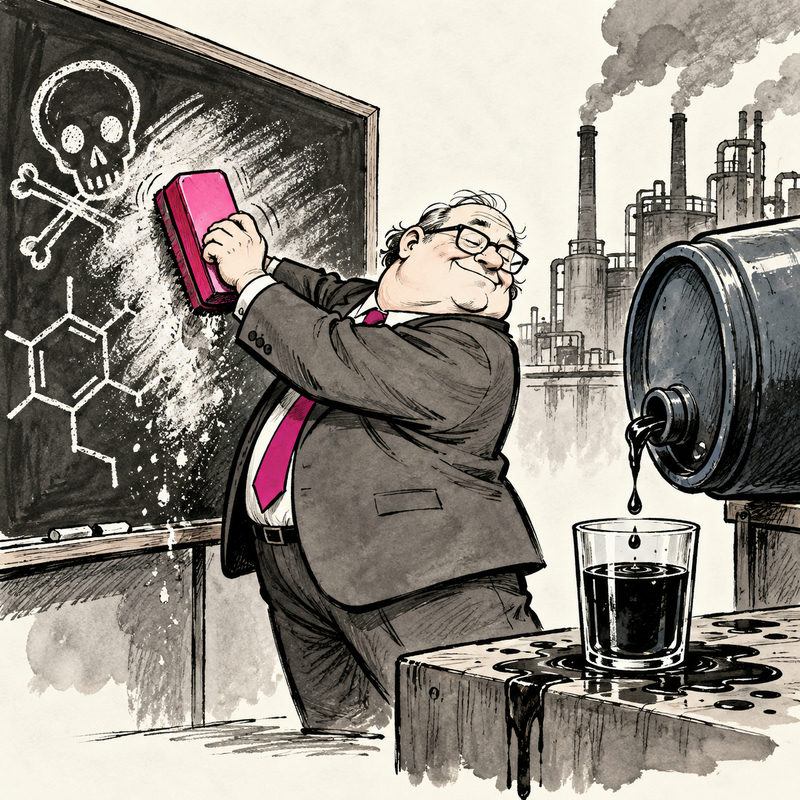
The Environmental Protection Agency has discovered a pollution problem it can solve with a keyboard. Its website suggested two notorious chemicals had been phased out. The chemicals disagreed. After a complaint, the wording changed. Congratulations to everyone involved in this major advance in sentence treatment.
The Guardian reports that EPA revised claims about PFOA and PFOS after Public Employees for Environmental Responsibility challenged them. The agency now acknowledges continuing production and uses. The earlier phase-out agreement involved eight producers; it was not a comprehensive ban. That distinction is rather important if you are a person, as opposed to a paragraph hoping to survive legal review.
A phase-out with exceptions is not the same thing as gone. If I announce that I have phased out leaving dirty dishes in the sink, while reserving ongoing uses for bowls, cups and whichever fork I like, my spouse has not received a cleaner kitchen. She has received an environmental impact statement written by an asshole.
The reporting centers on Inhance, which makes barriers for plastic containers. The company disputes measurable leaching, calls PFOA an impurity and says it reduced those impurities by 90%. It also points to risk assessments it says support safety. EPA has described the process as manufacturing PFAS; an earlier stop order was overturned in court. Those qualifications matter. This is not a story in which one scary noun automatically settles every legal or scientific question.
It is, however, a story in which the government's comforting public shorthand outran reality. You should not need to investigate the jurisdictional life story of a container barrier to understand whether “phased out” means phased out. A label that requires a seminar to avoid misleading people has failed at the one job a label has.
The corporate word impurity is doing some impressive emotional labor too. It sounds like a little manufacturing dandruff. Calling a substance incidental does not answer how much is present, where it goes or what exposure means. A problem does not become reassuring because nobody ordered it separately. Our smart-television security fiasco featured a different version of the same burden shift: the customer is expected to absorb complexities the seller would prefer not to headline.
Correcting the website is necessary. Pretending the correction completes the work would be absurd. Public agencies owe people accurate information and credible protection, not a succession of increasingly lawyered ways to say the brochure was optimistic.
The Trump administration's regulators should not need a citizen group to explain that reassuring the public requires first checking the thing you are reassuring them about. That is not an advanced module. That is the orientation video.
Now that EPA has located the delete key, perhaps somebody can show it the rest of the controls.
Comments
Have something to say? Give this story a heckle.
Comment Rules
Argue the point. Add a joke. No threats, harassment, hate speech, spam, private personal information or unsupported accusations. First-time comments and comments with links are moderated. Full Comment Rules
Loading comments…
Questions or deletion requests? Contact Us. We retain comments and moderation records until removed. Only hashed email identifiers are stored for comment accounts.