
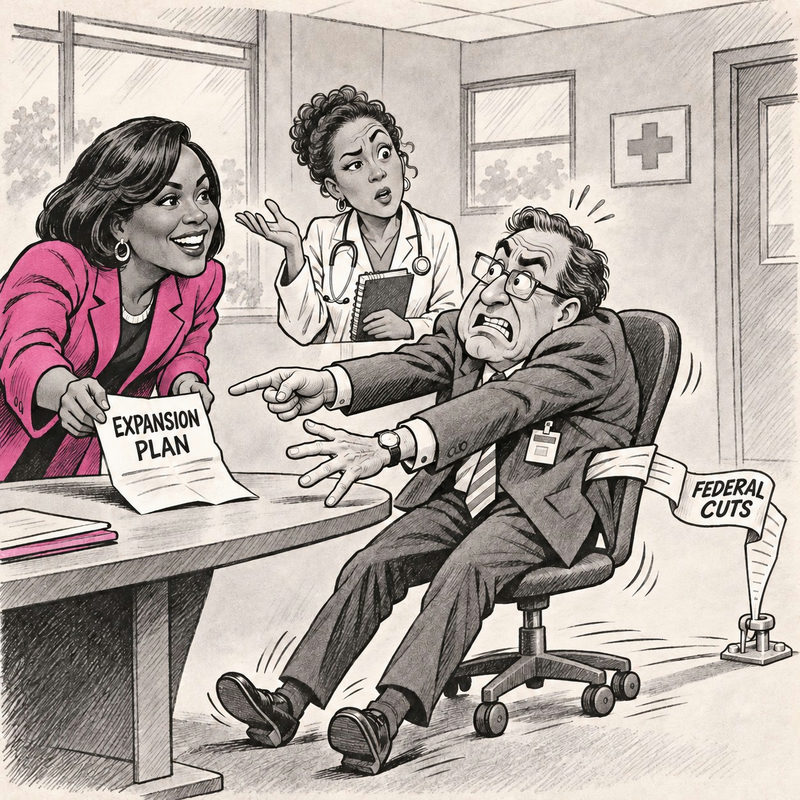
Georgia's election has given Medicaid expansion a fresh chance. Governor-elect Keisha Lance Bottoms and an incoming Democratic state House favor wider coverage. Hospitals, meanwhile, are examining a federal funding structure that can make insuring more people an occasion to reach for the antacid.
Republicans still hold the state Senate. Nothing has passed. But the Georgia Recorder reports new momentum—and a complication beyond the familiar argument about whether low-income people should have insurance.
The federal government pays ninety percent of expansion costs. That's a powerful incentive. More insured patients can also mean less uncompensated care. So far, a hospital administrator might reasonably allow one shoulder to relax.
Then come the new federal cuts. One hospital funding stream will shrink in all states, slightly more in expansion states. Some people now insured through the ACA exchange could switch to Medicaid, which pays hospitals less for their treatment. Hospital advocates estimate perhaps 500,000 such potential switchers in Georgia; these are insured people changing coverage, not half a million people suddenly losing it.
The Daily Heckler: five or six selected stories.
Political satire for your morning inbox.
Patients could benefit from that change while a hospital's finances worsen. The effects vary by hospital. The Georgia Hospital Association hasn't endorsed or opposed expansion and is seeking ways through the competing gains and losses.
We have designed a healthcare financing argument in which covering the patient and sustaining the hospital can end up on opposite sides of the calculator.
Who needed this additional level? Was getting sick insufficiently administratively rich?
Enrollment creates another problem. A CBPP study using 2024 data estimated that 347,000 uninsured Georgians might qualify under full expansion, before work requirements and application barriers. Eligibility is not the same as actually obtaining coverage. Our earlier work rules coverage examined how proving an exemption can become its own obstacle.
Georgia needs investment in enrollment systems as well as a legislative agreement. Changing federal reporting requirements would require federal action. Neither problem disappears because the election offered a better political opening.
There is real hope here. Use it. Negotiate coverage and viable hospital financing together.
The patient should not have to choose between an insurance card and a hospital able to accept it.
Comments
Have something to say? Give this story a heckle.
Comment Rules
Argue the point. Add a joke. No threats, harassment, hate speech, spam, private personal information or unsupported accusations. First-time comments and comments with links are moderated. Full Comment Rules
Loading comments…
Questions or deletion requests? Contact Us. We retain comments and moderation records until removed. Only hashed email identifiers are stored for comment accounts.