
 By
By Your prospective Democratic majority comes with comprehensive agreement that healthcare costs too much. Coverage for doing the same thing about it varies by member.
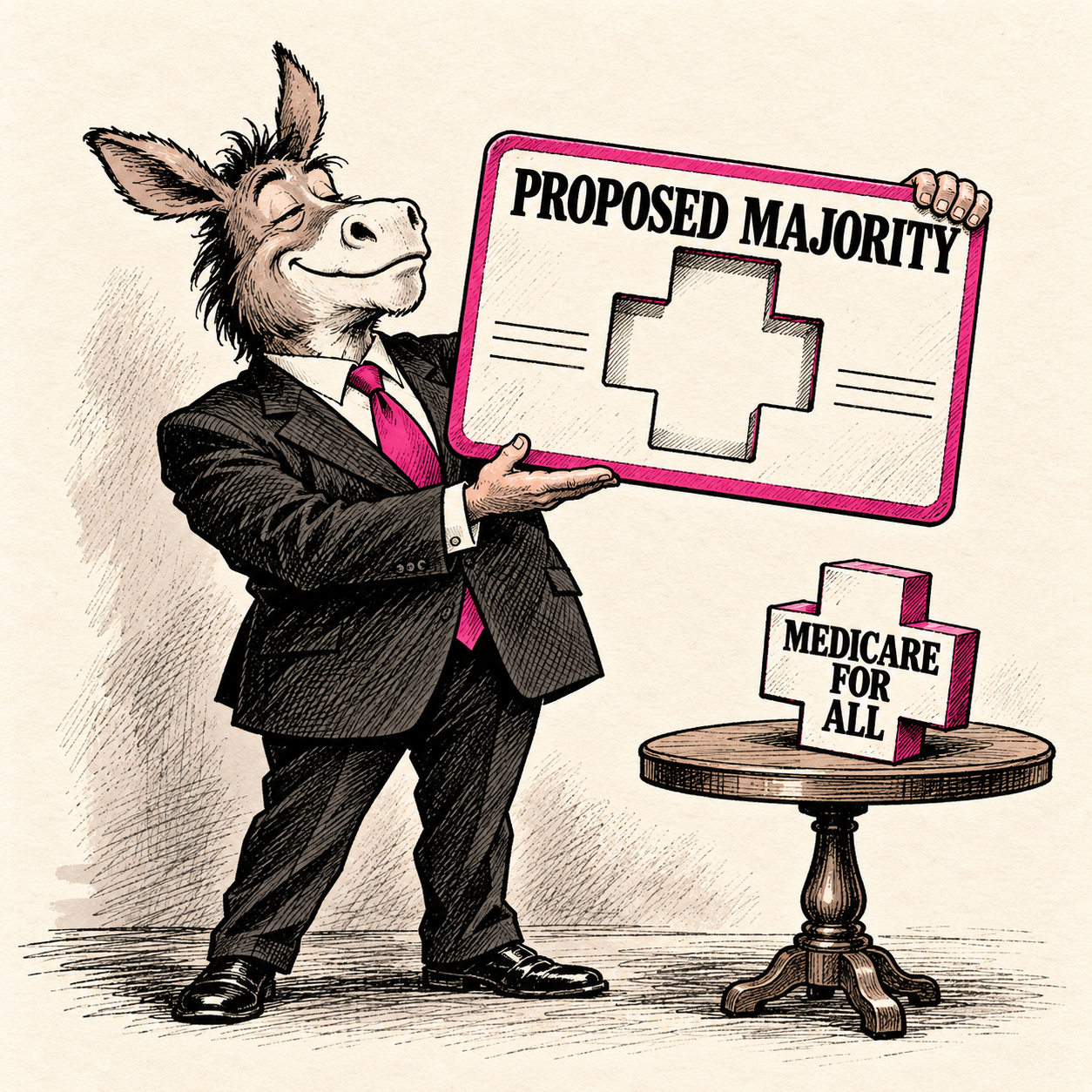
This is not an actual party document. It is the satirical benefits summary the campaign brochure keeps declining to include. Like an insurance card, a congressional majority can look reassuring until you turn it over and discover how many participating providers do not perform the procedure you wanted.
Axios’s October 16 analysis says many moderate Democrats who could help win Congress do not favor Medicare for All. Candidates Abdul El-Sayed and Troy Jackson support it. The election has not happened; the coalition is prospective. But its exclusions are already impressively legible for an American healthcare product.
What Your Majority Covers
A blue logo. A shared objection to expensive care. A strong conviction that somebody should do something. Selected members also cover an entirely different something.
The Guardian’s October 4 reporting documented the progressive-centrist split over Medicare for All. That is background reporting, not a new poll. The current question is what the party’s possible incoming membership would actually support, rather than how many people can applaud the phrase affordable healthcare without spraining a wrist.
The problem with a coalition is that it contains the people who won, not the people who would make your preferred proposal easiest to pass. This design flaw has been referred to the electorate, which insists that it is the design.
Winning a difficult seat can help a party take a chamber while making its internal policy agreement more complicated. In our imaginary benefits summary, this is classified as a successful enrollment with a nonparticipating senator.
That is not an argument against winning. Losing does not produce Medicare for All either; it merely saves everyone the trouble of arguing over the committee calendar. It is an argument against selling the party label as if it were prior authorization for every policy advocated under it.
Exclusions And Limitations
Universal coverage is a goal. Single payer describes a way to organize coverage. Agreement on the first does not automatically authorize the second. The similarity of the applause is not a reliable diagnostic test.
Nor does winning Congress transfer the presidency. This particular package does not include the White House, even if the photograph on the campaign leaflet makes the buildings look conveniently close together. There is no family plan that lets a House victory add the Senate and president as dependents.
Existing-program reforms are not automatically worthless because they are less sweeping. A single-payer proposal is not automatically a finished legislative coalition because its advocates have correctly identified the existing system’s failures. Neither side can submit sincerity in place of the missing votes, although sincerity remains fully reimbursable on cable news.
The difficulty is not that Democrats have views. They should have views, and fight for them. Agreement that the patient needs help still leaves the doctors arguing over the operation. The group photograph is extremely confident. The treatment plan is not in frame.
So inspect the coalition, not just the logo. The membership directory matters precisely because the stakes are real. And keep the card: you may need it to explain the difference between getting a majority and getting the policy.
Your card says Democratic Majority. The back says not valid for this procedure.