
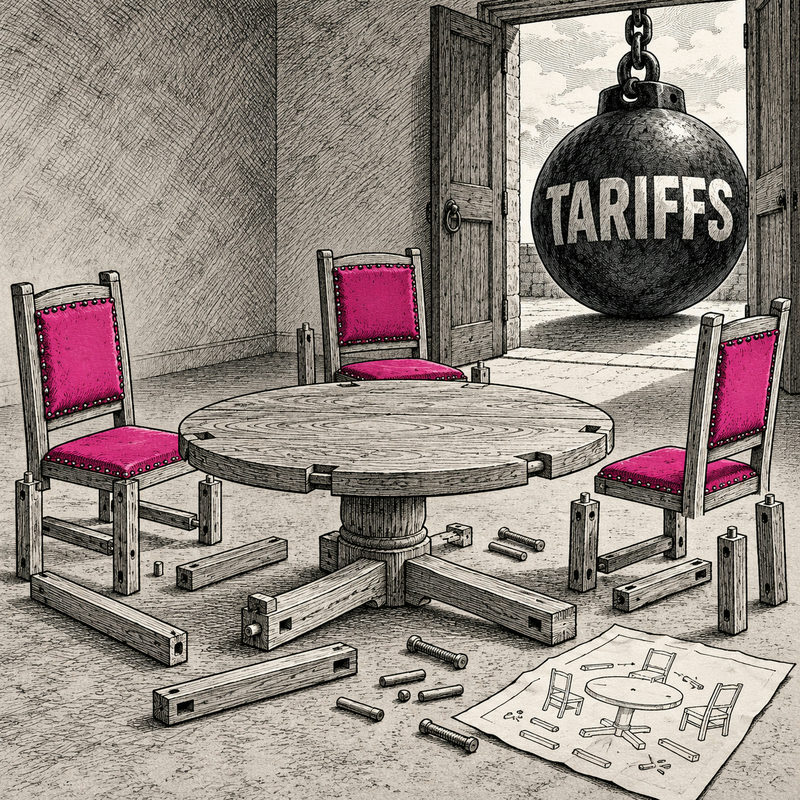
Germany’s chancellor is asking Japan to help organise a trade alliance against economic coercion. The sales pitch is essentially that countries should be able to conduct business without checking whether a larger power woke up in a tariff mood.
Reuters reports that Friedrich Merz used Wednesday’s visit to Tokyo to urge cooperation among like-minded partners defending rules-based trade. Germany and Japan issued a joint statement committing to stronger cooperation with such partners. That is a diplomatic step, not the inauguration of a completed global alliance with a membership card and a functioning complaints department.
The distinction is worth keeping. International politics already contains enough impressive organisations that exist primarily in the future tense.
Merz proposed coordinating responses when trade rules are violated or economic pressure is used against a country. He did not name particular states in that passage. The context is less mysterious: Trump’s tariffs have disrupted the global trading order, while Germany also faces intense competition from China and concerns about dependence on Chinese supplies.
Beijing rejects accusations of unfair trade practices. Responding to Merz’s proposal, it urged Germany and the European Union to be objective and rational and said it wanted stable trade and supply chains. It has also argued that China is a partner in solving Europe’s problems rather than their root cause.
All of those positions have to coexist with the basic fact that Germany trades extensively with China. This is not an invitation to pretend complicated economic relationships can be switched off like an irritating group chat. It is an effort to become less vulnerable inside them.
The Daily Heckler
The best of Democrawonk.
No algorithm required.
That is why the critical-minerals discussion matters more than the diplomatic catering metaphor. Merz invoked Mark Carney’s argument about middle powers choosing whether they are at the table or on the menu, then suggested that acting together could make them owners of the restaurant. The next useful question is who supplies the kitchen.
Japan has spent more than a decade diversifying imports, building reserves and developing recycling after a rare-earths dispute with China in 2010 exposed weaknesses in its supply chains. Those are concrete policies that can reduce the leverage attached to a threatened cutoff. A country cannot manufacture resilience by adding the word strategic to a purchasing spreadsheet.
Merz also pointed toward closer ties between the EU and members of the trans-Pacific CPTPP agreement. Japan’s prime minister welcomed German engagement and discussed deeper military and defence-industry cooperation. These are proposals and commitments to explore cooperation, not evidence that every negotiation has been completed.
The political consequence is nevertheless real. When major powers use access to markets or resources as a recurring threat, other countries have an incentive to build options. Those options may be slow, expensive and imperfect. They can still be preferable to having national policy depend on somebody else’s next ultimatum.
Trump’s tariffs are meant to exercise American leverage. One possible response is that the countries receiving them begin organising ways to need that leverage less. A successful threat can win a concession today while helping finance its own replacement tomorrow.
Merz has offered an invitation, not a finished alternative. The work now is to build the supplies, agreements and institutions that would make saying no economically possible. Otherwise the new restaurant is just another place where the largest customer writes the menu.
Comments
Have something to say? Give this story a heckle.
Comment Rules
Argue the point. Add a joke. No threats, harassment, hate speech, spam, private personal information or unsupported accusations. First-time comments and comments with links are moderated. Full Comment Rules
Loading comments…
Questions or deletion requests? Contact Us. We retain comments and moderation records until removed. Only hashed email identifiers are stored for comment accounts.