
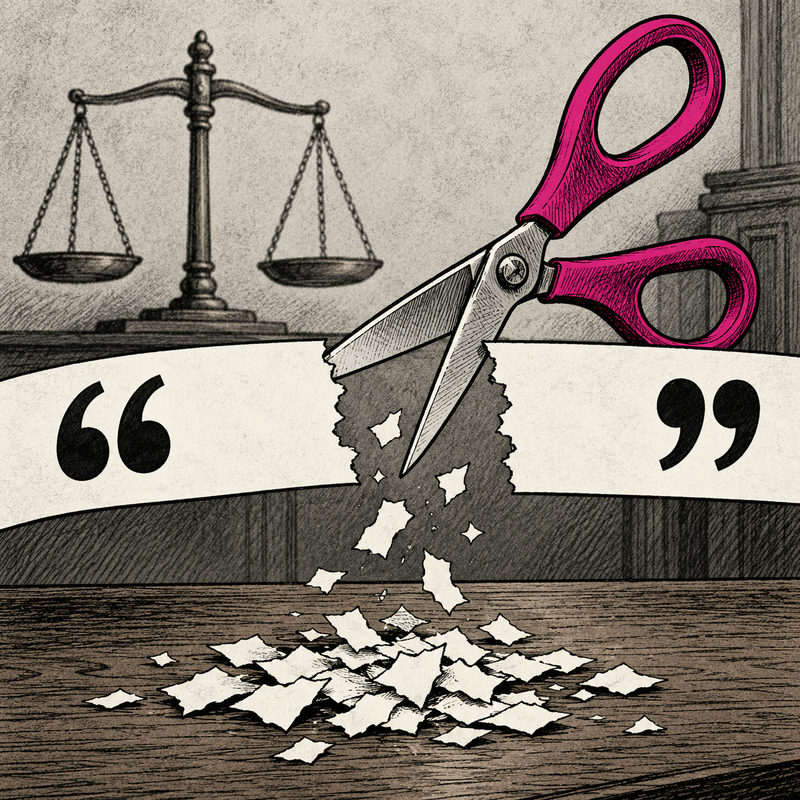
A political clip can lose its context in forty-two seconds and acquire a much longer life in court. Hasan Piker is asking a judge to examine how that transformation happened, with a $72.5 million damages demand attached.
The Guardian reports that the socialist streamer sued conservative commentator Scott Jennings on Tuesday in federal court in Washington. Piker alleges that Jennings used an edited video and added commentary to falsely portray him as advocating racist violence. Jennings had not publicly commented on the lawsuit, and the Guardian sought his response.
The central dispute is about attribution. According to the complaint, Piker was sarcastically mocking another commentator’s position during a 2024 broadcast. The filing alleges that a shortened and rearranged clip removed language indicating whose position he was describing and made the words appear to express his own beliefs.
The difference between describing an opinion and endorsing it can be two words. Removing those words is a small edit with a very large job description.
The lawsuit also alleges that Jennings supplied a caption presented as a direct quotation that did not appear in either the original broadcast or the edited video. That remains an allegation to be tested. The reporting gives us the plaintiff’s account of the clip and its use, not a judicial determination that every disputed edit or statement is defamatory.
The Daily Heckler
The best of Democrawonk.
No algorithm required.
Piker is seeking $27.5 million in compensatory damages and $45 million in punitive damages, and wants a jury trial. A requested amount is not money awarded. The lawsuit cannot be scored like a fundraising thermometer where the largest displayed number wins the argument.
What makes the case politically significant is the route from edited material to a confident claim about an opponent. The filing describes the disputed presentation appearing on a podcast and social media, where Jennings connected Piker to a Democratic Senate candidate. A disagreement about one person’s words becomes a claim about what a broader political movement supposedly wants.
That is a familiar distribution model: compress the evidence, expand the conclusion, then invite the audience to regard the result as self-explanatory. The shorter the clip, the less room there is for the inconvenient business of finding out who was talking about whom.
Sarcasm does not automatically settle every dispute in the speaker’s favour. People can disagree about what a remark communicates. But context is the material needed to have that disagreement honestly. You cannot resolve a question about attribution by treating the disputed removal of attribution as irrelevant.
The court will have to consider the actual claims and evidence. Readers can apply a simpler standard in the meantime: a caption is not a transcript, and an edited clip should not be asked to authenticate the words added above it.
Political commentary allows plenty of room for hostility. Quotation marks have a narrower assignment.
Comments
Have something to say? Give this story a heckle.
Comment Rules
Argue the point. Add a joke. No threats, harassment, hate speech, spam, private personal information or unsupported accusations. First-time comments and comments with links are moderated. Full Comment Rules
Loading comments…
Questions or deletion requests? Contact Us. We retain comments and moderation records until removed. Only hashed email identifiers are stored for comment accounts.