
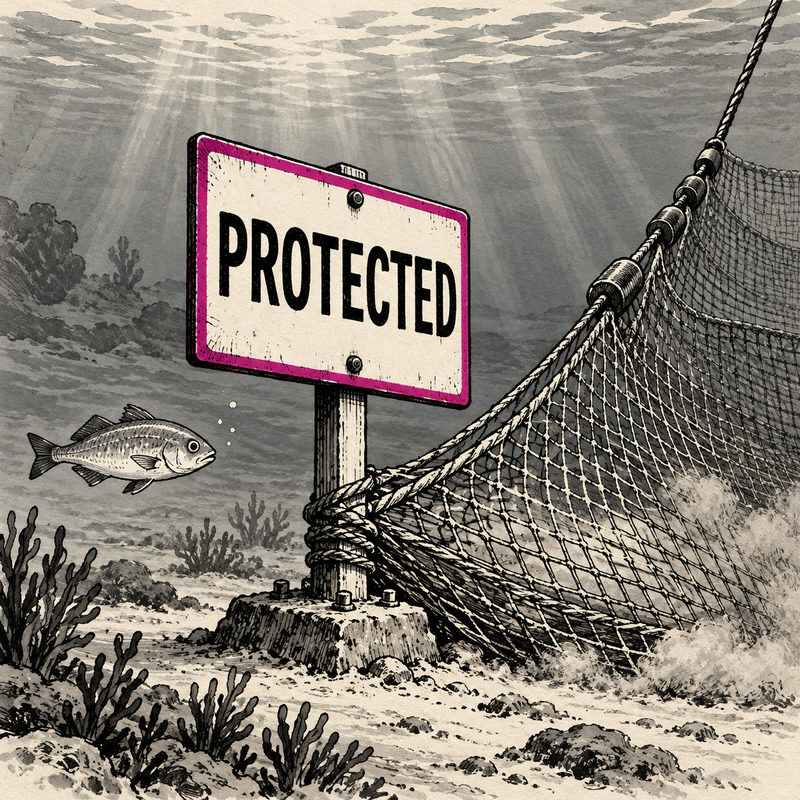
I keep getting stuck on the phrase marine protected area. It sounds wonderfully unambiguous until a government explains why banning bottom trawling there would be going too far. Then the protection turns out to have excellent manners and no intention of interrupting anything.
The Guardian reports that Britain rejected an outright bottom-trawling ban in these areas. As countries gather for the Cop17 biodiversity summit, the UK is on course to meet only three of 23 international nature targets. The government points to £7 billion for nature recovery and climate resilience, plus new pollution powers.
Good. I want those investments to work. I also want the word protected to develop a slightly more difficult personality.
If a habitat receives protection only while nobody particularly wants to damage it, what have we achieved? We have identified the least demanding circumstances in which to care about nature. Congratulations: the endangered species is safe whenever it is convenient.
There is a political habit here that deserves less respect than it gets. Announce the destination with tremendous conviction. Negotiate away the means with tremendous sensitivity. When the deadline arrives, express tremendous concern. The only thing growing reliably is the adjective budget.
A target is not a habitat. Nothing can live in it.
Nor is a national reputation for loving wildlife the same thing as keeping wildlife alive. I enjoy a nature documentary as much as anyone. The documentary becomes considerably less impressive as a conservation strategy if future episodes must be filmed entirely in the past tense.
The reporting includes real progress, including newly recognized Indigenous territories and new marine parks. This is not an argument that agreements accomplish nothing. It is an argument that the achievements deserve to survive contact with the next industry objection. Otherwise every success comes with a little trapdoor underneath it.
We have already considered the gap between clean-water promises and what happens downstream. Conservation has the same inconvenient requirement: the physical world has to improve. A fish cannot benefit from how warmly a minister described its prospects.
And as the EPA's misleading phase-out wording demonstrated in a different setting, a reassuring label can run considerably ahead of the protection it suggests. Words are cheap to maintain. Living systems require somebody to accept a limit.
That is where I want the political fight. Who is allowed to do what in a protected place? What changes when damage is documented? Who pays to help affected workers move to practices that do not defeat the purpose of the protection? These are questions with consequences, which explains why a photograph beside a whale skeleton can look like the more appealing assignment.
British ministers should be willing to upset a profitable activity before they congratulate themselves on preserving the environment around it. Other governments should, too. Nature cannot always be the party that compromises; it has already lost rather a lot of the negotiating team.
Keep the summits. Keep the targets. But if we're going to designate a place protected, the next thing we designate should be something you can't do there.
Comments
Have something to say? Give this story a heckle.
Comment Rules
Argue the point. Add a joke. No threats, harassment, hate speech, spam, private personal information or unsupported accusations. First-time comments and comments with links are moderated. Full Comment Rules
Loading comments…
Questions or deletion requests? Contact Us. We retain comments and moderation records until removed. Only hashed email identifiers are stored for comment accounts.