
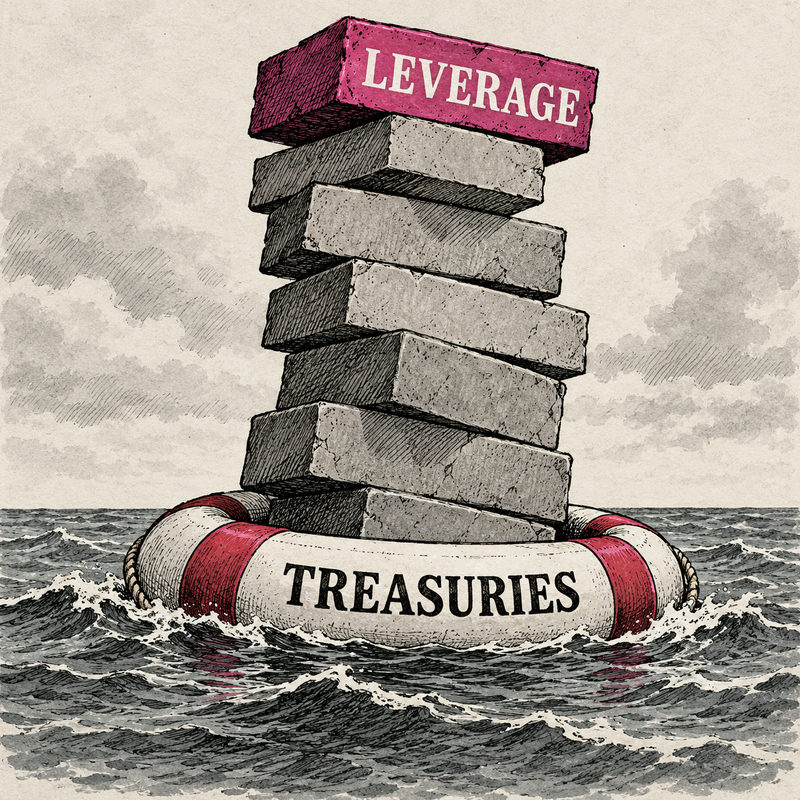
“Safe haven” is a reassuring description for a market until you discover how many people inside it are standing on borrowed ladders.
Axios reports that the Treasury market’s investor base is changing: foreign official institutions have become a smaller presence, while hedge funds and other price-sensitive private investors matter more. Some hedge funds use substantial borrowing to magnify their trades. This can magnify profits. The universe, annoyingly, has not agreed to magnify only that part.
Treasury yields swung sharply last week amid inflation concerns and anxiety about artificial intelligence. I am not assigning every movement to hedge funds. Financial markets have enough moving parts without hiring a columnist to pretend he has located the one guilty lever.
But I do object to treating the changing ownership of the government’s debt as a fascinating spectator sport. Mortgage borrowers do not receive a complimentary VIP ticket when market excitement reaches their monthly payment.
The share of Treasuries held by foreign official entities was 11.8% in August, according to the figures Axios cites, compared with roughly 40% around the financial crisis. The article also discusses a proxy for private financial activity in major trading centers. That is not a census of hedge funds; I will spare you the fake precision. There is already plenty of actual debt.
Central banks and hedge funds are not interchangeable simply because both can purchase a bond. One may be holding reserves. The other may be trying to profit from a tiny price difference with a position large enough to make that tiny difference pay for several extremely untiny things.
That trading can provide liquidity. It does not follow that more borrowing, more concentration and faster exits automatically make the system safer. A crowded room has excellent attendance right up until everybody needs the same door.
The public consequences are the part I care about. Greater volatility could mean higher long-term borrowing costs for households and the government. It is a risk, not a bill already issued to every family. Still, we should examine the wiring before congratulating the chandelier.
The federal government spent $1.052 trillion on interest in fiscal 2026, Axios reports. This is not a niche hobby with its own enthusiasts’ newsletter. It is infrastructure for how the country finances itself, increasingly populated by people whose job is to extract a return from it.
We already know financial complexity is a reason for oversight, not an exemption from it. Regulators should know where the leverage sits and whether positions can unwind without making everyone else discover what “liquidity” means during an unpleasant phone call.
I have no objection to a hedge fund taking a calculated risk with money it can lose. My objection begins when the calculation quietly relies on the rest of us needing the same market to keep functioning.
By all means, enjoy the ladder.
Stop resting it against everybody else’s house.
Comments
Have something to say? Give this story a heckle.
Comment Rules
Argue the point. Add a joke. No threats, harassment, hate speech, spam, private personal information or unsupported accusations. First-time comments and comments with links are moderated. Full Comment Rules
Loading comments…
Questions or deletion requests? Contact Us. We retain comments and moderation records until removed. Only hashed email identifiers are stored for comment accounts.