
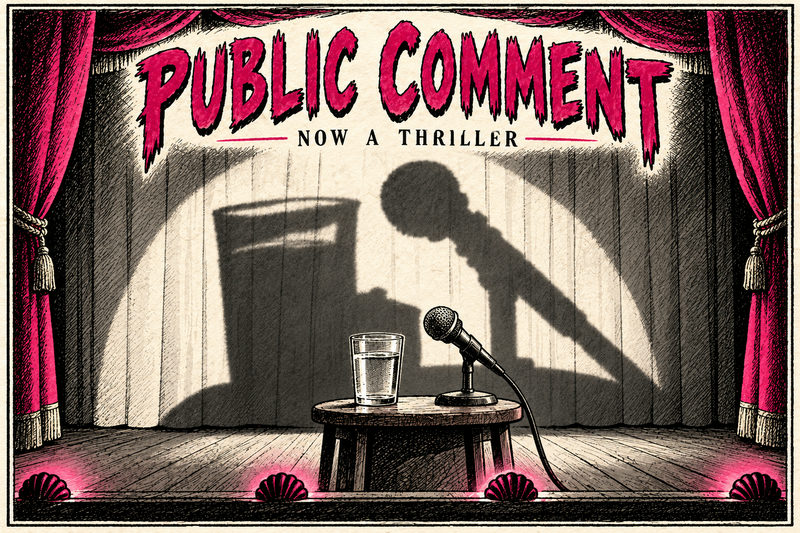
Congratulations to everyone who attended the local datacenter hearing. Your production has attracted an intelligence audience. The critics are not necessarily here to review your parking proposal.
The Guardian’s newly reported law-enforcement documents include an April Nevada Threat Analysis Center report that cited a Reno city council hearing on a datacenter moratorium as part of growing negative sentiment toward the facilities. The concerns it described included water consumption, utility costs, pollution and climate impacts. Public comment: now available in the threat-assessment genre.
The same investigation describes genuine violent threats against technology infrastructure. Those deserve investigation. A council hearing and a bomb plot are not the same kind of event, even if both contain someone dissatisfied with a building. Genre distinctions remain useful outside the streaming menu.
What follows is an imaginary theater review, not an actual intelligence document.
A Modest Local Production Finds A Wider Audience
The evening began with the traditional community-theater announcement: please state your name, keep your remarks brief and resist the temptation to explain the entire history of the intersection.
Then came the thrilling first act. A resident wanted to know where the water would come from. The question lacked a getaway car, a manifesto or even a particularly expensive jacket. Nevertheless, it had potential. Put it beside enough genuinely alarming material and it could develop atmosphere.
Our imaginary reviewer admired the production’s restraint. Nobody demanded a climactic explosion. Several speakers merely wanted the utility bill to remain within the recognizable range of a utility bill. This made for a challenging thriller, but the tension could be improved by moving the discussion into a more suggestive folder.
In ordinary civic life, asking a question is part of deciding what to build. In our fictional review, asking it twice establishes a recurring character. Asking it with neighbors supplies an ensemble cast. Bringing a chart demonstrates preparation, which is exactly what one expects from somebody who has been preparing.
The phrase negative sentiment is an extraordinarily accommodating stage. It can hold a threat. It can hold a person worried about water. Give it a large enough spotlight and the audience may forget these are different roles.
Please Remain For The Context
The real reporting does not establish that peaceful speakers were charged, designated terrorists or subjected to a particular investigation. Citing their hearing in this kind of report is the specific fact. There is no need to award the surveillance state extra achievements it has not documented.
But residents should not have to perform enthusiasm to keep ordinary objections legible as ordinary objections. Public participation is meant to help officials learn what people think. It is not a surprise audition for the category Things People Think Negatively About.
Back in our imaginary theater, the second act disappointed the reviewer. The residents kept returning to the water question instead of supplying a more dramatic motivation. Apparently they wanted the municipality to function. A difficult desire to frame as a sinister third-act revelation.
Our imaginary reviewer requested one rewrite: remove the water question. It was making the ominous ensemble sound like constituents.
The Comment Section Has Entered The Chat.
Argue the point. Add a joke. No threats, harassment, hate speech, spam, private personal information or unsupported accusations. First-time comments and comments with links are moderated. Comment Rules
Loading comments…
Questions or deletion requests? Contact Us. We retain comments and moderation records until removed. Only hashed email identifiers are stored for comment accounts.