
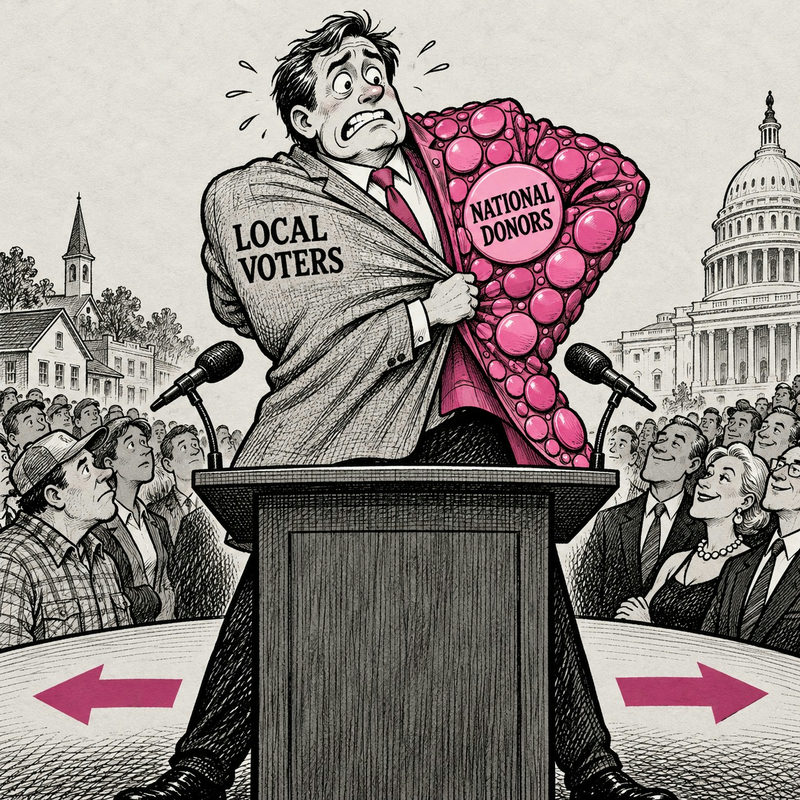
A Senate candidate has two immediate needs: votes from people in the state and money from people who may never set foot in it. NPR's new analysis shows how campaigns are building different appeals for those different audiences. Locally, candidates have to persuade an electorate. Nationally, they have to stand out in a crowded fundraising market.
That sounds manageable. Politicians have always addressed different audiences. You don't give the same speech at a farm as you do at a semiconductor plant, unless you've badly misunderstood what chips are.
But now we're approaching the campaign as a reversible jacket. Sensible neighbor on one side. National partisan emergency on the other. Turn inside out before clicking DONATE.
NPR examined Google advertising for four Senate races: Iowa, Georgia, Ohio and Texas. Democratic and Republican candidates spent more than $15 million on fundraising-related ads in the 2025–26 cycle, with about three-quarters of that spending going toward ads running nationally.
They're spending money to ask for money so they can spend money asking people for a job representing somewhere else.
Somewhere inside that sentence, a constituent tried to ask about a hospital and was transferred to marketing.
This isn't a claim that out-of-state giving is illegal. It isn't. People have legitimate reasons to care about Senate control beyond their own ZIP code. Federal decisions affect the whole country. A donor doesn't have to take a ceremonial bite of Iowa corn before supporting an Iowa candidate.
The problem is the incentive. The person who can elect you needs you to understand a place. The person you're trying to acquire as a donor may need you to become a nationally recognizable emotional event.
One wants a representative. The other fundraising pitch wants a season finale.
The Daily Heckler
The best of Democrawonk.
No algorithm required.
And yes, Democrats, this means you too. For Georgia's Jon Ossoff and Iowa's Josh Turek, more than 80 percent of itemized individual contributions came from outside their states. That's a specific category, not their entire funding, and Ossoff's campaign denies targeting audiences by location. It says small-dollar donors power the campaign and that he refuses corporate PAC and federal lobbyist donations.
Those distinctions matter. So does not pretending that a donation button becomes structurally adorable because ours is blue.
ActBlue and WinRed have made raising small contributions easier. Good. Political participation shouldn't require owning a golf course. But lowering the cost of soliciting money also makes it worthwhile to solicit everybody, everywhere, all the time, until representative government starts resembling an airport terminal where every announcement is your final boarding call for democracy.
WHO IS THE SENATOR REPRESENTING WHILE THE CAMPAIGN IS AUDITIONING FOR THE ENTIRE FUCKING INTERNET?
Not who owns the senator. Not a claim of bribery. Who gets the attention? Who gets the tailored message? Whose problems fit the advertisement well enough to survive the edit?
A local problem may be complicated, expensive and boring to explain. A national enemy comes preassembled. One takes a meeting. The other takes a thumbnail.
I need to close a tab. Maybe all the tabs. Somewhere a campaign consultant has probably discovered a way to fundraise from the sound of a tab closing.
And then, and THEN, comes the magnificent defect in this system: most of those donors cannot vote in that election. Cash can buy reach. It cannot convert a sympathetic Californian into a Georgia resident by refreshing the page.
THE CHECK CLEARS. THE DONOR STILL DOESN'T LIVE THERE.
As NPR notes, huge fundraising totals haven't prevented well-funded candidates from losing. Voters still decide. That's not an inconvenience to be optimized away. That's the actual arrangement.
By all means, raise the money. But spend enough time explaining what you'll do for the people whose ballots count, not just performing the version of yourself that converts best nationally.
Your state is not the shipping address for a national fundraising campaign.
Comments
Have something to say? Give this story a heckle.
Comment Rules
Argue the point. Add a joke. No threats, harassment, hate speech, spam, private personal information or unsupported accusations. First-time comments and comments with links are moderated. Full Comment Rules
Loading comments…
Questions or deletion requests? Contact Us. We retain comments and moderation records until removed. Only hashed email identifiers are stored for comment accounts.