
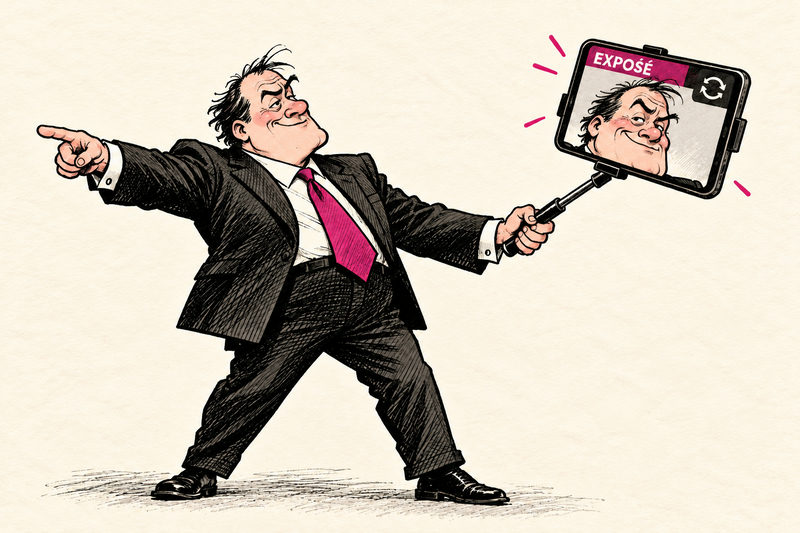
A smear campaign is a camera pointed firmly at somebody else. The first rule of our fictional production tutorial is never to touch the little button that turns it around. That button has ruined more flattering compositions than bad lighting ever could.
The Guardian documents racist and antisemitic posts by a promoter of false claims about James Talarico.
We will not reproduce the false claim or the slurs. Our parody tutorial concerns the person behind the lens, an imaginary producer who has prepared a devastating examination of everyone’s judgment except his own.
Please Keep The Operator Out Of Frame
In the fictional studio, the producer has selected a severe expression. This is investigative mode. The expression must communicate that an alarming conclusion has been reached, ideally before an exhausting amount of evidence has complicated the delivery.
An assistant asks whether they should check the source. The producer approves. Check that it is loud enough. Check that it will fit on a phone screen. Check whether the caption can be made larger without losing any of its certainty.
The assistant means credibility. An awkward word: long enough to spoil the caption, difficult to demonstrate with a ring light.
Our imaginary producer explains that the audience is interested in what the target has been hiding. The assistant points to the producer’s own public-facing output. This is an unauthorized camera movement. We are exposing other people. Please respect the format.
The front camera switches on.
Immediately, the production develops a fascinating new subject. Someone demanding trust is visible. His choices are in frame. His confident expression has survived, but its relationship with the material has become less flattering. The ring light can brighten a face. It cannot supply a principle.
The Credibility Filter Is Not Installed
Our fictional producer requests a tighter crop. Remove the context on the left. Remove the inconvenient example on the right. Ideally, leave only a pair of very authoritative eyebrows. Those have been independently verified as his own.
The assistant suggests that an accusation needs checking even when its target is politically convenient. The producer asks whether that can be expressed as a visual effect. Perhaps a tasteful blur over the uncertainty. Perhaps the uncertainty could appear only to subscribers.
No filter obliges. The camera has inexplicably remained interested in the person asking to be believed. He wanted a tool for examining an opponent. It has become a tool for examining the examination, a deeply hostile expansion of the product’s functionality.
At this point, our invented tutorial recommends blaming the angle. A poor angle can make anybody look bad, especially the angle from which their own choices are visible. Move the phone. Try the light again. Ask whether accountability would mind standing just outside the shot.
The assistant reviews the footage. It is sharp, intelligible and finally focused on something the producer is responsible for. The producer calls this a technical failure.
The camera did not malfunction. It finally found its subject.