
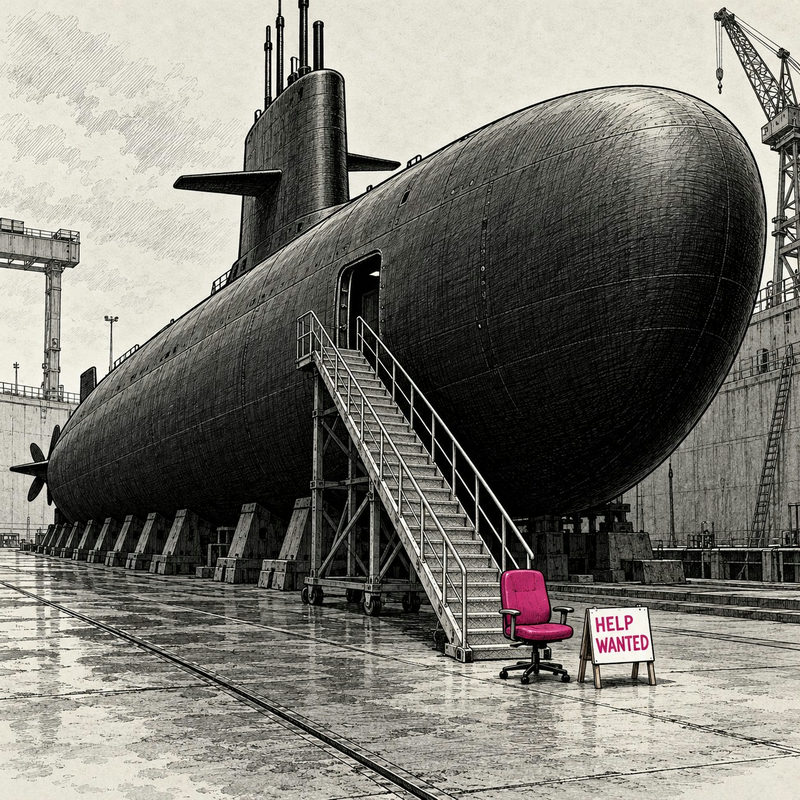
Australia’s future nuclear-powered submarines offer extraordinary range. The recruitment plan faces the more familiar problem of getting enough people to come to work.
As the USS Colorado visits Perth for maintenance and training, retired admiral Peter Briggs is warning about the workforce needed for the AUKUS fleet. The Guardian reports that Virginia-class submarines can require up to 134 crew, almost three times the number needed for Australia’s Collins-class boats. Buying a much larger submarine does not cause additional submariners to appear in the packaging.
The navy says 230 personnel are in various stages of the US nuclear-powered-submarine training pipeline. About 145 have completed US naval nuclear-power training and are building experience aboard American submarines. It expects 400 trained officers and sailors ready to serve by 2030.
Briggs argues that Australia is heading toward needing a submarine arm of around 3,000, compared with roughly 850 people currently qualified to operate Collins-class boats. Those figures describe different groups and stages of preparation. Subtracting the 400 trainees from the 3,000-person force estimate would not reveal a reliable vacancy count. It would reveal that someone had bought a calculator before reading the labels.
The point is large enough without that trick. This is not simply a matter of finding people willing to go underwater. The fleet needs nuclear training and more than a dozen trades, including sonar operators, radio specialists, electricians and cooks. You can give the programme a muscular geopolitical name, but eventually somebody has to prepare lunch and understand the reactor.
The Daily Heckler: five or six selected stories.
Political satire for your morning inbox.
There is also the complexity of running different types of submarine while Australia transitions to the future British-Australian design. Briggs points to training, spare parts, maintenance and logistics. The announcement acquires a fleet; the navy acquires several overlapping sets of instructions.
None of this means the work has not begun. The Colorado’s maintenance visit is part of building Australian skills, and allied submarine rotations through HMAS Stirling are planned from 2027. Officials say nuclear-related exercises during this visit are simulated and no radiological material will be transferred. The Australian government did not answer the Guardian’s questions about recruitment targets and whether workforce development was on track.
The sales pitch for the boats understandably emphasizes military capability. Recruitment must also deal with the living arrangements. The Guardian describes bunks stacked three high and, when required, sailors sharing beds on rotating schedules. That is a demanding workplace, not a reason to mock the people doing the job. It is a reason for the people commissioning the workplace to take staffing seriously before treating delivery dates as destiny.
The captain describes food and toilet paper as the practical limits on the vessel’s endurance. There is something wonderfully clarifying about an enormously sophisticated defence programme eventually arriving at the supply cupboard. Nuclear power can solve an extraordinary engineering problem. It cannot negotiate a career decision for the person expected to serve aboard.
The procurement announcement has plenty of room for national ambition. The recruitment plan needs room for actual people. They are not accessories to the submarine. They are the part that makes it a navy.
Comments
Have something to say? Give this story a heckle.
Comment Rules
Argue the point. Add a joke. No threats, harassment, hate speech, spam, private personal information or unsupported accusations. First-time comments and comments with links are moderated. Full Comment Rules
Loading comments…
Questions or deletion requests? Contact Us. We retain comments and moderation records until removed. Only hashed email identifiers are stored for comment accounts.