
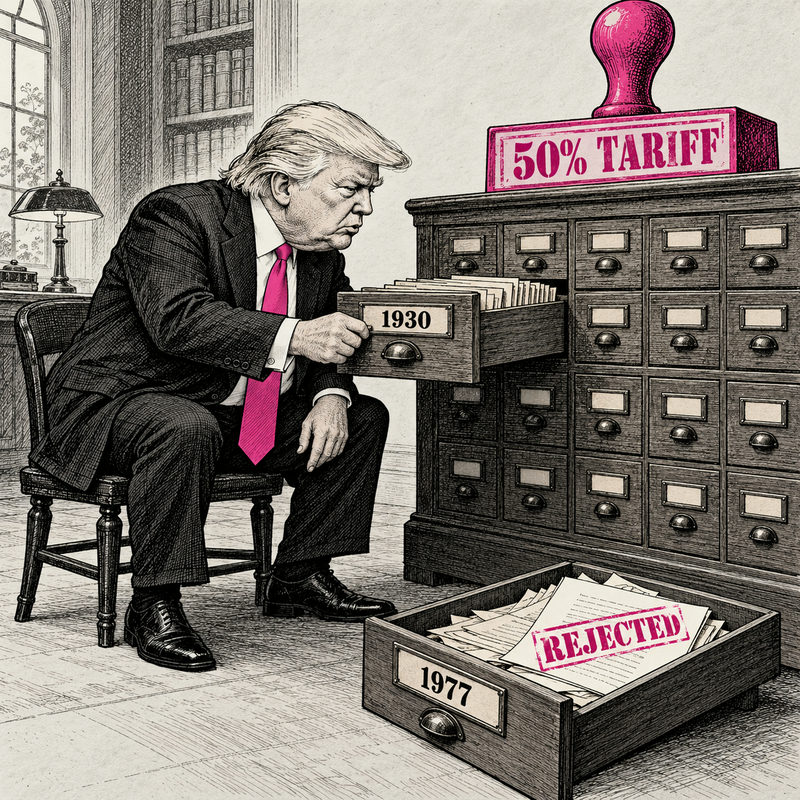
First the tariff needs legal authority. If the legal authority fails, the tariff needs different legal authority. At no stage in this process is the tariff expected to consider another line of work.
Donald Trump's trade policy has developed the persistence of a computer program whose only instruction is TRY AGAIN. The courts can reject a justification; the import tax stays employed while the administration interviews replacements.
The latest applicant is Section 338 of the Tariff Act of 1930. Trump used it in August to impose a 50 percent tariff on $20 billion in Canadian goods. On Tuesday, the Gellert Global Group, a New Jersey food importer that buys Canadian cheese, challenged that authority in the U.S. Court of International Trade, the Associated Press reports. American cheese importers have reached the stage of business planning that requires a working knowledge of the Hoover administration.
Here is the mechanism. Congress originally holds the constitutional tariff power. Over time, it passed laws delegating some of that power to presidents under specified conditions, with investigations and other procedural requirements. Those limits are the irritating part of delegation: someone gives you a power and then leaves instructions attached.
Make powerful people uncomfortable.
Subscribe to Democrawonk.
Gellert's lawyers at the Liberty Justice Center argue that the newer legislation superseded the dormant Section 338 authority. The administration's use of it has never been tested in a trade dispute in court. The case will therefore ask whether the old provision remains usable, not whether a sufficiently dusty statute automatically becomes a presidential permission slip. The White House and trade representative's office had not responded to AP's request for comment.
There is a practical reason to care about the dating system. Earlier this year, the Supreme Court struck down Trump's broad tariffs imposed under a 1977 emergency law, and the administration had to refund billions to importers. Having been told that one statute would not do the job, the president reached farther back. At this rate, the next trade agreement will require an archivist to witness the signature.
Canada retaliated dollar for dollar after the August tariffs. Trump then announced outright bans on nearly $1 billion in Canadian products. Thus a dispute about the power to tax imports has also produced fewer things to import. The process is becoming more efficient at eliminating the activity it claims to improve.
The lawsuit may succeed or fail. But watch what remains fixed while the legal theory changes: the president's desired tax. Congress can add conditions, courts can enforce limits, importers can sue, and everyone else must keep following along. The law is being treated as a search bar. Keep typing older dates until the screen returns YES.
Comments
Have something to say? Give this story a heckle.
Comment Rules
Argue the point. Add a joke. No threats, harassment, hate speech, spam, private personal information or unsupported accusations. First-time comments and comments with links are moderated. Full Comment Rules
Loading comments…
Questions or deletion requests? Contact Us. We retain comments and moderation records until removed. Only hashed email identifiers are stored for comment accounts.