
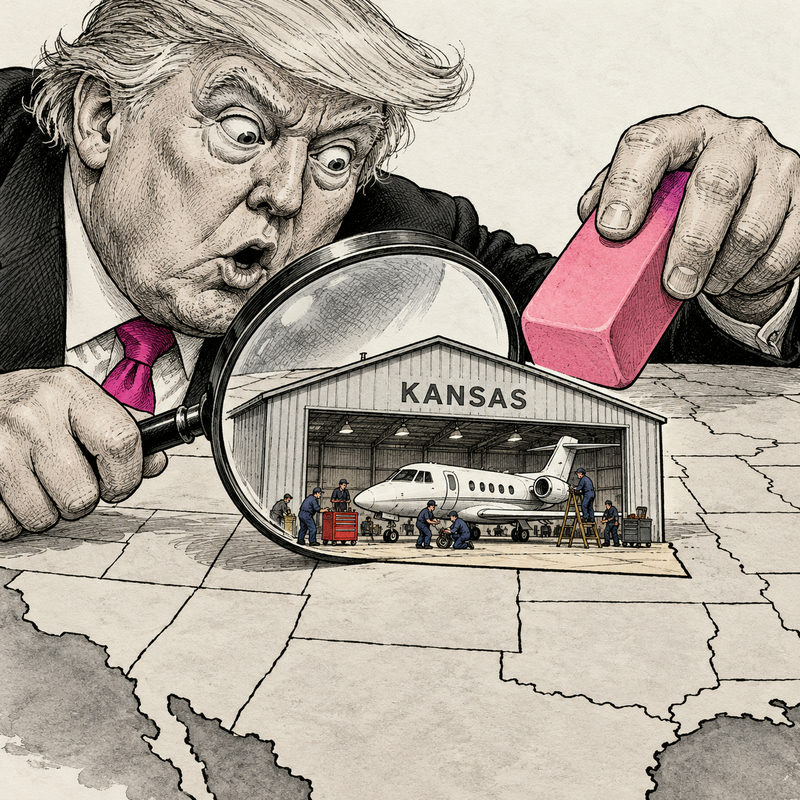
America First has made an important geographical discovery: some Americans work for Canadian companies. The administration may wish to commission a commemorative atlas before the information escapes again.
Reuters reports that Donald Trump, having threatened to bar Bombardier from the US market, said in Kansas on Monday that he did not plan to hurt the aircraft maker. He had learned it had a presence there. Bombardier employs 1,500 people in Wichita and 3,500 across the United States.
“But now I find out,” the president explained.
That is an unusually revealing sequence for an economic strategy. First identify the foreign company. Then announce the possible punishment. Then discover the American workforce. Due diligence has been promoted from a preparation to a plot twist.
The workers had not materialized in the interval to spoil the policy. The president's understanding had simply caught up with part of the country he was already protecting. One imagines the relief of learning that the place beneath one's protective umbrella exists.
No Bombardier ban actually took effect in the September measures, Reuters reports. That matters. This is not a story about workers losing jobs under a restriction that never happened. It is a story about presidential threats arriving ahead of presidential knowledge, then the retreat being presented as assistance. The company is to receive the benefit of not being harmed by the man explaining how he will help it.
Make powerful people uncomfortable.
Subscribe to Democrawonk.
The elevation of this into benevolence is the magnificent part. An administration that discovered the workforce before threatening the employer would have had no rescue to announce. Preparation would have deprived the president of a gratifying reversal in which his new knowledge becomes everybody else's good fortune.
Our earlier account of the Japan investment arrangement examined presidential discretion over which projects benefit. Here the preliminary question is more modest: has anyone established who already works at the company in question? It is difficult to direct an industrial renaissance while receiving American industry as breaking news.
This does not mean a multinational employer should be immune from regulation or trade policy. It means understanding its domestic operations belongs near the beginning of the decision, not inside the explanation for why the threat can now be softened.
Kansas, inconveniently, had been there throughout. So had the workers. Neither required a grand unveiling. Yet they have now enjoyed the peculiar honor of being discovered by their own president, just in time for him to announce his intention to look after them.
Comments
Have something to say? Give this story a heckle.
Comment Rules
Argue the point. Add a joke. No threats, harassment, hate speech, spam, private personal information or unsupported accusations. First-time comments and comments with links are moderated. Full Comment Rules
Loading comments…
Questions or deletion requests? Contact Us. We retain comments and moderation records until removed. Only hashed email identifiers are stored for comment accounts.