
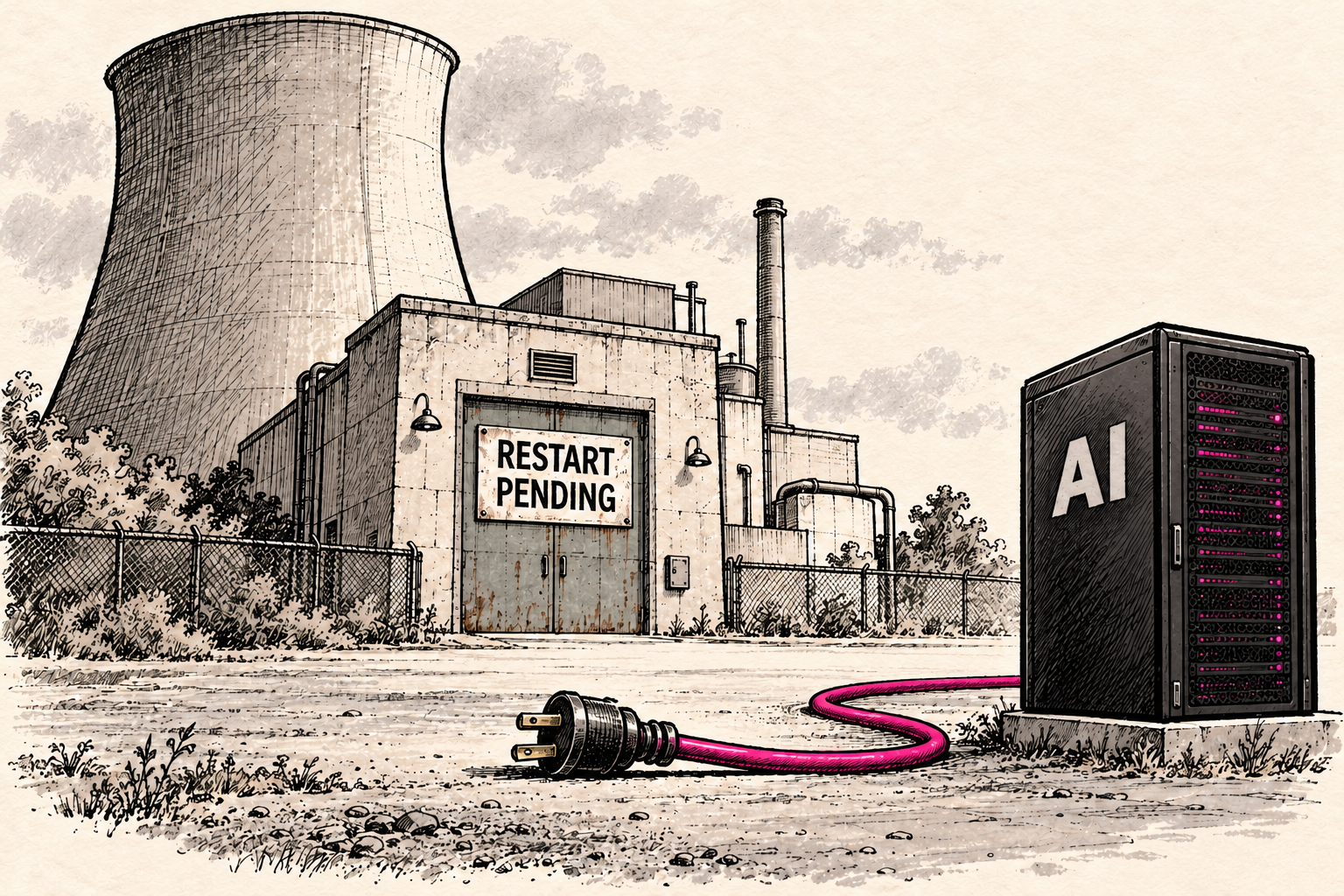
Artificial intelligence has reached the point in its development where the installation instructions include: locate a nuclear power plant that somebody stopped using. Apparently the future is not compatible with the power adapter in the box.
AP’s reporting examines efforts to restart Palisades in Michigan, Crane in Pennsylvania and Duane Arnold in Iowa, backed by as much as $4.4 billion in federal loans. Microsoft and Google have power agreements tied to two of the projects. These are restart efforts, not three reactors that switched on today.
The technological revolution has arrived at the refurbished section. Excellent condition, previous owner, some assembly and regulatory approval required. Please retain the turbine.
Your Future Requires A Legacy Component
For context, the Guardian reported Microsoft’s 20-year power agreement in 2024; the reactor had shut in 2019. That is the origin of the arrangement, not a deal announced today. An industry that sells exponential acceleration has been working on a rather more analog command: bring the old machine back.
The future has acquired a legacy dependency with a last-seen timestamp from the previous decade. In software, this is the point where someone suggests replacing the old component. In electricity, someone must explain that the component is the part making the electricity. You cannot migrate the turbine into a motivational slide.
There is nothing inherently ridiculous about restoring useful equipment. The ridiculous part is the sales presentation in which software seems to have transcended the physical world, followed by the engineering presentation in which the physical world is urgently asked whether it kept the spare parts.
A chatbot can produce a confident paragraph about abundant electricity. The paragraph does not produce electricity. You cannot connect a server rack to the confidence. Somewhere downstream of the demo, somebody still has to make a generator turn.
AP reports that the plants had closed largely because their electricity was considered too expensive. Big Tech’s appetite has helped change the economics. An old asset can look remarkably innovative once somebody large enough wants what comes out of it. The electrons have not upgraded their qualifications; the prospective customer has upgraded the price it is willing to discuss.
These are loans, not gifts; the announced ceilings are not measured taxpayer losses. Public financing can support useful infrastructure. It can also complicate the keynote’s impression that the future simply appeared because someone in a black T-shirt thought exceptionally hard. The taxpayer is not necessarily losing money. The taxpayer is, however, in the architecture diagram.
The stack now includes software, chips, power, financing and regulators. Curiously, only one layer gets to call everything beneath it legacy technology. The turbine is not obsolete when the server needs it. The regulator is not an annoying pop-up when an actual reactor is being restored. And the public balance sheet is not a cloud service you can leave out of the product description.
This is not an argument for keeping a workable plant closed, or a claim that restarting one guarantees cheap or safe operation. It is a small correction to the product description: artificial intelligence does not make its infrastructure artificial. The hardware remains impressively literal.
Please do not unplug the twentieth century while the future is installing.