
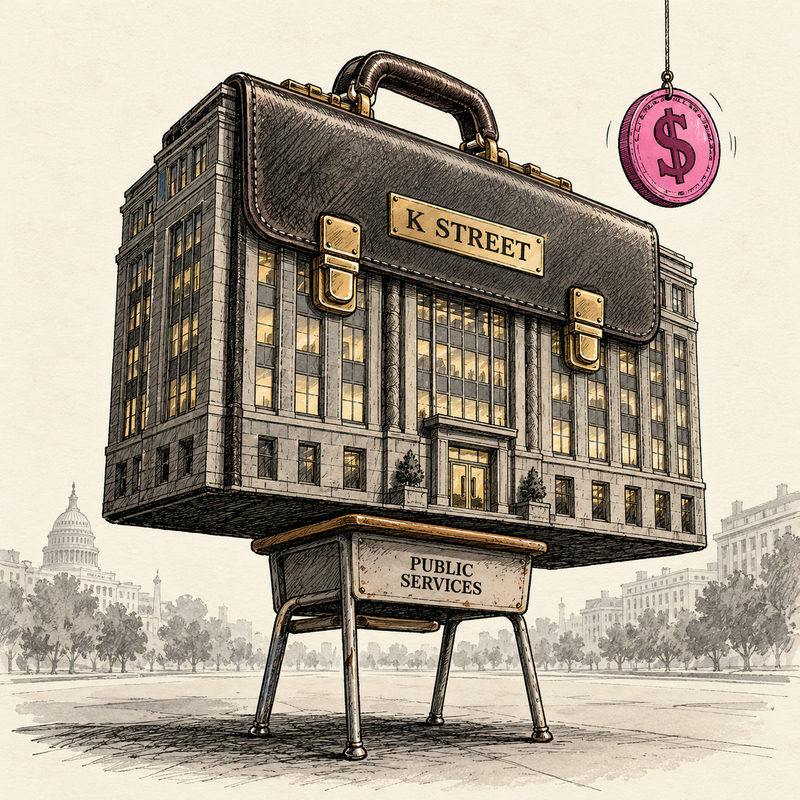
Washington has found a promising place to look for money: people who make money explaining Washington to other people with money. I realize this sounds dangerously close to interrupting the city's natural habitat. The lobbyists will recover. They know whom to call.
Axios reports that D.C. is considering new taxes as its economy weakens and federal employment shrinks. One proposal would broaden taxation of business activity, reaching law firms, lobbyists and consultants that critics say benefit from a loophole. Other ideas involve capital gains and expensive second homes. None is an enacted rescue package.
I favor asking the people prospering from proximity to government to help sustain the city in which they enjoy that proximity. A prestigious address is more than the letters on the door. There is an actual place outside it, inconveniently populated by people who require schools.
The alternative could include cuts to education, childcare and affordable housing. Apparently the city has two kinds of expenses: the ones that help a business operate, and the ones businesses would prefer the city to stop mentioning.
Business leaders warn that new taxes could send companies to Virginia and discourage investment. That risk deserves examination. But it is curious how readily the city's future becomes an emergency when affluent people might pay more, while reducing services for everyone else enters the discussion as prudent housekeeping. Children are apparently expected to absorb fiscal shocks with superior emotional maturity.
We have already seen a narrowly targeted tax marketed as everybody's problem. The useful question is who actually pays, including when the chosen policy is a cut. A cancelled benefit is a bill with the government's name removed from the envelope.
D.C.'s chief financial officer says the business-tax idea needs study, could take time to raise revenue and may face legal challenges. A second-home tax is unlikely before 2028. The tax office also has limits on how many changes it can implement at once. Those are real constraints. You cannot finance next month's classroom with a particularly inspiring discussion of next year's revenue.
Which is why the debate should begin with workable numbers, rather than the theatrical assumption that every existing exemption was handed down with the laws of gravity. A loophole is a policy choice that has grown comfortable.
Protect basic services while designing taxes the city can actually collect. Test the business warnings; test the revenue promises. The people who forecast the price of regulation should be equally interested in explaining the price of leaving their preferred arrangement alone.
And if K Street finds the process bewildering, there is excellent news. The neighborhood is absolutely crawling with highly paid experts in influencing tax policy. This time they might learn it from the taxpayer's side.
Comments
Have something to say? Give this story a heckle.
Comment Rules
Argue the point. Add a joke. No threats, harassment, hate speech, spam, private personal information or unsupported accusations. First-time comments and comments with links are moderated. Full Comment Rules
Loading comments…
Questions or deletion requests? Contact Us. We retain comments and moderation records until removed. Only hashed email identifiers are stored for comment accounts.